
Livraison le jour même ou le lendemain

Qualité garantie

Débloquez vos offres de bienvenue: Livraison GRATUITE | Jusqu'à -80 % | 30 jours d'essai gratuits à JoyPlus
Téléchargez l'application
Driving on an underinflated tyre isn't just an inconvenience: it's a genuine safety risk, not to mention the increased fuel consumption. The portable air compressor has thus become an essential accessory for many drivers, motorcyclists, and cyclists in the UK. The problem? The market is flooded with confusing marketing promises. Before you make a decision, it's crucial to know how to avoid the most common pitfalls to invest in a device that will actually deliver on its promises.
As the Head of Product Selections at Joybuy, my mission is to help you see clearly through this jungle of options. Let's break down the key points to watch out for and the objective criteria for choosing a reliable compressor that's truly suited to your needs.
Certain features, though proudly highlighted by manufacturers, are often misleading. Here are the three most common mistakes that lead to a purchase you'll bitterly regret.
To make an informed choice, forget the marketing slogans and focus on objective technical data. Here are the three fundamental parameters to scrutinise.
The maximum pressure, expressed in bars or PSI (Pound per Square Inch), is the ceiling the compressor can reach. Most models go up to 10.3 bar (150 PSI), which is more than enough for car, motorcycle, or bicycle tyres.
But be warned, pressure alone isn't everything. It's the air flow rate, measured in litres per minute (L/min), that determines the actual inflation speed. A compressor with a high air flow rate (e.g., 25-35 L/min) will fill your tyre much faster than a model with a low flow rate (15-20 L/min), even if their maximum pressure is identical. For a car tyre inflator, finding the right balance between these two values is therefore essential.
The choice of power source will depend directly on your use case.
Smart features make operation significantly easier. The auto-shutoff function is particularly handy: you preset the desired pressure, and the compressor stops by itself once the target is reached. No more risk of over-inflation; you can get on with other things in the meantime.
Many models also offer preset modes (car, motorcycle, bicycle, ball) that automatically set the target pressure. A real bonus for convenience, making the electric air pump accessible even to complete beginners.
Rather than an exhaustive list, we have selected models that stand out for specific user profiles, applying the criteria we've just discussed.

User Profile: The driver who wants a powerful and reliable device to keep in their boot for regular top-ups and emergencies alike. Speed and battery life are their priorities to ensure they're never caught off guard.
With a robust air flow rate of 35 L/min and a generous 7500 mAh battery, it tackles the problems of slowness and poor battery life head-on. It's built to handle inflating multiple car tyres on a single charge.
Its high inflation speed, large battery, and its function as a power bank to recharge a smartphone in a pinch.

User Profile: The family for whom the compressor needs to do it all: inflate the car tyres before a holiday trip, the kids' bikes, the football, and even the small air mattress. Simplicity and versatility are key.
Its 5 smart modes (car, motorcycle, bicycle, ball, custom) make it incredibly easy to use and prevent pressure errors. Its dual-display screen, which shows the current and target pressure simultaneously, is a model of clarity.
Ultra-light (460 g) and compact, it's effortlessly portable. Its preset modes and auto-shutoff make it so simple the whole family can use it.
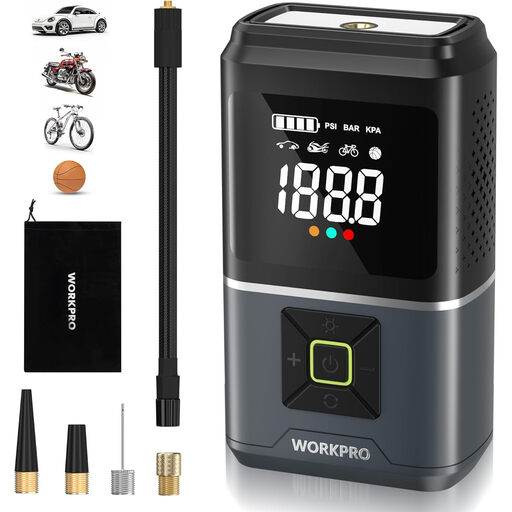
User Profile: The motorcyclist or cyclist for whom every gram and centimetre counts. They need an ultra-compact and lightweight bike pump or motorcycle tyre inflator that can slip into a backpack or saddlebag to adjust pressure mid-ride.
It doesn't promise the moon, like inflating 4x4 tyres. Its size (14 cm tall) and weight (530 g) are perfectly suited to its intended use. The 2500 mAh battery is calibrated for several two-wheeler tyre inflations, not for a family saloon.
Its extreme compactness and light weight. The integrated LED light with SOS mode is a real safety bonus in case of a forced stop on the side of the road.
Discover our complete, up-to-date selection of compressors that meet our selection criteria and current safety standards.
1. What is the lifespan of a battery-powered portable compressor? Its longevity depends on the quality of its battery and its maintenance. To preserve it, it's advisable to recharge it at least once every three months, even when not in use. Also, avoid storing it in extreme heat or cold (for example, in direct sunlight in a car during summer). A well-maintained device can serve you reliably for several years.
2. Can a 12V mini compressor drain my car battery? The risk is real if you use it for a long time with the engine off. That's why it is imperative to always start your vehicle before plugging in and using a 12V mini compressor. The current will then be supplied by the alternator, which protects your battery from a deep discharge.
3. Can I use a car compressor to inflate a bicycle tyre? Yes, absolutely. Most portable compressors come with a set of nozzles, including an adapter for Presta valves (the most common on road and mountain bikes). Furthermore, models with preset modes or manual adjustment allow you to set the pressure with the precision required for a bicycle tyre, which is often much higher than that of a car tyre.