
Livraison le jour même ou le lendemain

Qualité garantie

Débloquez vos offres de bienvenue: Livraison GRATUITE | Jusqu'à -80 % | 30 jours d'essai gratuits à JoyPlus
Téléchargez l'application
An underinflated tire isn't just a minor inconvenience?— it's a genuine safety risk, not to mention a drain on your fuel economy. The portable air compressor has established itself as the ideal solution for this problem, whether for a routine pressure check or a roadside emergency. The catch?is that the market is flooded with models that make enticing promises but often fail to deliver.
As our in-house product expert, my mission is to guide you through this jungle. Together, we'll dissect the most common pitfalls to help you make an informed decision, steering clear of deceptive marketing claims.
Buying a car tire inflator can quickly turn into a headache (and a disappointment) if you're not careful. Here are the three most frequent traps?:
To avoid these traps, let's focus on the technical specifications that really matter. Here are the three essential points to verify.
Your choice of power source will directly impact how and where you can use your compressor.
These two metrics are inseparable when it comes to judging a compressor's real-world performance.
An inflator with a digital pressure gauge has become standard. It allows you to preset the desired pressure and automatically shuts off when the target is reached—a practical feature that eliminates the risk of overinflation.
Certain options can transform a simple inflator into a motorist's Swiss Army knife?:
Instead of an exhaustive list, we've selected products tailored to three distinct user profiles. Find the one that's right for you.
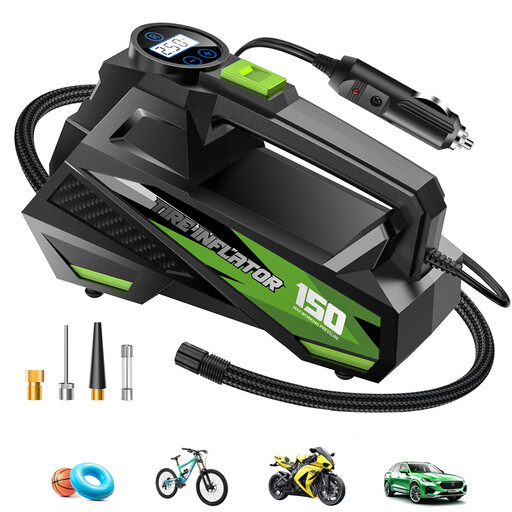
Why we recommend it : For the driver seeking a simple and reliable emergency solution, this corded model gets straight to the point. Leave it in your trunk, and it's always ready for action, with no need to worry about recharging a battery.
It bypasses the dead-battery pitfall by relying solely on the vehicle's 12V power supply. Its purpose is clear : to be an effective emergency tool, not a daily-use gadget.
Its 12V power source is foolproof — no unpleasant surprises from a dead battery. Its long cord is designed to reach all four tires effortlessly.
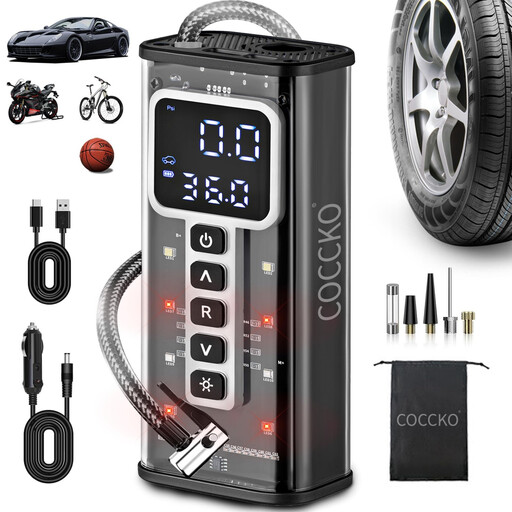
Why we recommend it : This cordless model is aimed at users who demand both performance and versatility. It's perfect for regular maintenance on car and motorcycle tires, as well as for recreational uses, thanks to its power and multiple features.
It tackles the speed and battery life pitfalls head-on with a respectable 35 L/min airflow and a solid 6000 mAh battery. Its digital screen and automatic shutoff make operation safe and secure.
Its 6000 mAh battery provides excellent runtime. The high airflow ensures quick inflation, while the built-in power bank and LED light features make it extremely practical.
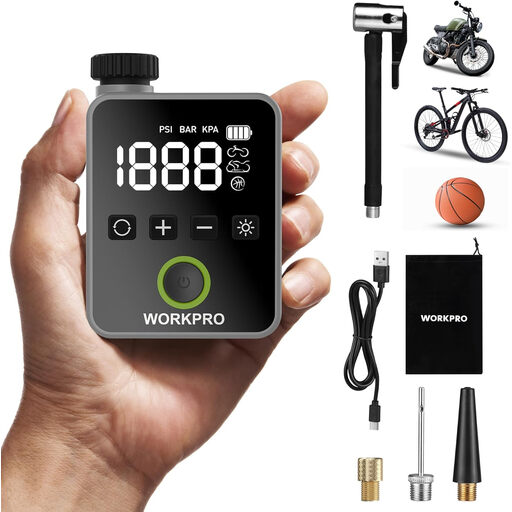
Why we recommend it : Portability is the name of the game here. Weighing only 270g, it's designed to slip into any backpack or saddlebag. It's the perfect tool for cyclists and motorcyclists seeking a featherlight solution.
It avoids the "false versatility" trap by focusing on its core purpose. It makes no claim to inflate a large SUV tire, but it excels where it's expected to : on bicycle and motorcycle tires, and sports balls.
Ultra-lightweight (270g) and compact, it's easy to forget you're carrying it. Its preset modes for bicycles and motorcycles make life easier for nomads.
We've curated a complete selection of portable compressors that meet our strict criteria for performance and safety.
A battery's lifespan depends on its capacity (in mAh), how often it's used, and its storage conditions. On average, a good quality battery can hold a useful charge for several months if left unused. To preserve its performance, it is advisable to fully charge it every 2-3 months, even if you aren't using it. Always follow the manufacturer's recommendations.
This is strongly advised against. Even when turned off, it can create a small power draw (a "parasitic drain") that could, over time, deplete your vehicle's battery. The best practice?is to store it in its case in your trunk and only plug it in when needed.
It entirely depends on the model. While most portable compressors can handle the tires of compact cars and sedans, those on SUVs and light trucks require a significantly higher volume of air. For these vehicles, it's crucial to select a model with a high airflow rate (over 30 L/min) and to confirm its compatibility with large-volume tires in the product specifications. Entry-level models risk overheating or taking an extremely long time to complete the task.