
Livraison le jour même ou le lendemain

Qualité garantie

Débloquez vos offres de bienvenue: Livraison GRATUITE | Jusqu'à -80 % | 30 jours d'essai gratuits à JoyPlus
Téléchargez l'application
Driving on an underinflated tyre isn't just an inconvenience: it's a genuine safety risk and a surefire way to see your fuel consumption skyrocket. The portable air compressor has become an essential accessory to keep in your boot. The problem? The market is flooded with models making often over-the-top marketing claims. To help you cut through the noise, we've decoded the pitfalls to avoid and the criteria that truly matter before you make a purchase.
With an overwhelming number of options, it's easy to be fooled. Many products make bold claims that prove disappointing in practice. Here are the red flags you should never ignore.
To ensure you choose a reliable device that's right for your needs, don't just trust the marketing. Focus on these objective technical specifications.
The maximum pressure, often advertised around 150 PSI (about 10.3 bar), indicates the compressor's peak power. This is more than enough for any passenger vehicle. But the real game-changer, the spec that determines inflation speed, is the air flow rate, measured in litres per minute (L/min).
The choice between a 12V mini compressor and a battery-powered model depends entirely on your priorities.
Some well-designed options turn a chore into a simple formality. An inflator with a digital pressure gauge ensures an accurate reading, while the auto-shutoff function stops inflation once the desired pressure is reached. No more risk of over-inflation! Preset modes (car, motorbike, bicycle, ball) and the inclusion of an LED light are also highly appreciated extras, especially during a night-time mishap.
Rather than an endless catalogue, we've selected products that match clear user profiles, all while avoiding the pitfalls we've just discussed.
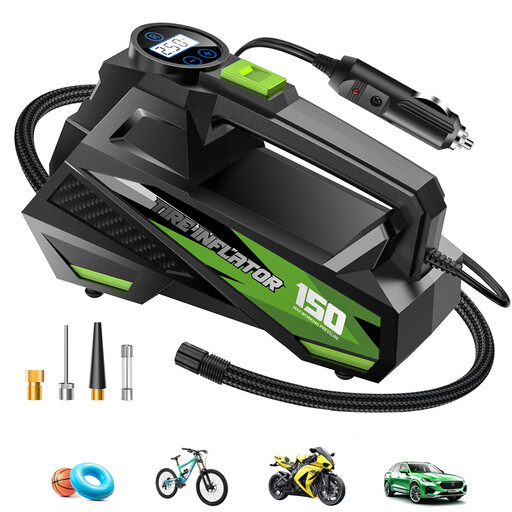
The user: For the driver who wants a "plug-and-play" solution to leave in the boot for emergencies or monthly top-ups. No battery to charge, no fuss.
By its very nature as a corded 12V model, it bypasses the battery life pitfall. As long as the car's engine is running, it works.
Its impressive simplicity. You plug it in, set the pressure, and that's it. Its long power cable makes it easy to reach all four of the vehicle's tyres.
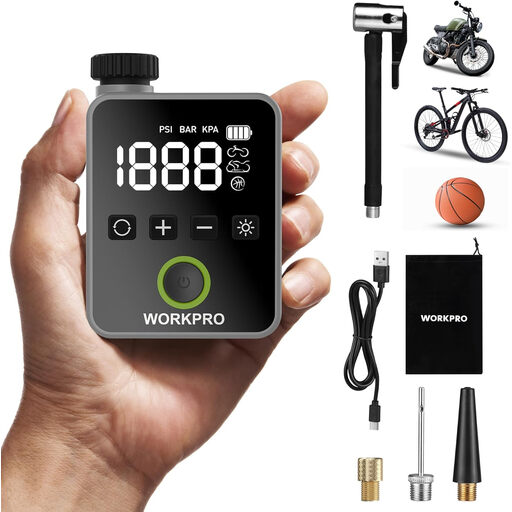
The user: Perfect for cyclists and motorcyclists looking for a featherlight (270g) and compact solution to slip into a bag. Its cordless design is a guarantee of freedom.
This model doesn't pretend to be something it's not. It's excellent for bikes and motorbikes, and can help with a car top-up in a pinch, but it doesn't claim to compete with more robust models.
Its versatility. It acts as a pump, a torch (with SOS mode), and even a power bank to charge a smartphone. A true Swiss Army knife for adventurers.

The user: For those who juggle multiple vehicles (car, motorbike, bicycle) and want a cordless solution that combines speed and endurance. It checks all the boxes with its high air flow rate and generous battery.
It answers the questions of speed and battery life with solid specs: an air flow rate of 35L/Min and a 7500 mAh battery. Enough to inflate several car tyres without skipping a beat.
Its ease of use. The large LED screen, smart modes, and auto-shutoff make it accessible to everyone. Its excellent battery life makes a real difference in day-to-day use.
Discover our full selection of products that meet our quality criteria and safety standards.
The risk is virtually zero if you follow one simple rule: always start your car's engine before plugging in and using the compressor. When the engine is running, the alternator takes over and powers the electrical system, preventing the battery from draining. A top-up of a few minutes won't do it any harm.
It depends on the quality of its battery and how you use it. Generally, a good lithium-ion battery will handle several hundred charge cycles before showing signs of degradation. To maximise its lifespan, avoid storing it completely empty and remember to recharge it every 2-3 months even if you don't use it. Keep it in a cool, dry place.
There's no one-size-fits-all answer; it all depends on what you're looking for: