
Livraison le jour même ou le lendemain

Qualité garantie

Débloquez vos offres de bienvenue: Livraison GRATUITE | Jusqu'à -80 % | 30 jours d'essai gratuits à JoyPlus
Téléchargez l'application
A flat tire, far from the nearest service station?? It's every driver's nightmare. The portable air compressor has become an essential accessory for regaining your autonomy and peace of mind. However, the market is flooded with models making tempting promises that, all too often, fall short.
As the editorial team's product expert, my mission is to guide you through the jungle of technical specs to help you sidestep the pitfalls and make the right choice. Despite sometimes aggressive marketing, some devices disappoint from the very first use. Here are the two most common traps to avoid.
Pitfall #1?: Overstated Battery Life, a Classic Trap. Many manufacturers advertise impressive runtimes. The problem?? These figures are almost always obtained under laboratory conditions, such as for a simple top-up on a bicycle tire. When faced with a completely flat car tire, the compressor often dies long before finishing the job, leaving you stranded on the roadside in an even more precarious situation.
Pitfall #2?: Misleading Inflation Speeds. A claim like "?inflates a tire in 2 minutes?" is meaningless without context. Does that mean a simple 0.2 bar top-up or inflating from completely flat?? And for what type of tire (car, motorcycle, bike)?? This vagueness often conceals an anemic airflow rate that will turn inflating an SUV tire into an exercise in patience.
To make the right choice, simply focus on a few key technical data points. These are what define the true performance of a cordless compressor.
The maximum pressure, often advertised around 150 PSI (approx. 10.3 bar), indicates the device's ability to reach high pressures, which are necessary for certain road bike tires. However, for a car tire inflator or a motorcycle tire inflator, the airflow (expressed in liters per minute, L/min) is just as, if not more, crucial.
The main advantage of a portable battery-powered compressor is, of course, its mobility. Its capacity, expressed in milliampere-hours (mAh), provides a good indication of its real-world endurance.
Extra features can transform a simple inflator into a true Swiss Army knife for roadside safety.
To put these criteria into practice, here is our selection of models tailored to different needs.
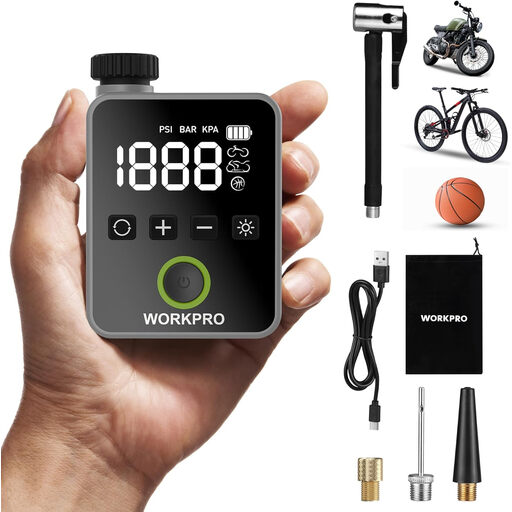
Why we recommend it : Perfect for those who want an ultra-compact emergency inflator to keep on hand at all times. At just 270 g, it slips into the glove box, a backpack, or even a large pocket. It's the ideal tool for regular top-ups and minor emergencies, whether for a car, scooter, or e-bike.
Its promise is honest : portability comes before raw power. It doesn't claim to reinflate four 4x4 tires in a row, but it reliably handles the essentials (top-ups, minor punctures). This avoids the disappointment of an overstated battery life for its compact size.
Its pocket-sized form factor makes it a discreet yet impressively effective companion for its size. The power bank function is a huge plus on such a compact device.
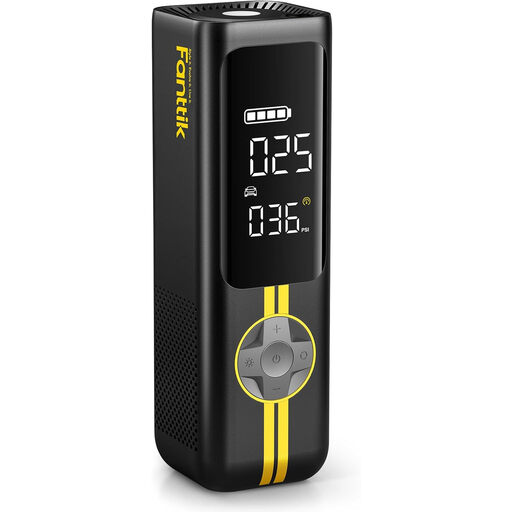
Why we recommend it : Designed for those who demand performance without compromise. It represents the perfect balance of speed, battery life, and features. It's the go-to tool for regular tire maintenance (car, motorcycle) and recreational activities (inflating balls, air mattresses, etc.).
It avoids the speed trap by providing transparent, quantified performance metrics (e.g., 56 seconds to inflate a standard tire from 28 to 33 PSI). Its active cooling system allows it to handle back-to-back inflations without overheating—the Achilles' heel of many entry-level models.
Its speed and endurance make it a top ally for regular use. The preset modes and auto shut-off function make operation incredibly simple.
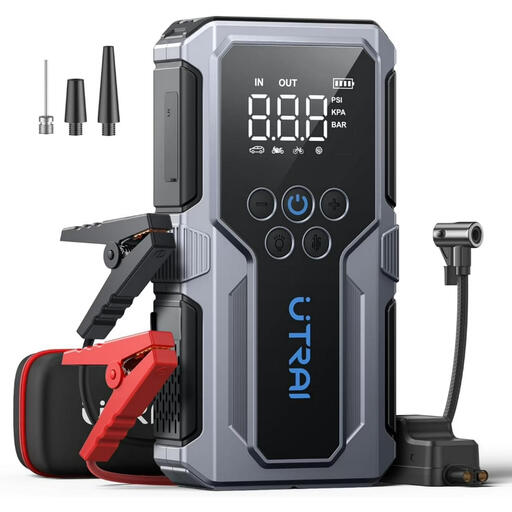
Why we recommend it : This is the ultimate roadside survival kit. It combines a heavy-duty jump starter with an air compressor, capable of starting gas engines up to 8.5 L and diesel engines up to 6.5 L. For high-mileage drivers or owners of older vehicles, it's the ultimate all-in-one solution for the two most common breakdowns : a dead battery and a flat tire.
Far from being a mere multi-function gadget, each feature is engineered for performance. The jump starter delivers a peak current of 3000 A, and the compressor is highly effective. It covers two critical needs with one device, making it a genuine piece of safety equipment, not just an accessory.
Its dual functionality (jump starter + compressor) and high-capacity 15,000 mAh battery make it a smart investment for complete peace of mind on the road.
We have selected a full range of products that meet our criteria for performance and reliability.
It all depends on the build quality and, crucially, battery care. To preserve a lithium battery, it's recommended to recharge it every 3 to 6 months, even if it's not being used, and to store it in a cool, dry place away from extreme temperatures (i.e., not in a car baking in the sun or in a freezing garage during winter).
Yes, a good model is capable of it, but be prepared to be patient. It's important to distinguish between a top-up (adding 0.2 to 0.5 bar), which takes only a minute or two, and inflating a completely flat tire, which can take 5 to 15 minutes depending on the compressor's airflow and the tire's size. Also, remember to let the device take breaks during a long inflation session to avoid overheating.
For a 12V mini compressor plugged into the cigarette lighter socket, it is strongly recommended that you leave the engine running. This prevents draining your car's battery, which is a very real risk if your battery is older or if the inflation process is lengthy. For a battery-powered cordless compressor, this precaution is, of course, unnecessary.