
Livraison le jour même ou le lendemain

Qualité garantie

Débloquez vos offres de bienvenue: Livraison GRATUITE | Jusqu'à -80 % | 30 jours d'essai gratuits à JoyPlus
Téléchargez l'application
An underinflated tyre can turn your daily commute into a hassle, or even a hazard. The portable air compressor has become the essential accessory to always keep in your boot. The problem: the market is flooded with models making tempting promises that often don't hold up. As a product expert at Joybuy, my mission is to help you see clearly and make the right choice.
But before you buy, watch out for these 3 common pitfalls that could turn your purchase into a useless gadget:
To avoid these pitfalls, here are the key technical points to scrutinise. These are what determine the performance and reliability of a car tyre inflator.
Most models advertise a maximum pressure of 150 PSI (about 10.3 bar), which is far more than you need for car, motorbike, or bicycle tyres. But be careful, this figure says nothing about the inflation speed. The real performance metric is the airflow rate, measured in litres per minute (L/min).
The choice between a corded model and a cordless tyre inflator depends on how you plan to use it.
A good modern mini-compressor should make your life easier. The auto-shutoff feature is essential here: you set the desired pressure on the screen, and the inflator stops automatically once the target is reached. This guarantees perfect pressure without the risk of overinflation. A built-in LED light can also be a real lifesaver for a nighttime emergency.
Rather than an endless catalogue, we've selected three models that meet specific needs, all validated against our performance and reliability criteria.
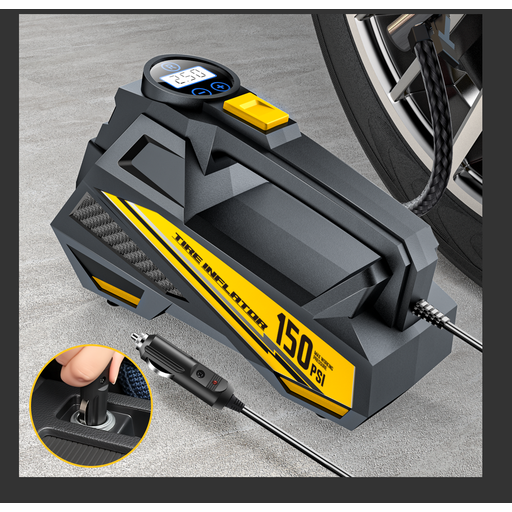
Our take: The perfect solution for those who want a simple, reliable device to leave in the boot for emergencies. No battery to charge—just plug it into the 12V socket and you're good to go.
Being corded, it completely eliminates the risk of a dead battery. It delivers consistent power as long as it's connected to the car.
Reliability: no chance of battery failure. Simplicity: ultra-intuitive, it gets straight to the point in an emergency.
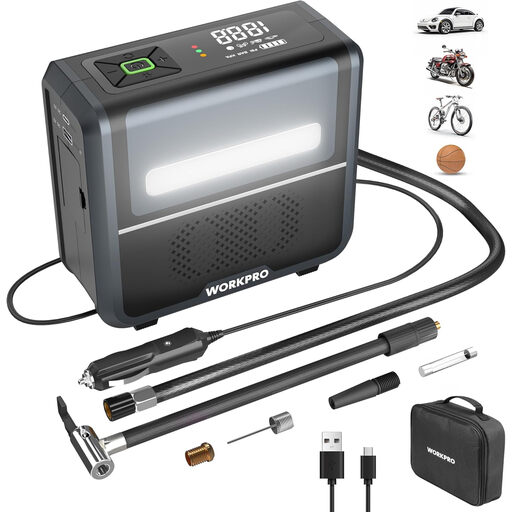
Our take: The ultimate all-in-one tool. It runs on battery for total freedom but also includes a 12V cable so you're never caught off guard. Its power bank and torch functions make it the ultimate travel companion.
Its dual power source (battery + 12V) is the perfect solution: it combines the freedom of cordless with the security of corded if the battery is low.
3-in-1 Versatility: inflator, power bank, and torch. Dual Power: maximum flexibility for any situation.

Our take: For bikers, cyclists, and campers, every gram counts. This model is ultra-compact and lightweight (460g), perfect for slipping into a backpack or motorbike saddlebag, while delivering surprisingly good performance for its size.
It solves the unreliable gauge problem with sensors advertised as highly accurate. Its 17 L/min airflow rate is very respectable for such a compact format.
Ultra-portable: feather-light and minimal bulk. Practical features: highly readable screen, preset modes, and a power bank function.
Explore our full selection of products that meet our quality criteria and safety standards.
Yes, more than enough. The recommended pressure for an SUV tyre is between 32 and 40 PSI (2.2 and 2.7 bar). A 150 PSI capacity is therefore well beyond what's needed. For an SUV, the most important factor will be the airflow rate (L/min): since the tyre volume is larger, a good flow rate will save you from a long wait.
It all depends on the battery quality and your usage. Generally, a good lithium-ion battery will retain most of its capacity for 3 to 5 years (several hundred charge cycles). To preserve it, avoid complete discharges and store the device away from heat and moisture.
It all comes down to your needs.