
Livraison le jour même ou le lendemain

Qualité garantie

Débloquez vos offres de bienvenue: Livraison GRATUITE | Jusqu'à -80 % | 30 jours d'essai gratuits à JoyPlus
Téléchargez l'application
A portable 2000 W induction hob can complement a small kitchen, temporarily replace a cooker, or be used when camping, in a studio apartment, student accommodation or even at the office. It heats up quickly, is easy to store and eliminates the constraints of an open flame. However, the maximum wattage alone is not enough to distinguish between models.
Cookware compatibility, precision of the settings, ventilation, cleaning and safety are just some of the criteria that are sometimes overlooked, despite having a direct impact on everyday convenience. Here are the key points to check before buying, followed by a selection of models suited to different needs.
A maximum output of 2,000 W is suitable for many preparations, but it does not guarantee precise control at low temperatures. To simmer a sauce, keep a dish warm or melt chocolate, the hob must also offer sufficiently gradual power levels.
Check the full range, for example 100 to 2,000 W, as well as the number of available settings. An induction hob with 8 power levels is sufficient for everyday use, while a 10-level model allows finer control, from gentle simmering to rapid searing.
Induction works with cookware featuring a ferromagnetic base. An aluminium, glass or ceramic saucepan without a magnetic base will generally not be detected.
The diameter stated by the manufacturer often refers to the recommended contact area rather than the cookware’s total diameter. Before placing your order, check:
For a 32 cm induction-compatible wok, the 32 cm measurement often refers to the upper diameter of the bowl. Make sure its flat base remains within the hob’s detection range. An uncoated cast-iron wok can work on induction, but its weight, thermal inertia and maintenance requirements should be taken into account.
An induction hob equipped with a timer and automatic programmes can simplify the preparation of soup, steamed dishes or boiling water. However, a preset programme does not always replace manual control: the amount of water, type of cookware and starting temperature can all affect the result.
It is better to choose a hob that combines preset programmes, power adjustment and temperature control. A timer of up to three hours is useful for slow-cooked dishes, but it does not replace the need to follow monitoring and ventilation guidelines.
A portable 2000 W induction hob generally operates on a domestic 220–240 V power supply. At 2,000 W, it can speed up boiling, but actual energy consumption depends on the selected level and operating time.
A temperature range of 60 to 270°C, such as the one advertised for the IAGREEA DF200-14V10, covers a variety of uses: keeping food warm, pan-frying, boiling and stir-frying. Touch controls provide a smooth surface that is easy to wipe clean. However, make sure they remain clear and responsive when your hands are damp.
A portable induction hob should be compact enough to fit in a cupboard while leaving sufficient clearance around the ventilation openings. An ultra-slim model measuring around 44.5 mm thick can be particularly convenient in a kitchenette or studio apartment.
Black glass or ceramic glass can be cleaned with a soft cloth once the surface has cooled. Avoid abrasive products and never immerse the appliance in water. The surface may remain hot after the hob is switched off, even though induction primarily heats the cookware.
At a minimum, look for:
The control lock limits accidental operation, but it does not replace supervision of a child. Also read the instructions and compliance information supplied with the product before first use.

Why this model suits this profile: its portable design is ideal for a first setup in a studio apartment, student room or secondary kitchen.
Its 10 power settings mean you are not dependent solely on an automatic programme. The control lock is also useful in shared accommodation.
Advertised output of 2,000 W, touch controls, glass panel and 6 preset functions according to the product listing.
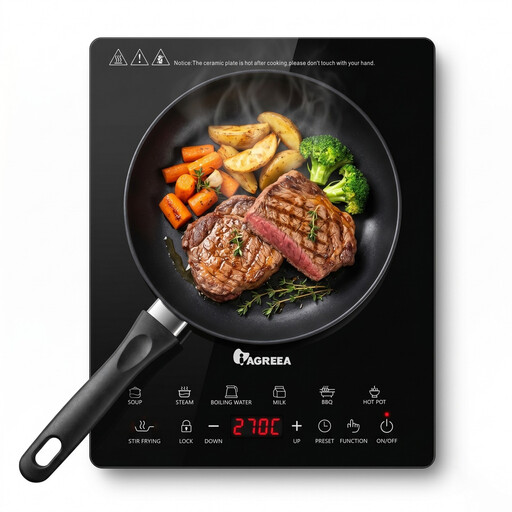
Why this model suits this profile: its 100 to 2,000 W adjustment range and advertised temperature range of 60 to 270°C suit users who alternate between gentle cooking and rapid preparation.
The product listing mentions pan detection, overheating protection and a timer of up to 3 hours, rather than simply promising high wattage.
8 power levels, 7 preset functions, child lock and an advertised thickness of 44.5 mm.
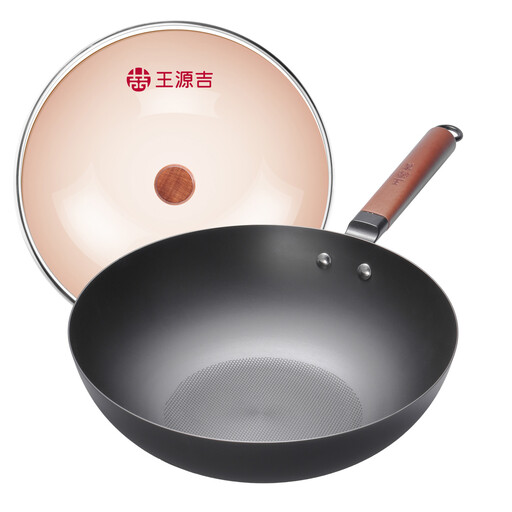
Why this model suits this profile: its flat base is advertised as compatible with induction, gas and electric hobs, making it easy to use in a variety of settings.
Its flat base helps prevent stability issues. Before buying, however, check that the contact diameter is compatible with your chosen hob.
Advertised diameter of 32 cm, stated weight of 1.1 kg and an uncoated design requiring initial seasoning and oil-based maintenance.
Place the portable induction hob on a flat, stable and heat-resistant surface. Leave sufficient space around the ventilation grilles and avoid installing the appliance near a sink or water source. A very large wok or frying pan must remain stable without extending excessively beyond the cooking surface.
To minimise splashes and simplify cleaning, wipe the hob with a slightly damp cloth once it has cooled. With an uncoated iron wok, dry it immediately after washing and apply a thin layer of oil. The seasoning will improve with use; avoid abrasive sponges, which could damage the surface.
Explore our updated selection of portable induction hobs and compare the available sizes, power levels, timers and safety features in France.
At full power, a 2,000 W appliance corresponds to an instantaneous consumption of 2 kW. Actual energy use then depends on the operating time and selected level. A short cooking session at high power may therefore consume less than a prolonged session at moderate power. To estimate the cost, multiply the power used in kilowatts by the number of hours, then by your electricity tariff.
No. Hold a magnet against the underside of the cookware: if it adheres firmly, the base is generally ferromagnetic. It must also be completely flat and have a diameter within the range accepted by the hob. Aluminium, copper and ceramic cookware without a magnetic base are not suitable.
Its lifespan depends on how frequently it is used, the quality of its cooling, maintenance and compliance with the intended load. Do not block the vents, move the appliance while it is heating or expose the glass surface to impacts. The instructions, warranty and availability of after-sales support are also criteria to check before placing your order.