Parents who want to choose what goes in
You make porridge at home and prefer to pick the ingredients you add to the oats. Compare the labels on plain options before adding, for example, fruit or cocoa.


If you want to control what goes into it, start with plain oats and check the ingredients. If you prefer a blend labelled ‘reduced sugar’, compare the ‘sugars’ figure per 100 g and check what it is being compared with. For a school lunchbox, also check allergens and school rules. If your recipe contains milk or yoghurt, make sure it can be kept under the required conditions until lunchtime.
You make porridge at home and prefer to pick the ingredients you add to the oats. Compare the labels on plain options before adding, for example, fruit or cocoa.
You need to check the ingredients and any ‘may contain’ information on the specific pack. If your child has an individual healthcare plan (PAI), their lunchbox must also follow the arrangements agreed with the school, as explained by the French Ministry of National Education.
You want to save time in the morning. Whether you pack dry oats or take prepared porridge depends, among other things, on what you add and whether it can be stored correctly until lunchtime.
For a school lunchbox, first decide what matters most: choosing your own additions, meeting dietary requirements or planning how to store it.
| Consideration | What to check | Who it matters to |
|---|---|---|
| Sugars and claims | Compare the ‘sugars’ figure per 100 g and the ingredients list. If it says ‘reduced sugar’, also check what it is being compared with. | If I want to choose my own additions, plain oats give me the freedom to put together my own recipe. If I choose a flavoured blend, I want to understand how much sugar it contains. Around 45% of consumers would prioritise this control over sugar. |
| Allergens and school rules | Read the allergen and ‘may contain’ information on the specific pack, then check the school’s arrangements or the PAI, if applicable. | If an ingredient needs to be avoided, the word ‘porridge’ alone isn’t enough to decide what your child can take to school. This compatibility would be the priority for around 33% of consumers. |
| Preparation and storage | Check whether the product will be taken dry or already prepared, and how any added ingredients need to be stored. | If I prepare the lunchbox the night before, I need to know whether its contents can be stored under the required conditions until lunchtime. Around 22% of consumers would put this planning first. |
France’s Directorate-General for Competition Policy, Consumer Affairs and Fraud Control points out that nutrition information is given per 100 g or 100 ml, making it easier to compare labels. When comparing dry oats with ready-made porridge, remember that adding liquid changes the amount of product being compared.
According to France’s Agency for Food, Environmental and Occupational Health & Safety (Anses), a product with no added sugars may still contain sugars that occur naturally in its ingredients.
Read the exact claim, then check the ingredients list and the ‘sugars’ figure per 100 g rather than relying on the front of the pack alone.
For example, Carrefour Bio’s oat flakes product information says the product may contain traces of other cereals containing gluten, nuts, soya, sesame and mustard. This applies to that specific product, not all porridges.
Check the pack of the product you choose and, if your child has a PAI, follow the arrangements agreed with the school.
A recipe containing milk or yoghurt needs to be transported in line with the storage instructions for the ingredients used. Anses says that keeping food at a low temperature slows the growth of micro-organisms.
If you can’t keep it chilled until lunchtime, consider taking the dry oats separately instead of packing porridge that has already been made with these ingredients.
Depending on the journey and the storage facilities at school, you may need a suitable container and a way to keep the food chilled.
Carrefour’s 500 g pack of small organic wholegrain oats makes a plain base you can customise.
E.Leclerc sells both oats and a chocolate and hazelnut muesli under this brand, labelled as reduced sugar. However, muesli and plain oats are different recipes.
Joybuy’s range includes a 500 g Quaker oats product and a version with flaxseed and cocoa.
This selection includes oats you can customise and blends to make into porridge. For a lunchbox, choose a recipe and way of transporting it that fit the school’s rules.
 Image unavailable
These oats are a good choice if you’d rather make your own recipe than choose a flavoured blend.
For a lunchbox, use a suitable container. Before preparing a portion, check the pack for the sugars listed, allergens and storage instructions.
 Image unavailable
These oats are for anyone who wants to choose the ingredients they add to their porridge separately.
If an allergen needs to be avoided, check the ingredients and ‘may contain’ information on the pack. Also consider how you’ll transport the porridge once you’ve added the other ingredients.
 Image unavailable
These oats are an option if you plan to make your own porridge and add other ingredients separately.
Check the nutrition information and allergens for the specific product. For a school lunch, also consider whether the oats will be transported dry or already prepared.
 Image unavailable
This blend may appeal to families who’d prefer cocoa porridge to a plain oat base they flavour themselves.
If sugar content matters when choosing what to pack for lunch, check the ‘sugars’ figure per 100 g on the pack. Also check allergens and, if you make it the night before with a fresh ingredient, how it needs to be stored.
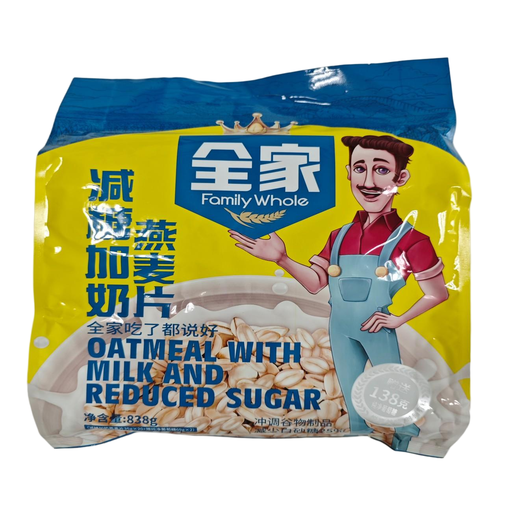 Image unavailable
This porridge blend may suit you if you’re looking for an individual portion, provided it can be prepared in a way that works at school.
The words ‘Reduced Sugar’ in the name aren’t enough to compare its sugar content with plain oats. Check the sugars per 100 g and what the pack says it is being compared with. Also check the allergens and the amount of glucose in the product.
No. Anses explains that sugars which occur naturally in the ingredients may still be present. When choosing a product, also check the ‘sugars’ figure per 100 g and the ingredients list.
Compare the nutrition information per 100 g and the ingredients, then check which product the claimed reduction is measured against. If you add ingredients to the oats yourself, take them into account when comparing the finished recipes.
No. Check the label of each product. For example, Carrefour’s product information for its organic wholegrain oats warns that the product may contain traces of other cereals containing gluten. This doesn’t tell you whether another recipe is suitable.
Check the ingredients and any ‘may contain’ information on the product you plan to pack, then check the arrangements agreed with the school. In France, the Ministry of National Education says that a PAI can be set up to support a pupil with, among other things, a food allergy. If your child has one, follow the arrangements in place for them.
Yes, as long as its ingredients can be stored under the required conditions until lunchtime. If it contains milk or yoghurt, check their storage instructions and whether you can keep it chilled during transport and at school. If not, packing the dry oats separately may be easier.