You’re looking for a ‘sugar-free’ claim
You want to check the stated sugar content without confusing this claim with ‘no added sugar’. Anses points out that a product with no added sugar may still contain sugars that occur naturally.


After an evening enjoying raclette, choose according to what you want from breakfast, without assuming that porridge will make up for the meal the night before. If you’re specifically looking for a ‘sugar-free’ claim, check the ‘of which sugars’ line: according to Anses, the threshold is less than 0.5 g per 100 g or 100 ml. Plain oats let you build your own bowl, while muesli with no added sugar may still contain sugars naturally present in its fruit. Neither category alone guarantees a ‘sugar-free’ claim.
You want to check the stated sugar content without confusing this claim with ‘no added sugar’. Anses points out that a product with no added sugar may still contain sugars that occur naturally.
Plain oats let you choose your liquid and toppings separately. You should still check the ingredients list and any allergen warnings.
Muesli with no added sugar may suit you if you’re happy to have sugars naturally present in the fruit. Before choosing, compare its ‘of which sugars’ figure and ingredients with what you’re looking for.
First, decide whether your priority is a ‘sugar-free’ claim, no added sugar or a plain base you can customise. According to Anses, ‘sugar-free’ means less than 0.5 g of sugars per 100 g or 100 ml; ‘no added sugar’ does not rule out sugars that occur naturally.
| What matters to you | What to check | Who is it for? |
|---|---|---|
| Sugar claims | Compare the exact claim and the ‘of which sugars’ figure per 100 g. | If I’m looking for a ‘sugar-free’ claim, a packet labelled simply ‘no added sugar’ may not meet my needs. Around 40% of consumers put this distinction first. |
| Fruity recipe | Check which fruit is used, the ‘of which sugars’ figure and the allergens. | For a fruity, ready-to-serve breakfast, I’m happy to have sugars naturally present in the ingredients. This is the top priority for around 30% of consumers. |
| Plain base and allergens | Check the ingredients list and any ‘may contain’ warnings. | If I want to choose my own additions, I opt for plain oats, while checking the warnings that apply to my dietary requirements. Around 30% of consumers prioritise this customisable base. |
Fruit muesli can carry the first claim while still containing sugars that occur naturally. For example, the Joybuy listing for 375 g of Bjorg muesli states that it contains 14 g of sugars per 100 g.
If you’re looking for a ‘sugar-free’ claim, check the exact claim and the ‘of which sugars’ figure per 100 g. Anses sets the threshold for this claim at less than 0.5 g per 100 g or 100 ml.
The Auchan.fr listing for 550 g of Quaker oats warns that they may contain barley and wheat; the listing for 500 g of Auchan oats mentions possible traces of cereals containing gluten.
If you need to avoid gluten, check the label on the specific packet rather than relying on the words ‘oats’ alone.
A bowl made with plain oats also depends on what you add. Honey, syrup, chocolate and dried fruit all change what’s in your breakfast.
Choose your base first, then check the ingredients and quantities of your toppings separately.
The 550 g Quaker oats listed by Auchan.fr contain 100% wholegrain oats.
The 500 g product listed by Auchan.fr contains 100% wholegrain oats.
Bjorg offers muesli with no added sugar, including fruity and crunchy recipes. These are different products from plain oats for porridge.
Carrefour.fr lists a 375 g organic fruit muesli labelled ‘no added sugar’.
This selection includes oats to prepare to your taste and fruity muesli for breakfast. Muesli isn’t a plain porridge base; check the claim you’re looking for and the nutritional information on each packet.
 Image unavailable
Worth considering if you’d like to make porridge and choose your own toppings. If a ‘sugar-free’ claim or avoiding gluten matters to you, check the ‘of which sugars’ figure and the allergen information on the packet.
 Image unavailable
Oats to consider for making your own porridge and adding toppings separately. For this 500 g packet, check the stated sugar content and gluten warnings directly; information for a different packet size is no substitute.
 Image unavailable
Another 500 g packet of oats for making a bowl with your choice of additions. Check the label if your decision depends on the sugar content or the possible presence of allergens.
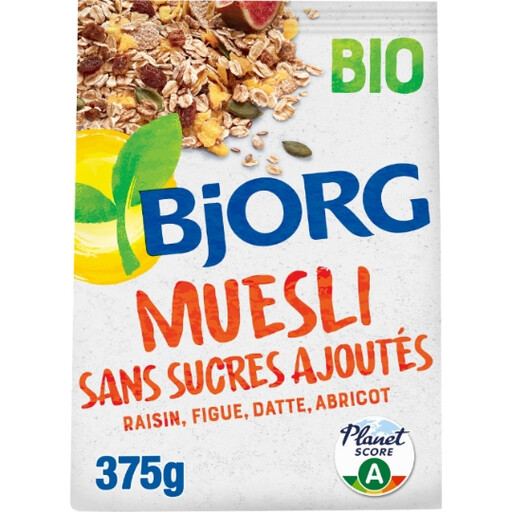 Image unavailable
Worth considering if you’d prefer fruity muesli with no added sugar rather than plain oats. The Joybuy listing states that it contains 23% fruit and 14 g of sugars per 100 g, so it does not meet the ‘sugar-free’ threshold given by Anses. Check the listed allergens before buying too.
No. Anses explains that products with no added sugar may still contain sugars naturally present in their ingredients. For a ‘sugar-free’ claim, it sets the limit at less than 0.5 g of sugars per 100 g or 100 ml. Check the exact claim and the ‘of which sugars’ figure.
No, porridge won’t make up for an evening enjoying raclette. If you simply want to put together your breakfast, plain oats let you choose your liquid and toppings separately. Consider the finished bowl, not just the packet of oats.
No. For the 550 g Quaker and 500 g Auchan products described by Auchan.fr, the listings warn respectively that barley and wheat may be present, and that traces of cereals containing gluten may be present. Check the labelling on the specific product to make sure it meets your requirements.
The Auchan.fr listing for this product suggests using 40 g of oats with 250 ml of water or milk. If you then add fruit, honey or chocolate, those ingredients count towards the contents of your bowl too.