Households short on space
You want to move on from pods without cluttering your worktop. A slim machine could catch your eye, provided you also have room to handle and rinse its parts after making a drink.


If worktop space and simplicity matter most, a compact or hybrid bean-to-cup machine is worth considering, as long as you’re happy to clean it after each cup. An automatic bean-to-cup espresso machine is a better fit if several people want different drinks, but you’ll need enough room to fill, open and clean it. A milk system is only worth having if milk-based drinks are genuinely part of your routine.
You want to move on from pods without cluttering your worktop. A slim machine could catch your eye, provided you also have room to handle and rinse its parts after making a drink.
You’d rather keep the number of settings to learn to a minimum. Compare the steps involved in making and cleaning your coffee, not just the number of controls: according to Philips France, the Baristina automates preparation, but you still need to remove and rinse its portafilter.
You’re weighing up a machine without a milk system, a steam wand or automatic milk preparation. How often you actually make cappuccinos or lattes will help you decide whether the extra parts and cleaning will fit into your routine.
To replace pods in a small kitchen, start with the space you have to work with and the steps you’re happy to take each day. Then choose the features that suit the drinks your household makes.
Worth considering: if width is your main constraint and you want a machine with few settings for your everyday coffee.
Bear in mind: you may still need to do something by hand after making your coffee. Les Numériques reports that the Krups Coffee Crush Experience’s portafilter must be emptied and cleaned after every coffee; Philips France says the Baristina’s needs to be removed and rinsed.
Worth considering: if several people want different drinks or settings, and you have enough room to use the machine comfortably.
Bear in mind: automatic preparation doesn’t eliminate the need to access the trays and water tank or carry out regular maintenance. The exact tasks depend on the model you choose.
| Consideration | What to check | Who it matters to |
|---|---|---|
| Space and access | Measure the width, depth and height, then allow for the space needed to open lids and remove parts. | In a small kitchen, I want to leave the machine in place without blocking access to fill it or the space in front of it; around 33% of consumers would prioritise its actual footprint. |
| Daily steps | Check the tasks required after each cup and the regular cleaning instructions in the manual for your chosen model. | For my everyday coffee, I’d rather have a routine that’s easy to remember, even if I need to rinse a part after use; simplicity would be a priority for around 27% of consumers. |
| Milk-based drinks | Compare the drinks you actually make with the cleaning required for a steam wand or milk system. | If I often make cappuccinos, I want to choose a milk-preparation method I’ll actually use; around 13% of consumers would make this their priority. |
| Ongoing maintenance | Check the descaling and cleaning instructions, along with any filters or other consumables required for the model. | I want to know what I’ll need to do over the coming weeks before switching machines; maintenance would come first for around 27% of consumers. |
A slim machine may still need more depth, or more clearance beneath a cupboard, when its portafilter is in place or its lids are open.
Before deciding where to put it, check its dimensions when in use and make sure you can remove the water tank, grounds container and other detachable parts.
Cleaning tasks vary from one machine to another. Les Numériques notes that the Krups Coffee Crush Experience’s portafilter needs emptying and cleaning after every coffee; Philips France says the Baristina’s portafilter needs rinsing.
Check the manual to see what needs doing after each cup, regularly and when descaling.
Also allow time to empty the coffee grounds and, depending on the model, maintain the brewing unit.
A milk carafe or system means more parts to handle and clean, even if your household mostly drinks black coffee.
Count how many milk-based drinks you make in a typical week, then choose between no milk system, a manual steam wand and automatic preparation.
The Coffee Crush Experience is worth a look if limited worktop width is narrowing your options.
The Baristina and Series 2200 show two different ways to switch to beans: a portafilter with automated preparation, or an automatic bean-to-cup espresso machine, depending on the model.
The Magnifica Start range lets you compare different ways of preparing milk, rather than treating this feature as a must-have.
These three automatic bean-to-cup espresso machines are designed for making coffee from whole beans using an integrated grinder. If you have a small kitchen, compare how much space they need when in use and the milk-drink routine you want before choosing a model.
 Image unavailable
Worth considering if you want to switch to beans with a grinder machine and are looking for the LatteGo variant. Check that you have enough room to access its parts and that its maintenance steps suit your routine.
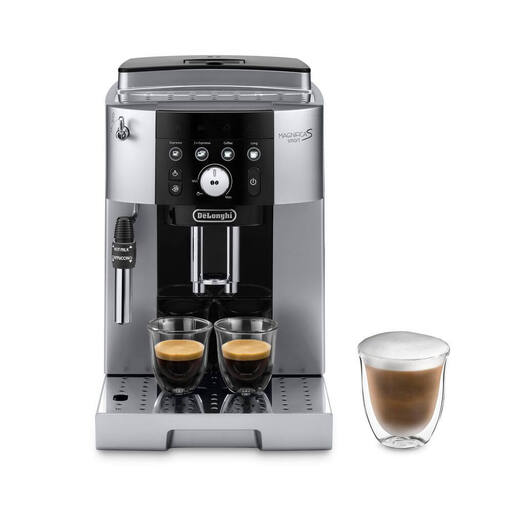 Image unavailable
This automatic machine with an integrated grinder suits anyone looking to make coffee from whole beans. If you also make milk-based drinks, check that the method provided for this model and the steps involved work for you. Be sure to measure the space it needs when in use, too.
 Image unavailable
This bean-to-cup machine is another option for replacing pods with a grinder. Check that its drinks, the steps involved in preparing milk and access to removable parts suit the way you’ll use it and where you plan to put it.
No, switching to whole-bean coffee doesn’t require a milk system. If you regularly make cappuccinos, compare a steam wand with automatic milk preparation, taking the steps involved and cleaning into account. Otherwise, this feature can be a lower priority.
Measure the space needed to use it, not just the dimensions of its body. Check the clearance beneath wall cupboards, whether the lids can open, access to the water tank and whether there’s enough room in front to remove parts.
No. It automates some preparation steps, but maintenance tasks vary by model. Philips France says to rinse the Baristina’s portafilter after use; Les Numériques reports that the Krups Coffee Crush Experience’s portafilter needs emptying and cleaning after every coffee. Check the manual for the model you’re considering to see what regular tasks are required.
An electric coffee machine that has reached the end of its life should go through the electrical and electronic equipment waste recycling scheme. France’s Ministry for Ecological Transition says that a collection and recycling scheme operates in France. Contact your local authority, a collection point or the retailer to find out where you can drop it off.