
Livraison le jour même ou le lendemain

Qualité garantie

Débloquez vos offres de bienvenue: Livraison GRATUITE | Jusqu'à -80 % | 30 jours d'essai gratuits à JoyPlus
Téléchargez l'application
Does your dog hog the sofa, push their bed around, or regularly turn their sleeping spot into a proper fur nest? A plush, washable donut dog bed can give them a cosy, enveloping space. But you need to pick the right one. A round shape, thick padding, or simply the word "washable" doesn't always guarantee a bed that's practical day to day.
Here are the points to check to avoid nasty surprises and find a bed that suits your companion's size, habits and activity level.
A 70 cm diameter might be perfect for a small dog that sleeps curled up, but it can be too tight for an animal that likes to stretch out fully. The outer dimensions usually include the raised edges, so the actual space available in the centre is smaller.
Measure your dog from nose to base of tail, then allow a comfortable margin. When choosing a round dog bed, compare this measurement to the total diameter of the bed rather than a vague label like "small" or "medium".
Some beds are marketed as easy to clean when their padding is completely sealed inside. Check for a zip, access to the central cushion, and the care instructions. A removable cover makes cleaning up little accidents and everyday dirt much easier, while the inner padding often needs separate treatment.
If your dog is active, elderly, or prone to little accidents, it's better to go for a dog cushion with a removable cover. Also remember to check the label before each wash.
Rubber nubs can stop the bed from sliding on a smooth floor, but they're not magic. On dusty wooden flooring, damp tiles, or a very thick carpet, the grip can vary significantly.
A non-slip dog bed should be placed flat, with its entire base in contact with the floor. Regularly inspect the seams, the zip, and any parts your pet might be tempted to chew.
The stated size should always be compared to your dog's weight, length, and sleeping position. The 70 cm diameter models shown here are better suited to small and medium dogs. The 80 cm versions are more for medium dogs, while the 100 cm models can work for medium to large dogs, depending on each product's specifications.
If your dog shares their bed with another animal or sleeps very stretched out, allow a few extra centimetres. The raised edge creates a lovely cosy cocoon feel, but it does reduce the actual space available in the centre.
The plush fabric gives a soft, warm feel that dogs who love to snuggle will particularly appreciate. The PP cotton or polypropylene fibre filling needs to stay evenly distributed so the cushion doesn't flatten quickly. A stated height of 20 cm refers to the total height of the bed, not necessarily the thickness of the central cushion.
The donut shape can create a calming dog bed in a quiet environment, but it's not a guarantee against anxiety or a promise of better sleep. In the first few days, place a piece of fabric with your scent or their favourite toy in the bed to help them settle in.
Some models are vacuum-packed for delivery. When they arrive, take them out of the packaging, shake them and pat them so the plush and padding regain their volume. Depending on the product, this reshaping can take a little time.
Where the model allows, remove the central cushion using the zip underneath the bed. Wash the cover following its label, with a gentle detergent and no bleach or harsh products. Every part must be completely dry before reassembling to prevent moisture from getting into the padding.
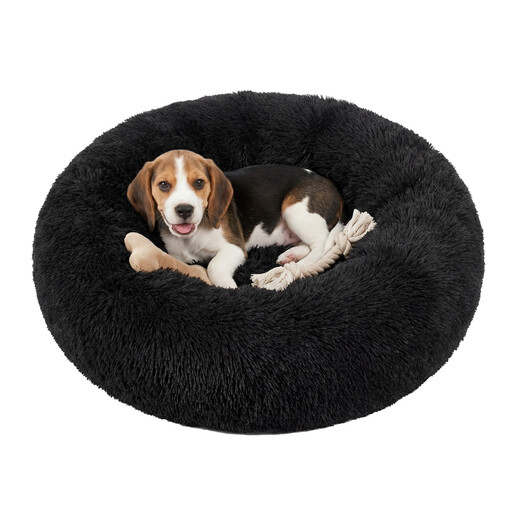
Why this choice suits this profile: its size works for small and medium dogs, while its design is simple enough for a first purchase.
The product page details the diameter, height, materials, and the presence of a zipped access to the central cushion, rather than just making general promises about comfort.
Plush surface, PP cotton padding, base with non-slip nubs, and removable central cushion.
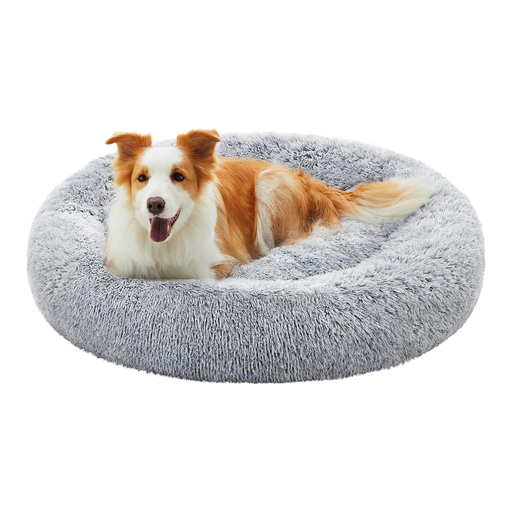
Why this choice suits this profile: its large diameter and 20 cm raised edge will suit households looking for a spacious bed for a medium or large dog.
The product page states a maximum capacity of 30 kg, a removable central cushion, and detailed washing and drying instructions.
100 cm diameter, long-pile plush fabric, PP fibre filling, and base with rubber nubs.
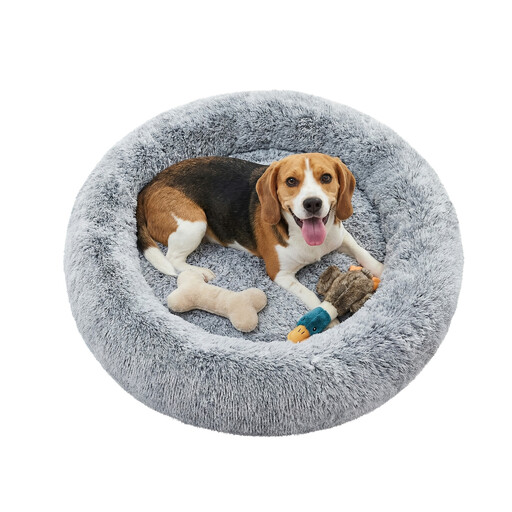
Why this choice suits this profile: its medium size can work for a medium-sized dog, whether in a living room or inside a sufficiently spacious crate.
Its dimensions of 80 x 20 cm are clearly stated. The zip underneath the bed allows you to remove the central cushion, and the base is non-slip.
Long-pile plush, PP cotton padding, cover care as per its label, and reshaping after vacuum-packed delivery.
We've selected a full range, updated in real time, of products that meet these demanding criteria as well as European safety regulations.
A donut bed can also work inside a crate, as long as you check that it still leaves your dog enough space to stand up, turn around, and lie down properly. For an elderly dog or one that's unsteady on its legs, avoid placing the bed in high spots or busy walkways.
Measure your dog when they're lying down, then compare that length to the total diameter of the bed. If they often sleep stretched out, allow extra room. A 70 cm model generally suits small and medium dogs, depending on their build, while a 100 cm model will give a medium or large dog more space.
The cover should only go in the machine if its label says so. First remove the central cushion if the bed's design allows it. The inner padding should not be washed without explicit instructions from the manufacturer. Dry the cover and cushion completely before putting them back together.
Its lifespan depends on the animal's weight, habits, scratching, and how often it's washed. Gentle care, thorough drying, and regular checks on the seams all help to preserve the bed. Replace it as soon as the padding starts to come out, the zip no longer holds, or the base loses its stability.