
Livraison le jour même ou le lendemain

Qualité garantie

Débloquez vos offres de bienvenue: Livraison GRATUITE | Jusqu'à -80 % | 30 jours d'essai gratuits à JoyPlus
Téléchargez l'application
Decluttering the garage, storing off-season clothes, taming the chaos of kids' toys... The promise of a tidy home often starts with buying storage boxes. However, what seems like a simple task can quickly turn into a headache. Between plastics that crack at the first frost and lids that refuse to cooperate, it's easy to make the wrong choice.
To avoid buyer's remorse, you first need to know how to avoid the most common pitfalls. Here are the three design flaws that will send a storage box to the landfill after just a few months:
Fortunately, a few simple checks are all it takes to tell the difference between a purchase you'll regret and a reliable storage solution that will last for years.
The type of plastic is crucial. Polypropylene (PP) stands out as the material of choice for a quality plastic storage crate. It's known for its flexibility, impact resistance, and ability to withstand temperature changes. This is an essential criterion for garage and cellar storage, where conditions are often harsher.
Another indicator of quality is the thickness of the plastic. A wall of about 2.5 mm, ideally strengthened with reinforcing ribs, is your guarantee that the box won't deform under the weight of its contents or when stacked.
The main benefit of storage boxes is, of course, being able to stack them to optimise vertical space. For this, stable stackable storage boxes are essential. The secret? A flat lid with rims or grooves that lock perfectly with the base of the box above. This is what ensures secure stacking. Robust locking clips are just as crucial for sealing the contents and reinforcing the entire stack.
Opting for a transparent storage bin is a huge time-saver: it allows you to identify the contents at a glance without having to unpack everything. When it comes to a large-capacity plastic box, don't just trust the litre rating. Look at the interior shape: straight walls and gentle corners maximise the truly usable space. Finally, for a visually cohesive organisation and better value for money, buying a set of storage boxes is often the smartest move.
Rather than an endless list, here are a few models that meet specific needs, all selected based on the durability and practicality criteria we've just covered.
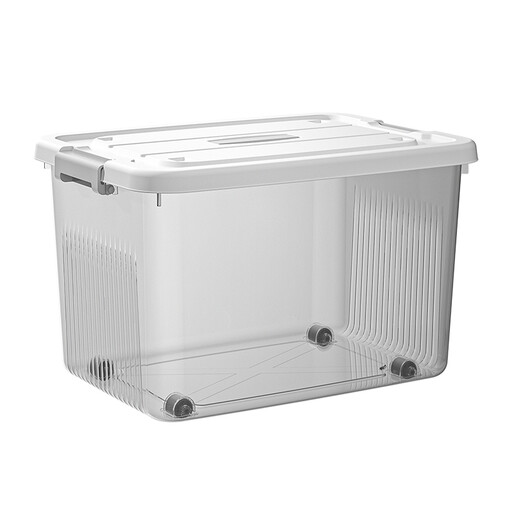
Why we chose it: This set of medium-sized boxes is the Swiss Army knife of home storage. Perfect for off-season clothes, toys, or arts and crafts supplies. Its transparency allows the whole family to easily find what they're looking for.
The 2.5 mm thick reinforced PP plastic resists warping and cracks. The clip-on lid ensures a reliable seal, preventing distortion and dust infiltration.
Stable stackable design thanks to the flat, interlocking lid and base, optimising space in cupboards or on shelves.
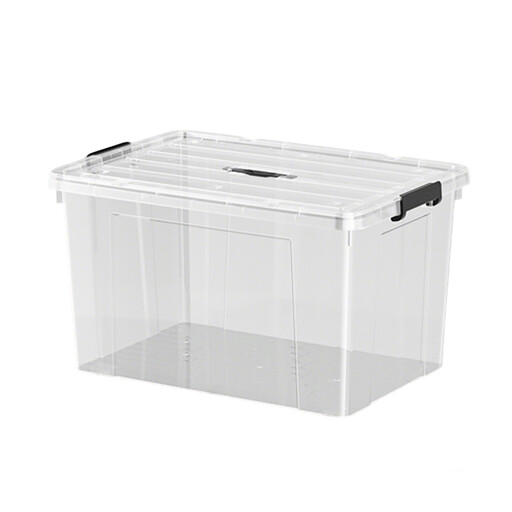
Why we chose it: Its large capacity is designed for bulky items like tools, duvets, or archives. Its robustness makes it a reliable option for the garage, cellar, or attic.
Its structure with reinforcing ribs and rounded corners prevents cracks under heavy loads—a classic flaw in low-end boxes when put under real stress.
A large-capacity plastic box with integrated ergonomic handles, which make it much easier to carry even when packed full.

Why we chose it: Perfect for archiving documents, sorting office supplies, or organising small inventory. The transparency lets you identify contents without opening each box, and the set format ensures a clean, cohesive look.
The clip-on lid seals tightly, protecting documents from dust, unlike lids that tend to gap. The non-slip base ensures secure stacking on shelves.
Sold as a set for a uniform and cost-effective archiving solution, with a reinforced structure designed to support the weight of paper.
We have selected a full range of products that meet our specifications and current safety standards.
To put it simply, polypropylene (PP) is the champion in its class. Unlike lower-grade plastics like polystyrene (PS), it offers much better resistance to fatigue, impacts, and chemicals. It also handles temperature fluctuations much better, making it the ideal candidate for storage in uninsulated areas like a cellar or attic.
For stable and risk-free stacking, follow these golden rules: