
Livraison le jour même ou le lendemain

Qualité garantie

Débloquez vos offres de bienvenue: Livraison GRATUITE | Jusqu'à -80 % | 30 jours d'essai gratuits à JoyPlus
Téléchargez l'application
Decluttering your home, organising the garage, or preparing for a move: it all starts with the same quest for the perfect plastic storage box with a lid. The mission seems simple, but the market is flooded with models of wildly inconsistent quality. Make the wrong choice, and you're setting yourself up for disappointment: cracked lids, precarious stacks, and money down the drain.
As a product selection expert for Joybuy, my mission is to help you gain some clarity. This guide breaks down the most common design flaws and gives you the essential criteria for making a smart, long-lasting purchase.
Before you head to the checkout, watch out for these recurring problems that can send a storage box to the landfill far sooner than you'd think.
To avoid falling into these traps, examine a few objective technical specifications. These are the true indicators of a storage bin with a lid's quality and longevity.
Not all plastics are created equal—far from it. For storage boxes, polypropylene (PP) is the material to look for. It's known for its robustness and its resistance to impacts, temperature changes, and many chemicals. Also, be sure to check the wall thickness. A thicker wall (usually indicated in millimetres) ensures better rigidity and a higher load capacity, a crucial criterion for a large-capacity storage box.
A truly stackable storage crate is recognisable by its specific design details. Look at the lid: does it have raised edges or grooves? Check the base: does it have notches that correspond perfectly to the contours of the lid? This interlocking mechanism is what guarantees a stable and secure stack. Sturdy, integrated handles are also a real bonus for handling.
The choice between a transparent storage box and an opaque model depends on what you plan to store inside.
Here is our selection of models that meet specific needs, all chosen for their durability and smart design.
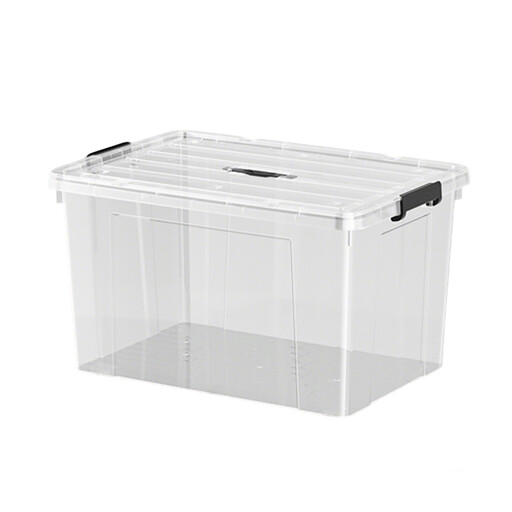
Why we love it: This set is perfect for families juggling the storage of countless items, from seasonal clothing to children's toys. The transparency allows everyone to easily find what they're looking for, and buying a storage box set is often more cost-effective.
The manufacturer specifies a 2.5 mm thickness and reinforcing ribs—a design that directly tackles the problem of plastic warping. Its non-slip base and clip-on lid are designed for stable and secure stacking.
Reinforced polypropylene (PP) structure and a design optimised for secure stacking, even when fully loaded.

Why we love it: The ideal solution for those seeking a heavy-duty storage box for the garage. Its large capacity and reinforced structure are designed to handle tools, DIY equipment, or heavy archives, all while optimising vertical space.
This model directly counteracts the risk of unstable stacking and deformation. Its flat lid interlocks perfectly with the base of the box above it, and its ribbed structure prevents any sagging, even under a heavy load.
High load capacity and a design optimised for stable vertical stacking to maximise storage space in utility areas (garage, workshop, etc.).
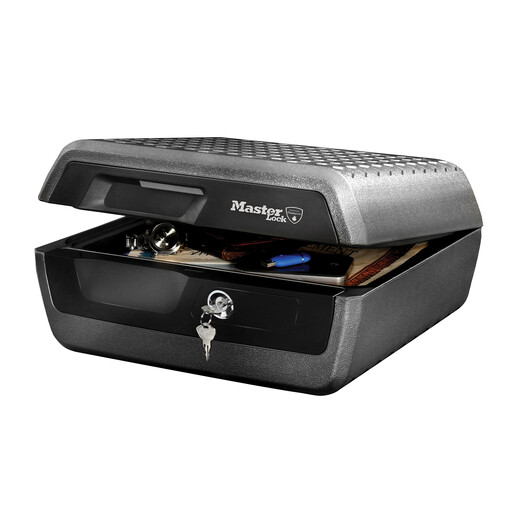
Why we love it: When simple storage isn't enough, this safe takes over. It's designed to protect your most valuable documents (passports, deeds) and digital media (USB drives, hard drives) from worst-case scenarios: fire and flood.
This is in a different league. There's no standard plastic here, but rather a fire-resistant composite construction. It completely eliminates issues of fragility and warping by offering certified protection against extreme hazards.
UL certified for fire protection (1 hour at 927 °C) and ETL certified for water submersion, providing complete peace of mind.
Explore our full selection of products that meet our quality criteria and current safety standards.
It all depends on its manufacturing quality and how it's used. A good model made of thick polypropylene (PP), stored indoors, can last for many years. Conversely, a low-quality box left in a sweltering attic in summer or a freezing garage in winter can become brittle in just one or two seasons.
It couldn't be simpler. A damp cloth and a little mild soap are sufficient in most cases. Avoid scouring powders and abrasive sponges that could scratch the surface, especially on a transparent storage box. Make sure the box is completely dry before putting clothes or linens back inside to prevent mould growth.
It is strongly discouraged. Mixing models or sizes compromises the stability of the entire stack. For safe stacking, it's best to stick to boxes from the same product line, designed to interlock perfectly. The golden rule: always place the heaviest boxes at the very bottom of the pile.