
Livraison le jour même ou le lendemain

Qualité garantie

Débloquez vos offres de bienvenue: Livraison GRATUITE | Jusqu'à -80 % | 30 jours d'essai gratuits à JoyPlus
Téléchargez l'application
Who hasn't dreamed of a perfectly organised living or working space? The obvious solution seems to be a plastic storage box. The problem is, the market is flooded with models that make tempting promises but often prove disappointing in practice. To avoid nasty surprises, it's best to know the common pitfalls and make a choice that is both smart and durable.
We've all experienced boxes that crack at the slightest impact, lids that warp after being handled a few times, or stacks so precarious they threaten to collapse at the slightest breeze. These design flaws quickly turn a purchase meant to simplify your life into a real headache. This guide is here to arm you with knowledge: we're going to break down the details that separate a useless gadget from a truly reliable storage solution.
To ensure you don't regret your purchase, a few technical details make all the difference and are a true hallmark of quality and longevity.
The type of plastic is the primary indicator of a box's sturdiness. The two stars of the market are Polypropylene (PP) and Polyethylene Terephthalate (PET).
A good box is more than just a plastic rectangle. The design details make all the difference in daily use.
The choice between a transparent storage box and an opaque model depends on how you plan to use it. Transparency is a major asset for identifying contents at a glance, which is ideal for shoe storage or craft supplies. Opaque boxes, on the other hand, are perfect for hiding clutter or protecting light-sensitive items.
To illustrate these criteria in practice, here are a few models that meet specific needs.
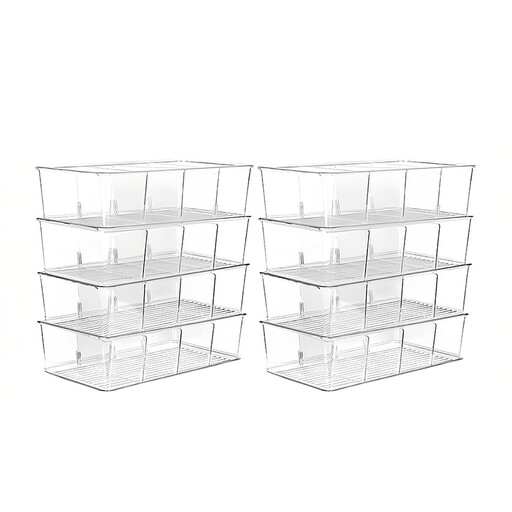
Why we chose it: Ideal for tidying up small everyday items, whether on a desk or in a drawer. This set allows you to sort tea bags, coffee pods, stationery, or cosmetics and find everything at a glance.
Thanks to its rigid and transparent PET material, it avoids the "cheap plastic" look, offering perfect visibility without even needing to open the boxes.
A modular and transparent design for visual, intuitive, and accessible organisation.

Why we chose it: This set of large-format boxes is perfect for storing bulky items: seasonal clothing, children's toys, archives, or tools. Their robust design makes them the perfect ally for cupboards, cellars, and garages.
This model avoids the classic pitfalls of fragility and instability thanks to its thick 2.5 mm structure, its reinforcement ribs, and its non-slip base that guarantees perfectly stable stacking.
A high load capacity and secure stacking to maximise vertical space.
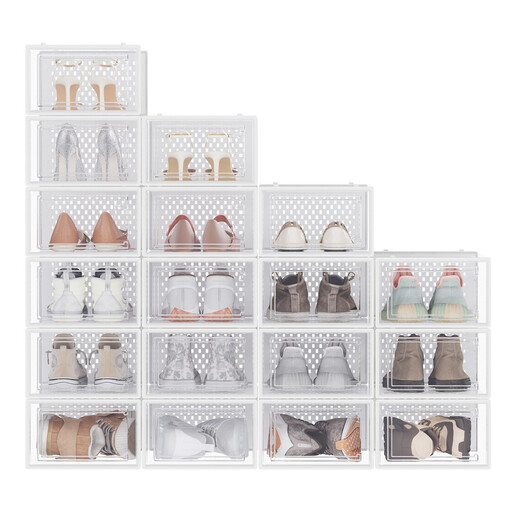
Why we chose it: Designed for sneakerheads and collectors, this system allows you to create a true storage wall for your shoes. Each pair is visible, protected from dust, and always within reach.
No more hassle with traditional lids! The transparent front door is a game-changer: you no longer need to unstack everything to grab the pair at the very bottom. The stack remains perfectly stable.
Ultra-practical front access, ventilation to prevent odours, and a perfect view of your collection.
We have selected other products for you that meet our quality and safety criteria.
To put it simply: Polypropylene (PP) is flexible and highly impact-resistant. It's the champion for large crates that take a beating (garage, moving). PET, on the other hand, is more rigid and transparent, making it perfect for smaller storage where aesthetics and visibility are key (office, kitchen).
The secret is in the lid: it shouldn't be flat and smooth. A good stackable system has raised edges or grooves that interlock perfectly with the base of the box you place on top. This interlocking mechanism prevents any slipping. A non-slip base is also a real plus.
Absolutely not. It is imperative to check that the plastic is certified "food-grade." This information is usually indicated by a pictogram (a glass and a fork). While PET and certain types of PP are often compatible, always check the manufacturer's instructions before storing food in them, even dry goods.