
Livraison le jour même ou le lendemain

Qualité garantie

Débloquez vos offres de bienvenue: Livraison GRATUITE | Jusqu'à -80 % | 30 jours d'essai gratuits à JoyPlus
Téléchargez l'application
A plastic mesh fence is ideal for marking out a vegetable patch, securing an enclosure, or creating a temporary partition in a yard. Lightweight, it’s easy to transport and install. However, not all nets are suited to every purpose. A mesh designed for a chicken coop won’t necessarily work for a puppy, while a roll intended for permanent use requires sturdy posts and even tension.
Before placing an order, three common mistakes keep cropping up.
An outdoor plastic mesh may hold its colour in the sun without being able to withstand repeated pulling, biting, or rubbing. UV stabilisation slows down the ageing caused by sunlight, but it doesn’t turn a flexible net into an impact-resistant barrier.
For long-lasting use, check each of the following separately:
A wide mesh can work well for a garden fence or a visual screen. However, it poses greater risks for small animals. A rabbit, guinea pig, or young puppy might try to poke its head through or push against the net.
For a fence for rabbits and guinea pigs, a chicken coop net or animal enclosure, measure the gap between the mesh openings and compare it to the size of the animal. Even a dense mesh doesn’t replace regular supervision.
Even a flexible, UV-resistant fence can sag if it’s simply laid on the ground. Depending on the terrain, you’ll need posts, ground pegs, staples, or cable ties. For a permanent installation, the tension must remain even, with no sharp corners or loops that could snag an animal.
Agricultural polypropylene mesh is lightweight, won’t rust, and can be cut fairly easily with the right tool. Nets with a biaxially oriented molecular structure are designed to distribute strength in several directions. This design can be useful when a fence needs to withstand both longitudinal tension and lateral stress.
However, plastic remains vulnerable to sharp tools, intense heat, and biting. Do not use it as a height safety barrier, pool cover, climbing net, or electric fence unless the manufacturer explicitly allows it.
The height should be chosen according to the intended use:
The roll length also affects your budget and the number of joins. A 10 m roll is enough for a small area, while 50 m or 100 m formats are aimed at larger gardens, farms, or repeated installations.
Attach the net at regular intervals and carefully inspect the joins. The bottom edge should stay close enough to the ground to limit animals getting underneath, without forming a pocket where one could become trapped. Regularly check for tears, stretched mesh, and loose fixings.
For a predator-proof fence, the net must be properly anchored and suited to the target animal or intruder. No flexible model on its own can guarantee universal protection.
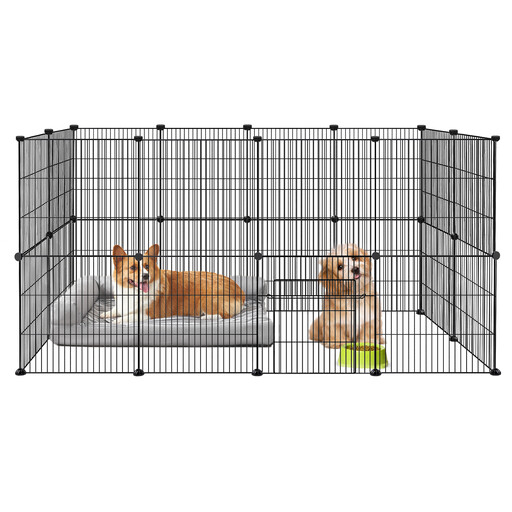
Why this choice suits this profile: Its panel design with a door lets you quickly create a small space for rabbits, guinea pigs, or puppies, both indoors and outdoors.
The dense mesh limits overly large openings, and the door means you don’t have to remove a panel to access the enclosure.
Modular format with 24 panels, integrated door, and suitability for both indoor and outdoor use.
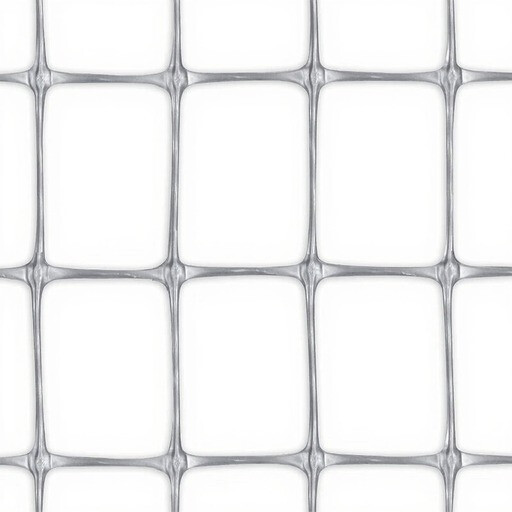
Why this choice suits this profile: This 1.5 × 10 m roll is ideal for a permanent residential installation, particularly in a garden or an area exposed to sea spray.
The specifications indicate a 35 × 48 mm mesh, UV stabilisation, and resistance to salt corrosion, with no anti-corrosion treatment needed.
100% virgin polypropylene, stated weight of 200 g/m², and a 10-year manufacturer’s warranty.
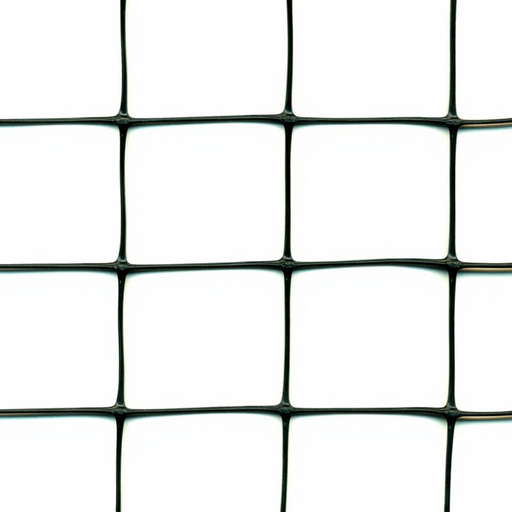
Why this choice suits this profile: The 100 m roll is designed for large agricultural perimeters, poultry runs, aviaries, and animal enclosures.
The long length minimises the number of joins on large sites. The product sheet still recommends careful tensioning and fixing to prevent snagging risks.
Dimensions of 1.5 × 100 m, UV-stabilised polypropylene, and suitability for runs, cages, and garden protection.
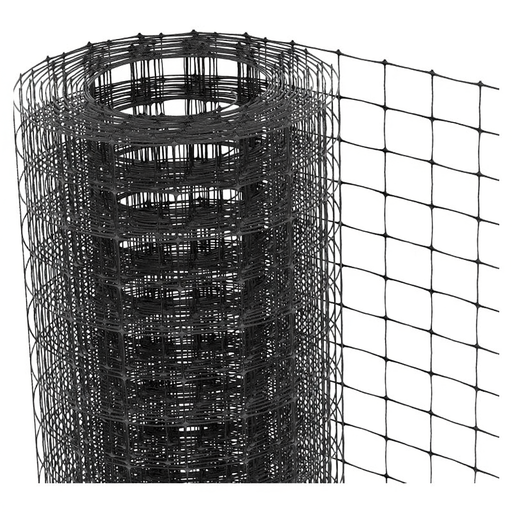
Why this choice suits this profile: With its 1 m height and 100 m roll, this model is ideal for a garden fence, poultry yard, or courtyard partition requiring a long length.
The net can be cut and fixed with standard fasteners, making installation straightforward. However, it should not be used as a climbing net or safety barrier.
Format of 1 × 100 m, polypropylene, and maintenance described as simple with water.
We’ve put together a comprehensive, real-time selection of products that meet these strict criteria, as well as European safety requirements.
For a neat installation, start by measuring the perimeter and marking out the corners. Then put the supports in place before unrolling the net. Avoid pulling sharply on the mesh: a gradual tensioning process helps prevent distortion. On soft ground, bury or pin down the bottom edge of the net to reduce the chance of animals getting underneath.
After installation:
The lifespan depends on exposure, tension, friction, and handling. UV stabilisation can slow down ageing, but it doesn’t replace regular inspection.
A chicken coop net should have a mesh dense enough to limit animals getting through, and it must be properly fixed to both the ground and the supports. To restrict access for certain predators, the height, ground return, and strength of the fixings matter just as much as the material.
Yes, provided it’s suited to the dimensions of the site and fixed to regularly spaced supports. The taller and more exposed the net, the more careful you need to be with tension and anchoring. In very windy areas, you may need to reinforce the installation.
The price mainly depends on the height, roll length, mesh density, and installation accessories. A small panel enclosure can keep additional purchases to a minimum. Conversely, a 50 m or 100 m roll reduces the number of joins over a large area, but requires more supports.