
Livraison le jour même ou le lendemain

Qualité garantie

Débloquez vos offres de bienvenue: Livraison GRATUITE | Jusqu'à -80 % | 30 jours d'essai gratuits à JoyPlus
Téléchargez l'application
Standard PLA filament is the starting point for most 3D printing enthusiasts, praised for its exceptional ease of use. But as soon as projects demand greater durability and better impact resistance, you quickly run into its limitations. The resulting parts are often brittle and poorly suited for functional applications.
This is precisely where PLA+ filament comes in. Marketed as an evolution of PLA, it positions itself as the perfect middle ground between the printability of PLA and the toughness of more technical materials like ABS or PETG. In this guide, we'll break down the essential criteria for choosing the right PLA+ and present our selection of the best spools for 2026.
Navigating the filament market can feel overwhelming. Don't worry. Here are the key points to check to make the right choice.
The primary reason to choose PLA+ is for its mechanical performance. A good PLA+ should be distinguished by:
These properties make it the material of choice for rapid prototyping, jigs, fixtures, or any part intended for regular handling.
The standard for consumer-grade 3D printers is 1.75 mm PLA+ filament. So, the first step is to verify that this is the diameter compatible with your machine. But what's most important is the filament's dimensional tolerance. A consistent diameter (usually advertised as 1.75 mm ± 0.02 mm) is the guarantee of smooth extrusion. This is what will help you avoid the dreaded nozzle clogs (clogging) or failed prints due to a lack of material (under-extrusion). A quality spool of PLA+ must offer this consistency over hundreds of metres.
The market is seeing a rise in products labelled as Bio PLA+. This label means the plastic is bio-based, i.e., produced from renewable resources (like corn starch) rather than petroleum. However, be wary of the term "biodegradable," which is often misused. PLA degradation only occurs under very specific industrial composting conditions (high temperature, controlled humidity), and certainly not in your garden compost or in nature. Nevertheless, choosing a bio PLA+ is still a relevant step towards reducing dependence on petroleum-based plastics.
To guide you, here are a few tried-and-tested recommendations, acclaimed for their reliability and positive feedback from the maker community.
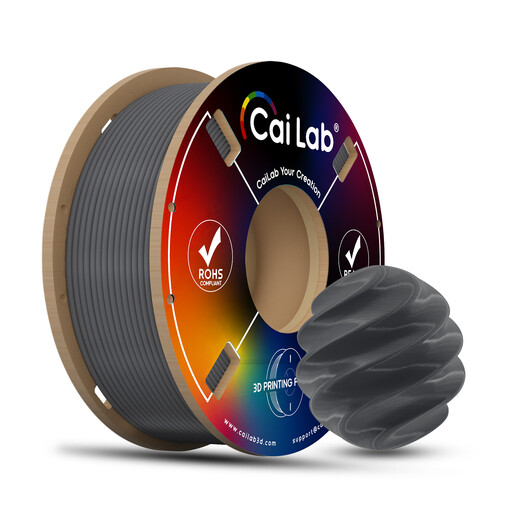
Why it stands out: Its neutral grey and matte finish make it the ideal candidate for prototyping. It's perfect for evaluating a model's shapes and volumes without visual distraction. The PLA+ Bio label is a welcome bonus for those who are conscious of material origins.
Advantages:
Who is it for?: For designers, engineers, and makers looking to produce functional prototypes, architectural models, or mechanical parts where colour is not a primary concern.
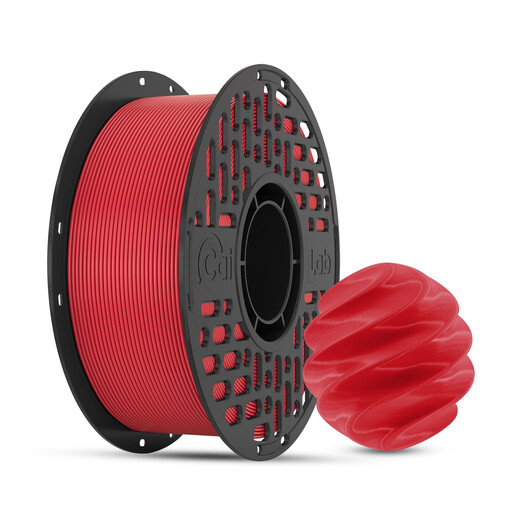
Why it stands out: This PLA+ filament is notable for its vibrant and perfectly consistent red, ideal for parts that need to be noticed. The Cailab brand is renowned for its colour consistency, guaranteeing a uniform finish even on the largest prints.
Advantages:
Who is it for?: For creators of decorative objects, toys (to be used under supervision), colourful replacement parts, or prototypes where colour helps distinguish different components.
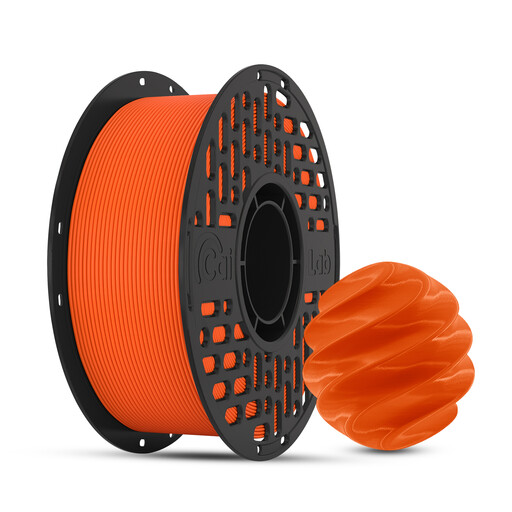
Why it stands out: An original and energetic tangerine shade. It allows you to create parts that stand out from the crowd without sacrificing the toughness of PLA+. Its formula is optimised for smooth extrusion, even at relatively high printing speeds.
Advantages:
Who is it for?: For makers, both hobbyists and professionals, who want to inject a splash of personality into their creations: everyday objects, desk accessories, artistic projects, and more.
PLA+ is an excellent all-rounder, but for some projects, you need to step up to the next level, especially regarding heat resistance. For example, if your part needs to survive inside a car on a hot summer day, you'll have to turn to more technical materials.
? Discover our selection of High-Temperature PLA Filament for more demanding needs.
Simply put, PLA+ is PLA that has been enhanced with additives to boost its mechanical properties. In practice, it has better resistance to impact and bending, is stronger overall, and has improved inter-layer adhesion. Being less brittle than standard PLA, it is perfectly suited for mechanical or functional parts.
Not at all. In fact, this is one of its major strengths: PLA+ is as easy to print as standard PLA. It doesn't necessarily require a heated bed (although it is recommended, around 50-60°C) and prints within the same temperature range (approximately 190-220°C). It emits virtually no odour and has a very low risk of deformation (warping), making it an excellent choice for beginners.
PLA+, just like its standard PLA counterpart, is hygroscopic: it readily absorbs moisture from the air. A filament that has absorbed moisture becomes brittle and can ruin your prints by causing bubbling or sizzling as it exits the nozzle. The best practice to preserve your spool of PLA+ is to store it in an airtight bag with a few packets of silica gel (desiccant) as soon as you're done using it. An airtight, light-proof storage box is the ideal solution.