Livraison le jour même ou le lendemain

Qualité garantie

Débloquez vos offres de bienvenue: Livraison GRATUITE | Jusqu'à -80 % | 30 jours d'essai gratuits à JoyPlus
Téléchargez l'application
The sound is almost imperceptible. A steady, rhythmic mechanical whisper escapes from a corner of the workshop or office. It's the melody of an idea taking shape, layer by layer. 3D printing has moved beyond the confines of industrial labs and into our homes, not as a mere gadget, but as a true personal creation tool. It gives us the power to repair a broken object, prototype an invention, or simply craft a one-of-a-kind decorative piece. This marks the return of a new kind of craftsmanship, where the hand is guided by the digital mind.
At the heart of this domestic revolution lies a material as humble as it is accessible: PLA filament. Polylactic acid, derived from renewable resources like corn starch, has truly democratised additive manufacturing. Its ease of printing, lack of strong odours, and low tendency to warp (the infamous warping) make it the ideal gateway for anyone venturing into the world of 3D printer filament. The standardisation around 1.75mm PLA filament diameter and the 1kg PLA spool has forged a simple and reliable ecosystem, allowing creators to focus on design rather than technical constraints.
Choosing your material is the first step in the creative process. Standard PLA is the perfect companion for initial drafts, functional tests, and everyday objects. Its rigidity and precision make it a go-to choice for detailed models. For parts that need to withstand greater mechanical or thermal stress, like a garden tool holder or an electronics enclosure, alternatives such as PETG filament are a popular choice. PETG offers increased resistance and better heat tolerance, opening up possibilities for more demanding applications while remaining easy to master at home. Selecting a filament is therefore not just a technical step; it's the project's first creative act, defining both its aesthetics and function.
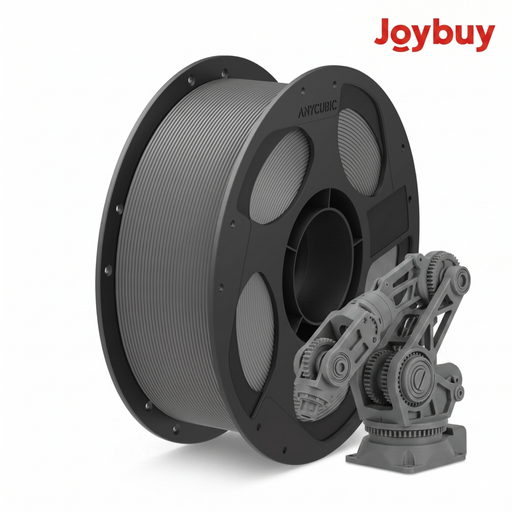
Raw material is a blank canvas. For rapid prototyping or creating pieces where form takes precedence over colour, a neutral filament is simply essential. It allows you to study volumes, shadows, and lines without the distraction of colour. A spool like ANYCUBIC x Joybuy's grey Basic PLA or its pure white variant provides an excellent foundation, offering a smooth, uniform surface that enhances the purity of the design. These fundamental shades are the pillars of any maker's workshop, enabling a seamless transition from idea to tangible object with impressive clarity and precision.
Once the function is validated, it's time for expression! The texture and finish of an object can completely transform its perception. Silk PLA filament is particularly prized for its ability to capture and reflect light, lending a satin sheen and subtle depth to surfaces. An object printed with CAILAB's Gold Silk PLA is no longer just a prototype, but a decorative piece in its own right. For a more understated and contemporary look, a shade like Midnight Black brings a discreet elegance, perfect for designer desk accessories or storage solutions. The material itself becomes a language, conveying aesthetic intent.
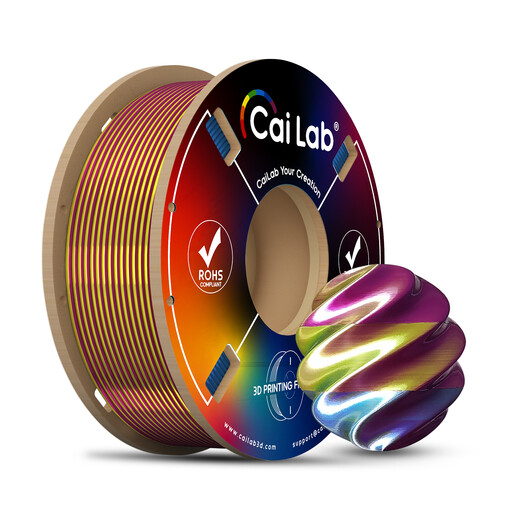
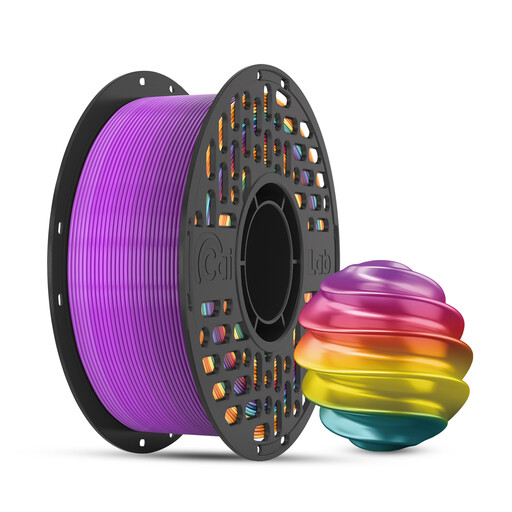
Creative exploration is as much about seeking the unexpected as it is about optimising the process. For designers and engineers who produce multiple iterations, a high-speed PLA is a major asset. Creality's Hyper PLA drastically reduces printing times without sacrificing the part's strength. At the other end of the spectrum is the play of colour. A rainbow filament, like CAILAB's Rainbow #10 gradient, turns every print into a unique experience, where the random chromatic shift creates objects that are impossible to replicate exactly. For even more striking effects, tri-colour filaments like the Gold, Silver, and Copper version intertwine hues for a finish that changes with the viewing angle, adding an almost poetic dimension to the final object.
For those wishing to explore a wider selection of creative materials, the complete catalogue of 3D printer filament is a true goldmine of inspiration.