
Livraison le jour même ou le lendemain

Qualité garantie

Débloquez vos offres de bienvenue: Livraison GRATUITE | Jusqu'à -80 % | 30 jours d'essai gratuits à JoyPlus
Téléchargez l'application
Choosing the right PLA filament can be overwhelming with so many options on the market. Between PLA+, matte, "Silk," and high-speed variants, it's hard to know where to start. Yet, whether you're a passionate maker, a prototyping pro, or an educator, finding the ideal consumable is the key to a successful 3D print.
As the Head of Product Recommendations at Joybuy, my mission is to guide you. This buyer's guide offers practical advice and a curated selection of PLA filaments for every need, all without the unnecessary marketing jargon.
To ensure your next 1 kg spool of PLA is perfectly suited for your printer and projects, here are the essential points to check.
The vast majority of consumer-grade 3D printers use FDM (Fused Deposition Modeling) technology. On these machines, the standard filament diameter is nearly universal: 1.75 mm. This is the first thing to check in your printer's specifications before any purchase. Using the wrong diameter will not only make the filament unusable but also risks clogging your extruder's nozzle.
PLA (Polylactic Acid) isn't a single material but a family of polymers with very different properties.
PLA is a hygroscopic material: it absorbs moisture from the air. A filament that has absorbed moisture can cause numerous problems: bubbling, crackling during extrusion, and a poor surface finish. Make sure your filament is delivered in a vacuum-sealed package with a desiccant packet. Once the spool is open, store your 1 kg spool of PLA in an airtight container to preserve all its properties.
Here are our recommendations, each tailored to a specific need.
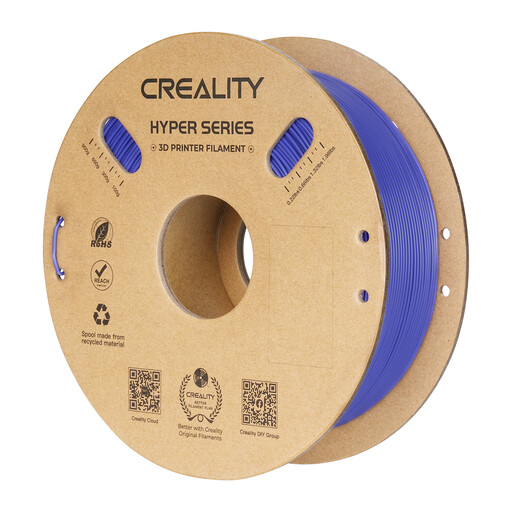
Why we love it This high-speed PLA from Creality is specially formulated to keep up with the blistering pace of the fastest 3D printers on the market. It allows you to drastically reduce print times without compromising on the part's strength and finish.
Highlights
Who is it for? For owners of high-speed 3D printers who want to optimize their production workflow, especially for rapid prototyping or small-batch production.
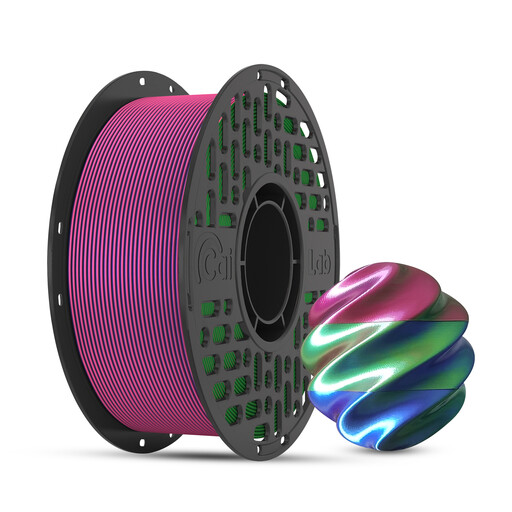
Why we love it This "Silk" filament stands out with its tri-colour extrusion (red, green, blue) that creates fascinating colour gradients depending on the viewing angle. Every print becomes a unique work of art.
Highlights
Who is it for? For creators, artists, and makers who want to produce decorative objects, toys, or gifts with an immediate visual impact.

Why we love it CaiLab's matte PLA offers a textured, non-reflective surface that gives prints a very sophisticated look. Its ability to hide layer lines is its main advantage for achieving a flawless result.
Highlights
Who is it for? Designers, architects, and model makers who demand a professional final result for their models. It's also an excellent choice for miniatures and art objects.
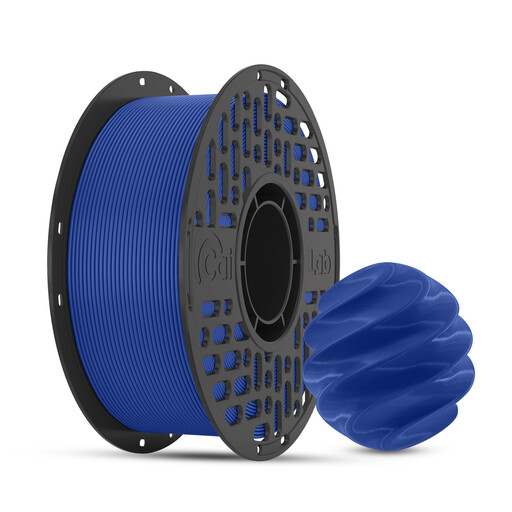
Why we love it This PLA+ filament is designed to offer better mechanical performance than standard PLA. It's stronger and less brittle, making it ideal for creating functional parts subject to moderate stress.
Highlights
Who is it for? For engineers, hobbyists, and makers who print functional parts: brackets, enclosures, simple gears, or repair tools.
Our selection highlights several options, most of which are blue PLA, a very popular colour for its versatility. If your project requires a specific shade—sky blue, navy blue, or electric blue—be aware that a multitude of choices exist.
? Discover our full range of blue PLA filaments to find the perfect spool for your next creation.
PLA+ is a modified version of PLA, to which manufacturers add additives to improve its mechanical properties. As a general rule, PLA+ is less brittle, more impact-resistant, and offers better inter-layer adhesion than standard PLA. It's an excellent compromise for parts that need to be more robust without switching to more technical materials like ABS or PETG.
PLA is sensitive to moisture. Once the vacuum-sealed bag is opened, it's crucial to store the spool in an airtight container (a plastic box with a seal, a large resealable bag, etc.). For optimal protection, add one or more silica gel (desiccant) packets inside to absorb any residual moisture. A well-stored filament guarantees high-quality prints and helps prevent nozzle clogs.
PLA filament is one of the most universal materials, compatible with the vast majority of FDM 3D printers. The only real criterion to check is the filament diameter, which must match what your machine accepts (usually 1.75 mm). Furthermore, since PLA does not require a heated bed, it's accessible even for the most basic 3D printers.