
Livraison le jour même ou le lendemain

Qualité garantie

Débloquez vos offres de bienvenue: Livraison GRATUITE | Jusqu'à -80 % | 30 jours d'essai gratuits à JoyPlus
Téléchargez l'application
Choosing the right PLA filament can quickly become a headache. Between the colours, special finishes, and lengthy spec sheets, finding the perfect spool for your project and 3D printer is crucial for the final quality of your creations. Our mission?? To help you see things more clearly. This guide offers our advice and our selection of the best filaments available today, all without the unnecessary marketing jargon.
Before diving into our selection, let's review the key criteria for choosing your 3D printing material.
Not all 3D printers are created equal when it comes to speed. If you own a recent, high-performance model, a high-speed PLA filament will drastically reduce your print times?—a major advantage for rapid prototyping or small-batch production. For more conventional printers, a standard PLA remains a reliable choice. Just remember to verify that the filament manufacturer's recommended speeds are compatible with your machine to avoid any risk of under-extrusion or a clogged nozzle.
PLA is no longer just about a basic, matte finish. Your projects deserve a material that makes them stand out?:
The vast majority of consumer FDM (Fused Deposition Modeling) 3D printers use a filament with a 1.75?mm diameter. It's the near-universal standard, but checking your machine's specifications is still essential?: some older or professional models require a 2.85?mm diameter. As for weight, the 1?kg PLA spool is the most common format, offering the best balance of quantity, price, and size.
Let's get down to business?: here are the PLA filaments that caught our eye, each suited for specific applications.
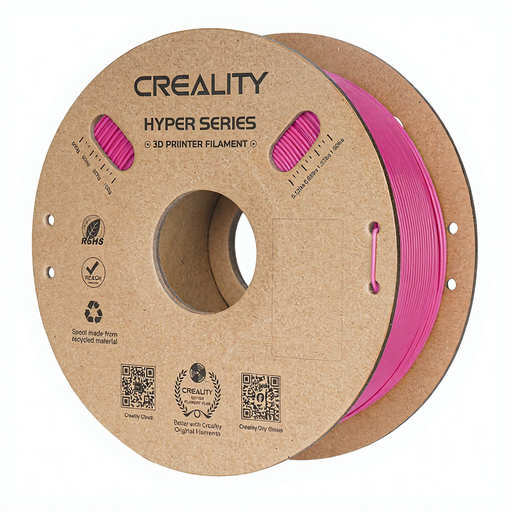
This filament is specially formulated for the fastest 3D printers. Creality makes its purpose clear?: it's optimised for speeds of up to 600?mm/s. Its dimensional accuracy of +/-?0.02?mm ensures consistent and reliable extrusion, even at top speed.
The ideal choice for owners of high-speed 3D printers who want to reduce their production times, whether for functional prototyping or small-batch manufacturing.
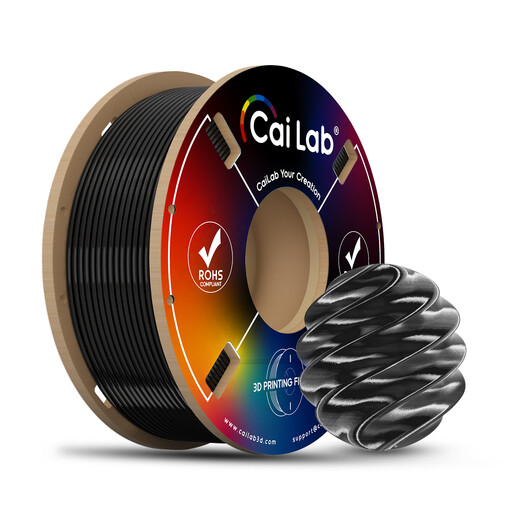
CAILAB's Silk PLA filament stands out with its ultra-glossy, satin-like finish. It catches the light in a way that enhances the curves and details of every model, delivering a look close to real silk. Its deep and intense midnight black colour is perfect for parts with a premium look.
It's aimed at creators, designers, and makers who want to produce objects with high visual impact. Ideal for vases, sculptures, jewellery, or any project where aesthetics take precedence over mechanical strength.
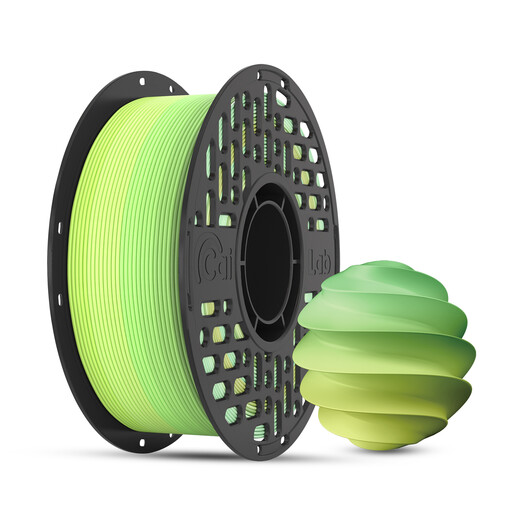
This Rainbow PLA filament offers a smooth, continuous colour transition along the entire length of the 1?kg spool. Every print is a surprise, revealing a unique gradient that varies with the size and shape of the object. It's the easiest way to get multicoloured parts without changing filaments.
The perfect filament for projects aimed at children, art pieces, personalised gifts, or for anyone looking to inject a dose of fun and originality into their 3D creations.
Our selection focuses on specific uses, but the world of 3D printing is much broader. Do you need other colours, more technical materials like PETG or ABS, or do you want to explore other PLA brands??
Explore our complete collection of filament spools to find the ideal material for your next project.
PLA (Polylactic Acid) is a bioplastic made from renewable resources (like corn starch). It is easier to print, doesn't always require a heated bed, and has a much more subtle odour. ABS (Acrylonitrile Butadiene Styrene), a petroleum derivative, is more resistant to heat and impact. In return, it is more technical to master (a heated bed is essential, risk of warping) and requires good room ventilation.
PLA is hygroscopic?: it absorbs moisture from the air. A filament that has absorbed moisture is the source of many printing problems (bubbles, popping sounds, poor layer adhesion). To preserve it, it's crucial to store your spools in an airtight bag or a sealed box with a desiccant packet (silica gel) whenever you are not using them.
No, it is imperative to use the filament diameter your 3D printer was designed for. While the vast majority of modern consumer printers use 1.75?mm PLA, some models (often older or professional ones) are calibrated for 2.85?mm. Using the wrong diameter will lead directly to a clogged nozzle and extrusion failures. When in doubt, a quick look at your machine's manual will save you a lot of trouble.