
Livraison le jour même ou le lendemain

Qualité garantie

Débloquez vos offres de bienvenue: Livraison GRATUITE | Jusqu'à -80 % | 30 jours d'essai gratuits à JoyPlus
Téléchargez l'application
Taking several medications, vitamins or dietary supplements requires a minimum of organisation. A poorly designed pill box can quickly make medication schedules more complicated: a lid that is difficult to open, compartments that are too small, labels that fade or a closure that comes undone inside your bag. Before buying a pill organiser, it is therefore worth looking beyond colour and marketing claims.
This guide reviews the key criteria to check and presents a selection of models suited to different uses in France: daily medication, weekly pill organisers, air travel or storing supplements such as fish oil capsules.
The actual capacity depends primarily on the size of the tablets and capsules. A pill box may be perfectly suitable for small capsules, then become difficult to fill with large vitamins or several fish oil capsules. Check the number of compartments, their layout and, where available, their dimensions.
A daily pill organiser with three or four compartments may be sufficient for a day involving only a few doses. If your medication schedule is more complex, a model separating “morning”, “midday”, “evening” and “bedtime” helps minimise the risk of mixing doses.
Inside a handbag or suitcase, closures are subjected to constant movement. A lid that opens too easily can cause tablets to spill out. Look for a snap closure that offers clear resistance, or even individual lids or a peripheral seal.
However, a water-resistant pill organiser, or one simply described as moisture-resistant, should not be considered completely waterproof unless the manufacturer provides precise information. When travelling, it is best to place the box inside a pouch, especially in rainy conditions or in a humid bathroom.
Day or dose-time indications are essential, particularly for older people and carers. Text that is too small or simple printed markings can become difficult to read over time. Engraved, high-contrast and sufficiently large labels are generally easier to consult.
A weekly pill organiser with seven compartments is suitable for preparing several days of medication, where the treatment allows it. Models with 21 or 28 compartments add several dosing times per day. For occasional use, a portable pill organiser with three, four or six compartments will be more discreet and easier to slip into a bag.
Do not automatically transfer all your medicines: some package leaflets require tablets to remain in their original packaging, protected from light or moisture. If in doubt, ask your pharmacist for advice, especially for sensitive medications.
People with arthritis may find small tabs difficult to handle. A push-button mechanism or a wider lid can make opening easier. Also check the hinge resistance: a lid that is too stiff becomes tiring to use every day, while one that closes too loosely provides less protection for the contents.
Polypropylene, ABS and polycarbonate are commonly used for portable medicine boxes. Some products specify BPA-free or food-grade plastic, but this does not mean that the container is intended to hold food. Clean the pill organiser according to the instructions, dry each compartment thoroughly and avoid using a dishwasher when the manufacturer advises against it.
An integrated tablet cutter can be useful for splitting certain tablets, but it is not suitable for every pharmaceutical formulation. Never split a medicine without checking the package leaflet or asking a healthcare professional.
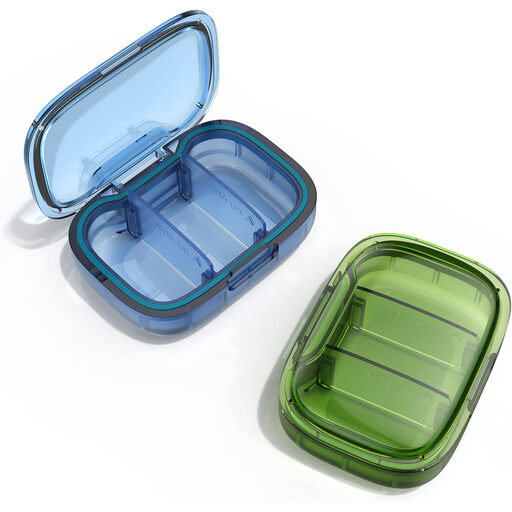
Why this choice suits the profile: Its compact format slips easily into a pocket, bag or toiletry case for short trips and straightforward medication schedules.
Three separate compartments help distinguish doses without the need to carry a large medicine box.
The two-pack lets you keep one box at home and another in a bag. The description mentions protection against moisture.
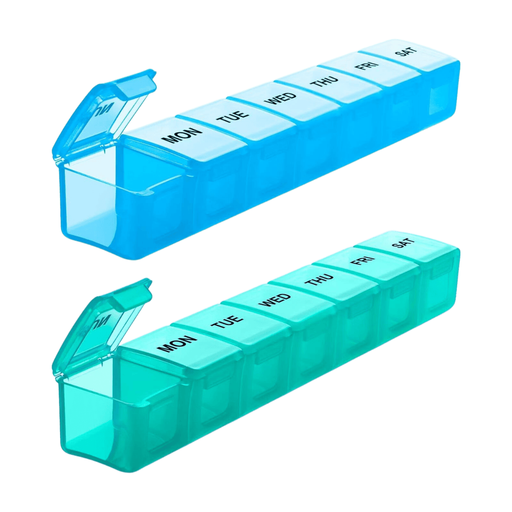
Why this choice suits the profile: The generous compartments are suitable for people who take several vitamins, supplements or large capsules throughout the week.
The advertised compartment width means you do not have to cram tablets into a small daily pill organiser.
The product is sold as a two-pack and has seven compartments, with snap lids and a design described as moisture-resistant.
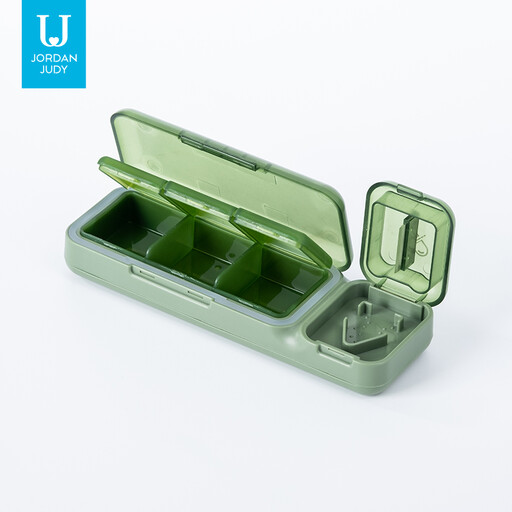
Why this choice suits the profile: Its advertised dimensions of 13.8 × 4.5 × 2.4 cm make it suitable for daily commutes and compact luggage.
The snap-shut lid helps prevent spills, while the compact format avoids the bulk of an oversized medicine box.
A stainless-steel tablet cutter is integrated into the design. Keep the blade away from fingers and children; its use depends on the shape of the tablet.
We have brought together an up-to-date selection of medicine organisers, pill boxes and portable pill organisers for different uses in France.
Seven compartments are sufficient for one daily dose. If you need to spread your medication across several times of day, choose a model with 14, 21 or 28 compartments. Your choice also depends on the volume of the tablets and whether you need to separate different dosing times.
Not always. Some medicines must remain in their original packaging to protect them from light or moisture, or to retain traceability information. Ask your pharmacist for confirmation before transferring medication into a medicine box.
Replace it if a lid no longer closes properly, a hinge is cracked, the markings become illegible or the compartments retain an odour or residue despite cleaning. Its service life depends on the materials, how frequently it is handled and the conditions in which it is transported.