
Livraison le jour même ou le lendemain

Qualité garantie

Débloquez vos offres de bienvenue: Livraison GRATUITE | Jusqu'à -80 % | 30 jours d'essai gratuits à JoyPlus
Téléchargez l'application
Splitting a tablet sounds simple… until half of it crumbles, the medicine slips or the blade becomes awkward to handle. For adults following regular treatment, older people, carers or anyone travelling with medication, the right pill cutter makes the process easier and helps prevent wasted doses.
However, not all manufacturers’ claims are equal. Compatibility, stability, safety and maintenance are the key criteria to consider before buying, followed by a selection suited to different needs.
Not all tablets have the same diameter or shape. A tablet splitter that is too wide will allow a small tablet to move, while a model that is too narrow will not accommodate larger formats.
Look for an adjustable guide, a V-shaped slot or clear information about compatible dimensions. For small tablets, this information is far more useful than a vague “universal” claim.
A visible blade increases the risk of accidentally cutting yourself. Residue can also build up in corners and mix with the next tablet.
It is better to choose a pill cutter with a protected or concealed blade. Afterwards, clean the inside with a dry or slightly damp cloth, following the manufacturer’s recommendations. Always allow the accessory to dry completely before storing it.
A pill cutter that can split tablets in half or into quarters can be useful. However, whether a medicine can be divided depends on its form and the prescription. Some prolonged-release, gastro-resistant or coated tablets must not be altered. Others may only be split under specific conditions.
Before using a pill cutter, ask your doctor or pharmacist for advice. Never cut a gelatine capsule, capsule or tablet if the instructions advise against splitting it.
For a clean cut, the tablet must remain completely still while pressure is applied. A V-shaped design, side guides or non-slip strips can help keep it in place. An adjustable model is particularly useful if several tablet sizes are used in the household.
For tiny tablets, look for a design specifically intended for this purpose. A model advertised for dimensions between 3 and 12 mm, for example, provides much more practical guidance than a simple claim of versatility.
A pill cutter is not a substitute for a medical dosage device. The amount taken must always match the prescription.
A stainless-steel blade is used in most models in this category. The casing is generally made from ABS plastic, PP or another synthetic material. For everyday use, check the strength of the hinge, how securely the lid closes and how stable the accessory is on the table.
Cleaning with a cloth is often the simplest solution. Some models are not dishwasher-safe : check the instructions supplied. In all cases, store the blade out of children’s reach.
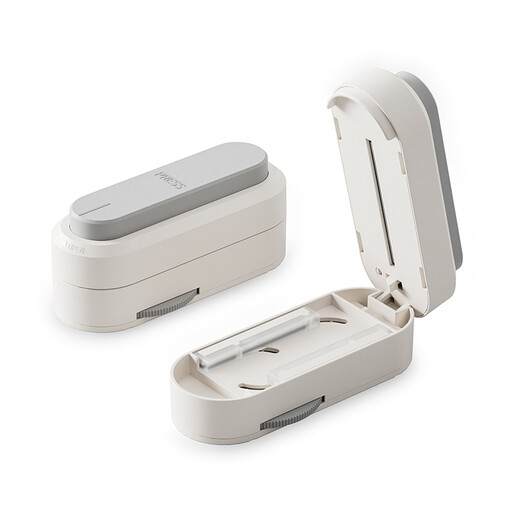
Why this choice suits this profile : This model is well suited to first-time users and lets you choose between splitting tablets in half or into quarters. Measuring 10.5 × 4.6 × 4.5 cm, it slips easily into a wash bag or handbag.
The V-shaped blade helps hold the tablet in place, while the lid protects the cutting area during use.
Splits tablets in half or into quarters, stainless-steel blade, ABS and silicone components, manual cleaning recommended.
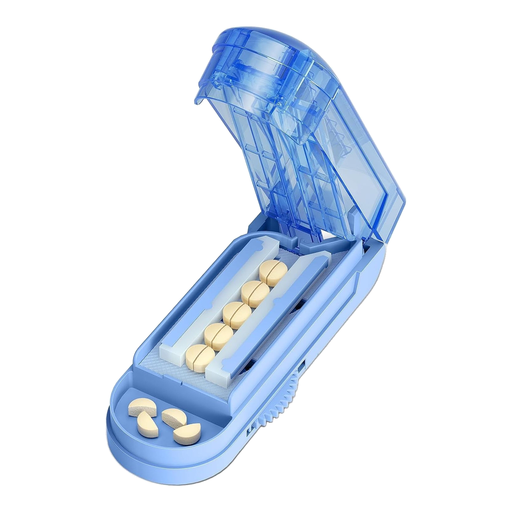
Why this choice suits this profile : Its adjustable design is ideal for users who want to fine-tune the grip for tablets of different sizes, including the smallest formats.
The concealed blade reduces the risk of contact during use, while the adjustable guides stop the tablet from moving.
Concealed stainless-steel blade, adjustment for several tablet sizes, non-slip silicone strips and retractable guard.
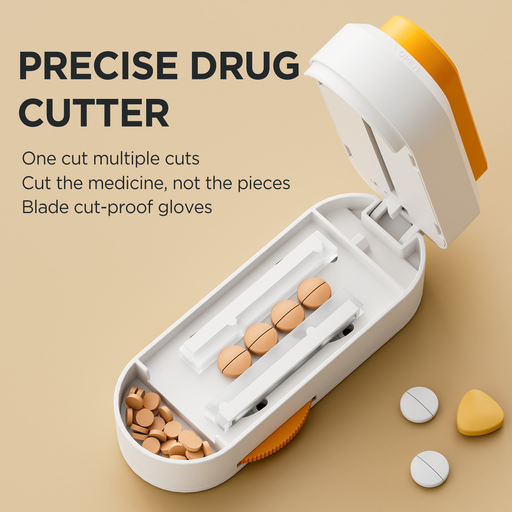
Why this choice suits this profile : The vertical pressure and adjustment for several sizes may suit a household that regularly prepares similar tablets.
The blade guard and supplied brush address the storage and residue problems often encountered with an accessory used frequently.
Adjustment for small, large and tiny tablets, vertical pressure, protected blade and cleaning brush included.
To achieve a more even cut, always follow the same method :
If you use a pill organiser with a pill cutter, fill the compartments after cutting and clearly label the days or times when the medicine should be taken. Avoid mixing several medicines in the cutting compartment.
No. Gelatine capsules, capsules and certain modified-release tablets or tablets with a special coating must not be cut without specific guidance. The instructions and your pharmacist are the first sources of advice to consult.
Remove fragments after each use. Depending on the product, use a dry cloth or gently wash it by hand. Dry the blade and the inside thoroughly before closing the casing. Avoid using a dishwasher unless this is explicitly permitted.
This depends on how often it is used, the hardness of the tablets and how well it is maintained. Replace the pill cutter if the blade becomes blunt, the lid no longer closes properly, the tablet slips or the casing develops cracks.