People organising a picnic to share
A larger bottle may suit a group, as long as you plan what to do with any juice left after opening.


For a summer picnic, first choose a drink type and bottle size that suit sharing, then check the storage instructions and the venue’s rules on glass. Pure juice, juice made from concentrate and nectar are different categories. Check the product description, ingredients and sugars per 100 ml rather than relying on the bottle’s appearance alone.
A larger bottle may suit a group, as long as you plan what to do with any juice left after opening.
The product description distinguishes between juice and nectar, among other things. To compare two drinks, also check the ingredients and the ‘of which sugars’ figure per 100 ml.
The bottle needs to be protected from knocks in transit and permitted at your picnic venue. You’ll also need to take it home afterwards for recycling.
First, check that glass bottles are allowed at your chosen venue. Then compare the ingredients, bottle size and instructions for after opening.
| What to consider | What to check | Who is it for? |
|---|---|---|
| Ingredients and sugars | Read the product description and ingredients, then compare the ‘of which sugars’ figure per 100 ml. The DGCCRF distinguishes between the descriptions used for juices and nectars; a product’s description alone doesn’t tell you its sugar content. | If I’m looking for a particular recipe, I want to be able to distinguish it from a nectar without assuming that pure juice is low in sugars. Around 42% of consumers would put this first. |
| Transporting glass | Check that the bottle is made of glass and find out about the venue’s rules. Make sure it’s secured for the journey. | If I’m walking or cycling, I need to be able to carry the bottle without exposing it to knocks and know whether it’ll be allowed at the venue. Around 33% of consumers would put this first. |
| Bottle size and leftovers | Compare the net contents with the number of people, and read the refrigeration and after-opening instructions. | If the group doesn’t finish the bottle, I want to be able to store what’s left as directed on the label. Around 25% of consumers would put this first. |
The description tells you what the product is, not how its sugar content compares with a different recipe. To compare two bottles, use the same nutritional basis.
Read the product description, ingredients and the ‘of which sugars’ figure per 100 ml.
The bottle could be knocked during transport, and whether it’s allowed depends on the venue or event rules.
Check before you go and secure the bottle away from hard objects. If glass isn’t allowed, choose another type of packaging.
Instructions vary by product: Auchan’s product pages state three days for Thomas Le Prince pure apple and pear juice and five days for the Auchan Bio juices mentioned here.
Choose a bottle size that suits your group, then follow the refrigeration instructions and use-by period on the bottle you buy.
A bottle that can’t be finished or stored as directed risks going to waste.
Choosing glass also means planning to take the bottle home after use. ADEME advises putting glass packaging in a glass recycling bank.
Take the empty bottle with you and put it in the appropriate recycling stream.
Auchan’s product pages feature two 1 L organic pure juices in glass bottles: a mixed fruit juice and an orchard fruit juice.
Auchan’s product page describes a 1 L bottle of organic pure apple and pear juice, made with 70% organic apple and 30% organic pear.
Auchan’s product page lists a 75 cl glass bottle of pineapple juice made from concentrate.
This 1 L bottle of pineapple nectar is a glass-bottled fruity drink to share. If you’re specifically looking for pure juice, check the category before choosing.
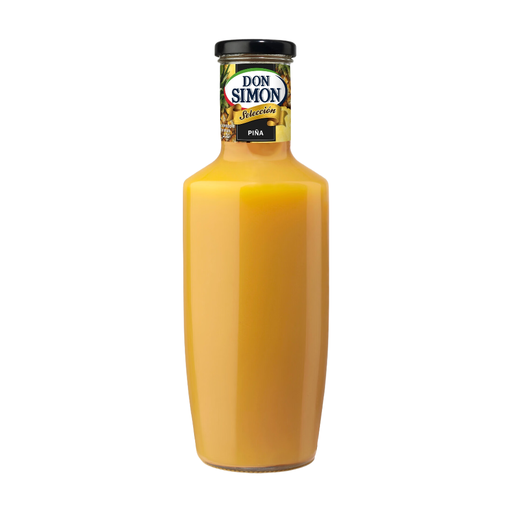 Image unavailable
Worth considering if you’d like to share pineapple nectar in a glass bottle. This is nectar, not pure juice, so check the venue’s rules on glass before taking it with you.
Check the product description on the packaging: these terms refer to different categories. The DGCCRF explains that the descriptions used for juices and nectars are governed by specific definitions. Check the ingredients too to find out what’s in the product you’re considering.
No. You still need to compare the ‘of which sugars’ figure per 100 ml. This gives you a consistent basis for comparing the nutritional values of two drinks, without confusing their product descriptions or bottle sizes.
Follow the storage instructions on the bottle you bought, including refrigeration and how long it can be kept after opening. Auchan’s product pages state three days for Thomas Le Prince pure apple and pear juice and five days for the Auchan Bio products mentioned here; these time limits don’t apply to all juices.
Take it home and put it in a glass recycling bank: this is the route ADEME recommends for glass packaging. Plan to take it to a collection point rather than leaving it at the picnic venue.