
Livraison le jour même ou le lendemain

Qualité garantie

Débloquez vos offres de bienvenue: Livraison GRATUITE | Jusqu'à -80 % | 30 jours d'essai gratuits à JoyPlus
Téléchargez l'application
Looking for a pickleball set to play with your family, practise indoors or introduce your friends to the sport? At first glance, the different kits often look very similar. In reality, their contents and intended uses can vary considerably. A set with two paddles and four balls does not meet the same needs as a 4-paddle pickleball set designed for the whole family.
Before placing your order, pay close attention to the type of balls included, the paddle weight and the accessories actually supplied. These simple checks can help you avoid buying equipment that is poorly suited to your court, skill level or playing frequency.
Pickleball balls are not interchangeable in every situation. Indoor pickleball balls are generally designed for the even surfaces found in gyms and community sports halls. Outdoor models need to withstand wind, changing temperatures and more abrasive playing surfaces.
A kit marketed as versatile may include only two balls of each type. That is enough for a first trial, but quite limited if you play regularly: balls are often the first accessories that need replacing.
A lightweight paddle is easy to handle, but it will not necessarily suit every playing style. Conversely, a heavier model may provide a more satisfying feel on impact and greater stability. Weight should therefore be considered alongside grip shape, overall balance and the surface material.
The specifications for the models featured here indicate a weight of approximately 216 to 227 g per paddle for several fibreglass sets. This is a tangible detail—far more informative than a generic promise of comfort.
A pickleball set with a carry bag can be extremely useful if you walk, cycle or drive to different courts. However, check what it can actually hold: some bags are designed for paddles only, while others also include a mesh pocket for balls, a water bottle or a towel.
Fibreglass pickleball paddles offer an appealing balance between low weight and surface flexibility. Several NIUPIPO models combine this surface with a polypropylene honeycomb core. According to the manufacturer, this construction is intended to improve stability and reduce impact noise.
For beginners, a sufficiently wide hitting surface can also make those first rallies easier. Some models measure up to approximately 393 × 198 mm.
A grip with a 4.25-inch circumference, or approximately 10.8 cm, should be considered in relation to the size of your hand. If it is too wide, it may feel uncomfortable; if it is too narrow, it may lack stability.
Pickleball paddles for beginners generally feature a non-slip handle. The product descriptions also mention a coating designed to help limit moisture around the grip. This describes a material feature, but naturally does not guarantee that your hand will remain fatigue-free after a long match.
The NIUPIPO balls featured here measure 74 mm in diameter. Indoor models are listed at between 23 and 26 g, while the 12-ball outdoor pack specifies 26.5 g per ball. Take a moment to check the intended use of each ball before you start playing.
To explore other formats and refill options, visit the pickleball balls category.
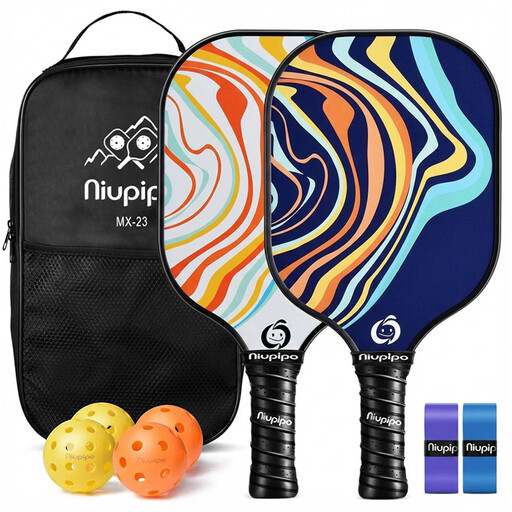
Why choose it: A well-suited format for two players who want to get started at home, in a sports hall or on an outdoor court.
The kit contains two indoor balls and two outdoor balls, making their intended use immediately clear.
Fibreglass paddles, a polypropylene honeycomb core, a listed weight of 216 to 227 g and an included backpack.
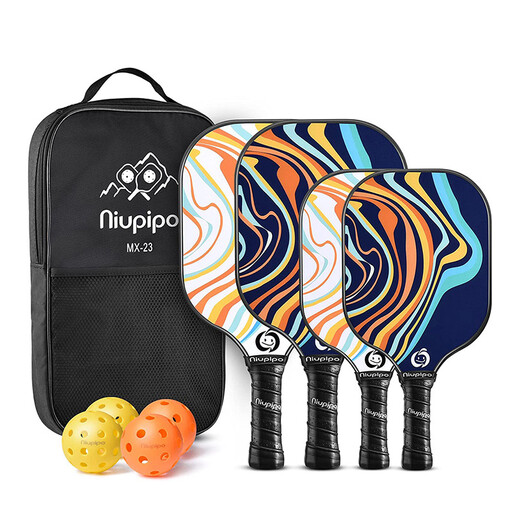
Why choose it: The set distinguishes between adult and children’s paddles, with a listed weight of 216 g for the former and 180 g for the latter.
There is no need to purchase four similarly sized paddles separately when playing with children.
The set includes 4 paddles, 2 indoor balls, 2 outdoor balls and a carry bag.
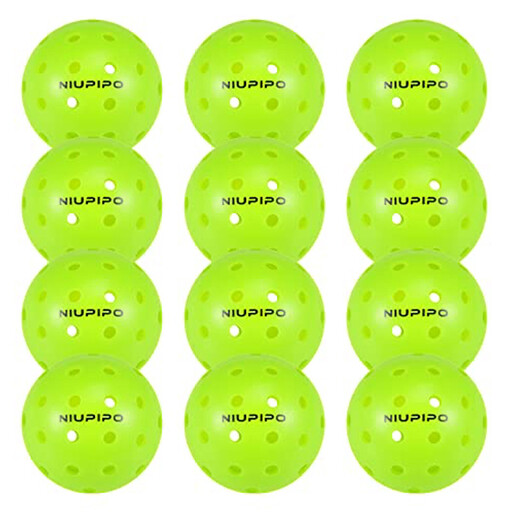
Why choose it: A generous supply for group training sessions, clubs or regular games in the park.
The pack means you are not limited to four balls during training: it supplies 12, designed for outdoor play.
Balls listed as PE, with a diameter of 74 mm, a weight of 26.5 g and 40 holes per ball according to the manufacturer’s specifications.
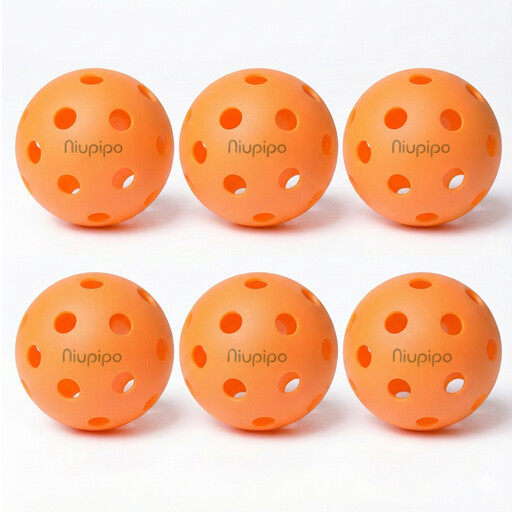
Why choose it: An ideal addition if you already own paddles and mainly play in a gym or sports hall.
The product is clearly intended for indoor use, so it cannot be mistaken for an outdoor ball.
We have brought together an up-to-date selection of products suited to different pickleball uses, formats and needs.
Store paddles and balls in a dry place, away from direct sunlight and excessive heat. After each game, wipe the surfaces with a dry cloth. Manufacturer specifications recommend avoiding alcohol and chemical solvents.
Outdoor balls may wear more quickly on rough ground or after repeated impacts. To extend the time between replacements, keep a few spares on hand and regularly check for cracks, dents or reduced bounce.
Some of the products featured come with a one-year limited warranty covering certain quality defects under normal conditions of use. Review the terms applicable to your chosen model before purchasing.
A 2-paddle pickleball set supplied with indoor and outdoor balls is ideal for trying different playing surfaces without purchasing each accessory separately. Even so, check the paddle weight, grip size and whether a bag is included.
For occasional play, four balls may be sufficient. For a family, training sessions or multi-player games, a pack of 6 or 12 balls will be considerably more practical. In every case, choose balls suited to the playing surface.
NIUPIPO presents certain models as USAPA-approved pickleball paddles. This claim should be checked on the product page and then confirmed with the competition organiser, as rules and lists of permitted equipment may change. For recreational play, weight, handling and kit contents generally remain the most practical criteria.