
Livraison le jour même ou le lendemain

Qualité garantie

Débloquez vos offres de bienvenue: Livraison GRATUITE | Jusqu'à -80 % | 30 jours d'essai gratuits à JoyPlus
Téléchargez l'application
Whether you want to perfect your selfies, go viral on TikTok, or simply look your best on video calls, lighting quality makes all the difference. The phone ring light has emerged as the go-to solution: it's simple, affordable, and effective. The problem is, the market is flooded with models making tempting promises that often hide deal-breaking flaws. To avoid ending up with a gadget that will just gather dust in a drawer, it's crucial to know how to avoid the most common pitfalls.
As the Head of Buying Guides at Joybuy, my mission is to help you see things more clearly. We'll break down the three main pitfalls to avoid and the criteria that truly matter for choosing a light that meets your expectations.
Too many users complain about accessories that end up in a drawer after just a few weeks. The cause? Three recurring flaws that turn a bargain into a disappointment.
To make an informed choice, focus on these key technical specifications. They are the true guarantors of a quality phone fill light.
A good smartphone ring light must offer maximum flexibility. The ability to adjust both the intensity and the temperature (or "warmth") of the light is essential for adapting to any environment.
This is THE most overlooked technical spec, yet it's the most important for image quality. The CRI measures a light source's ability to faithfully reproduce the colours of an object compared to natural light.
The everyday practicality of a rechargeable ring light depends on its mounting system and battery.
Every user has different needs. Here are a few models that stand out for their design, cater to specific user profiles, and avoid the pitfalls we've just discussed.
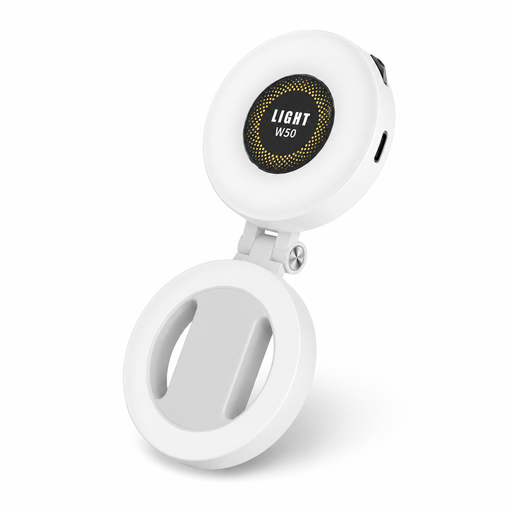
Why we love it: Built for mobility, this is the perfect accessory for TikTok or Instagram creators. Its magnetic mount is instant on MagSafe-compatible devices and universal thanks to the included adapter. The integrated mirror is a handy little extra for a quick makeup touch-up between takes.
It bypasses the flimsy mount problem with its reliable magnetic system. Its CRI of 95+ guarantees natural colours, thus avoiding the trap of washed-out skin tones.
3-in-1 versatility (light, mirror, stand) and 360° rotation to switch between selfie lighting and ambient lighting.
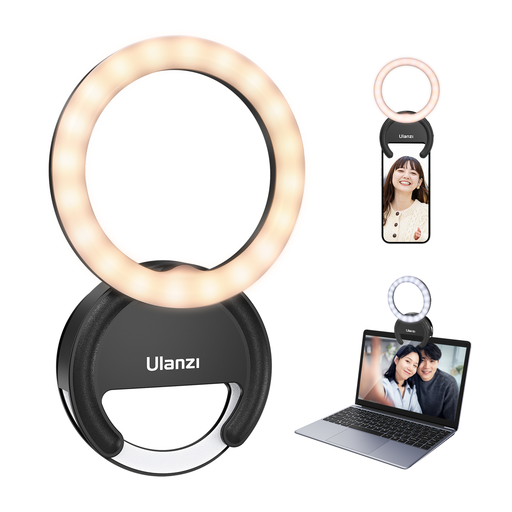
Why we love it: The perfect companion for your calls on Zoom, Teams, or Meet. Its clip is designed to attach securely to a laptop screen or monitor. Its wide range of colour temperatures allows you to adapt to the ambient lighting of your office or home for a consistently professional image.
Its robust, padded clip system is specifically adapted for screens, avoiding the pitfall of an unsuitable mount. The 5 brightness levels ensure you won't run out of battery mid-meeting.
Total control over the light, with a very wide colour temperature range (3000 K to 7000 K) and 5 intensity levels.
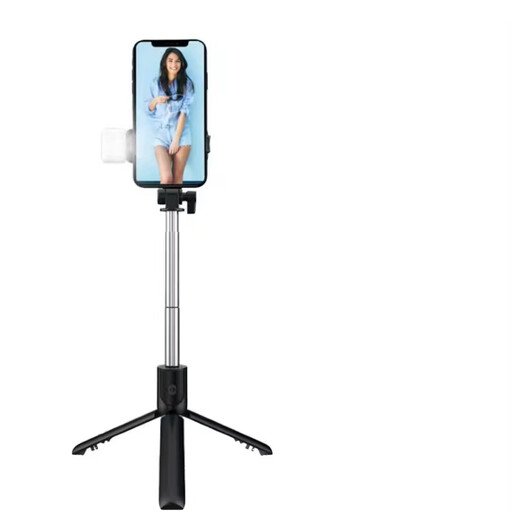
Why we love it: This is the Swiss Army knife for content creators, ideal for beginners or for maximum versatility. It combines a selfie stick, a stable tripod, and a fill light. Perfect for varying your shots: vlogs on the move, static shots, group photos, etc.
By integrating the light into a complete system, it bypasses the problem of a precarious mount. No more juggling multiple accessories: the phone holder is integrated with the stick and tripod.
The all-in-one kit with a telescopic stick up to 1m, tripod function, and a Bluetooth remote for distance control.
We have compiled a complete and up-to-date selection of products that meet our demanding selection criteria and current safety standards.
The lifespan depends on two factors: the battery and the LEDs. For the battery, its longevity is measured in charge cycles (usually several hundred). Its runtime per charge, however, should be judged at full power; a good model offers between 45 and 90 minutes. As for the LEDs, their lifespan is very long (several thousand hours) and they rarely fail.
The risk is real with entry-level models that have hard plastic clips without protection. To avoid any damage, opt for models where the clip is covered with soft silicone or rubber pads. Magnetic models are an excellent alternative as they exert no pressure on the screen.
Although it's less critical than for professional photography, a high CRI (above 90) really makes a difference. It ensures more faithful colour rendering and a more natural skin tone, which contributes to a more polished and professional image during video conference lighting. It's this detail that elevates your image from "simply lit" to truly high-quality.