
Same-day & Next-day Delivery

Quality Guaranteed

Unlock Your Welcome Offers: FREE Delivery | Up to 80% OFF | Free 30-day JoyPlus trial
Download the APP
A PFOA-free, non-stick induction frying pan can make preparing eggs, vegetables, pancakes or meat much easier. However, some product listings blur the distinction between granite-effect coatings, ceramic coatings, PFOA-free products and PFAS-free products. The pan’s material alone is not enough to guarantee satisfactory use on an induction hob.
Before buying a frying pan, a sauté pan with a lid or a non-stick cookware set, three points deserve careful consideration.
PFOA belongs to the PFAS family, but the claim “PFOA-free” does not automatically mean that a product is free from all PFAS or PTFE. Look for more precise information in the technical specifications, and check for any “PFAS-free” and “PTFE-free” claims too.
Some formulations specify only the absence of intentionally added substances. This distinction should be taken literally: it does not necessarily constitute a general certification covering every substance present.
A granite non-stick frying pan generally has a composite coating with a stone-like appearance. The term “granite” mainly describes the look or commercial category of the coating, rather than indicating a pan made entirely from stone. So check the material of the body, which is often cast aluminium, as well as the stated composition of the coating.
Even a non-stick coating designed to make cleaning easier can be damaged by heating an empty pan, using metal utensils or scrubbing with an abrasive sponge. An easy-to-clean pan still requires you to follow the manufacturer’s care recommendations. Dishwasher compatibility can also vary between models within the same range.
For a frying pan compatible with induction, look for a base containing a ferromagnetic material, usually a disc or base made from magnetic stainless steel. A pan described as suitable for all hobs should specify compatibility with induction, gas, electric, ceramic or halogen hobs.
The base must be flat enough to ensure good heat transfer. A simple magnet test can provide an initial indication, but the manufacturer’s product information remains the definitive source for confirming the stated compatibility.
A 20 to 26 cm frying pan is suitable for individual portions and everyday cooking. For a family, a diameter of 28 to 32 cm or a deep sauté pan provides more capacity. A glass lid allows you to monitor cooking while also being useful for simmered dishes.
A set of non-stick frying pans can be a practical choice if you need several diameters. Conversely, an oversized cookware set may take up unnecessary cupboard space. Also remember to check the weight, whether the pan has rivets, the type of handle and the maximum oven-safe temperature.
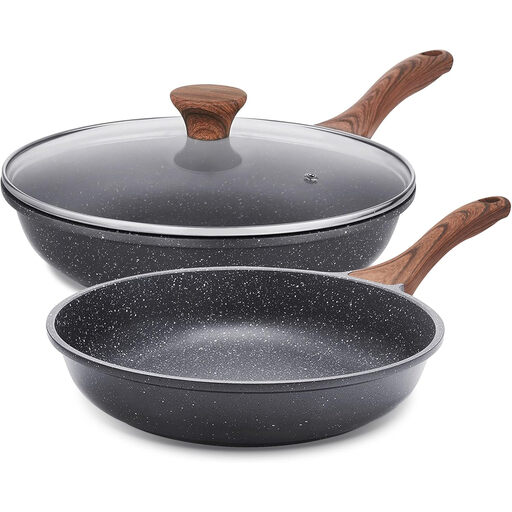
Why this choice suits this profile: The pair of 20 and 28 cm frying pans, with a lid for the larger model, covers everyday cooking needs without adding unnecessary utensils. The product information states that the base is compatible with induction, gas and electric hobs.
The listing specifies that no PFOA has been intentionally added and details compatibility with different hob types, rather than relying on a vague general claim.
Two diameters, a glass lid, Bakelite handles and stated dishwasher-safe cleaning.
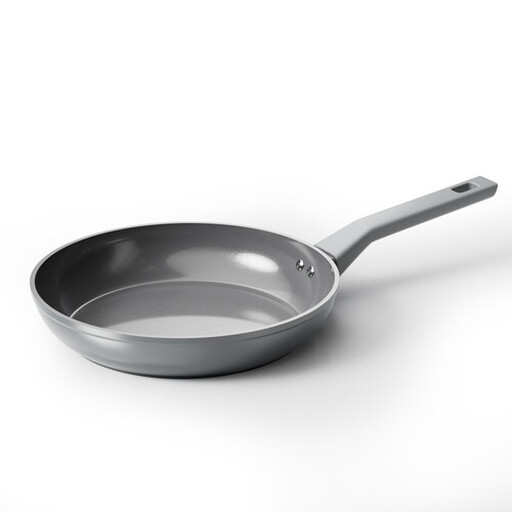
Why this choice suits this profile: This model features a multi-layer construction combining ceramic, aluminium and stainless steel. Its product information states that it is free from PFAS, PFOA and PTFE.
The stated composition details the different layers and does not rely solely on the commercial term “non-stick”.
26 cm diameter, stated compatibility with all hob types, Bakelite handle and dishwasher-safe care according to the listing.
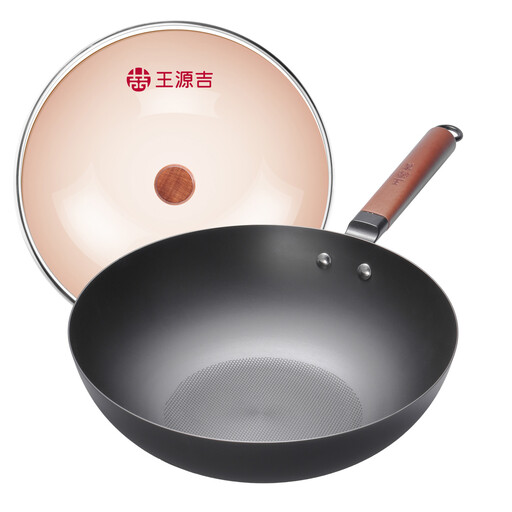
Why this choice suits this profile: This flat-bottomed wok is stated to be compatible with induction, gas and electric hobs. It is ideal for stir-frying, provided you are prepared for slightly more demanding care.
It is advertised as uncoated, helping to distinguish a non-stick layer from natural seasoning. In return, initial seasoning and oil-based maintenance are essential.
Stated weight of 1.1 kg, flat base, glass lid and no coating.
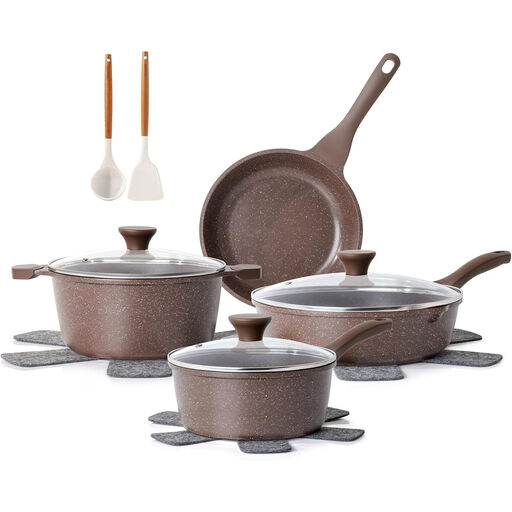
Why this choice suits this profile: This set includes frying pans, saucepans, lids, silicone utensils and pan protectors. It is ideal for households looking to create a coordinated cookware collection.
The listing specifies compatibility with induction, gas and electric hobs, as well as the stated absence of PFOA, PFOS, lead and cadmium. It also recommends hand washing.
13 pieces, handles stated to stay cool during cooking and storage accessories included.
We have put together a complete, real-time updated selection of products that fully meet these strict selection criteria and European safety regulations.
No. PFOA is one particular type of PFAS. The claim “PFOA-free” alone does not prove that a product is free from all PFAS. If you are looking for a PFAS-free ceramic frying pan, check for an explicit statement covering the entire family and review the conditions of the manufacturer’s declaration.
A diameter of 24 to 28 cm is generally suitable for two or three portions. For four people or dishes containing lots of vegetables, a 28 to 32 cm frying pan or a deep sauté pan will provide more space. Also remember to measure your induction hob’s cooking zone to minimise differences in heating.
Its lifespan depends on how often it is used, the temperature, cleaning methods and the utensils used. A coating that is scratched, blistered or no longer allows food to release properly is a sign that the pan should be replaced. To extend its useful life, use moderate heat, avoid abrasive products and store pans with protectors.