
Livraison le jour même ou le lendemain

Qualité garantie

Débloquez vos offres de bienvenue: Livraison GRATUITE | Jusqu'à -80 % | 30 jours d'essai gratuits à JoyPlus
Téléchargez l'application
Healthy eating starts with the right equipment. Amid ongoing concerns about traditional non-stick coatings, the PFOA-free ceramic pan has emerged as the premium alternative. The only issue? The market is so vast it's easy to feel overwhelmed.
This guide is here to shed some light and give you the keys to making the right choice. At Joybuy, our mission is to decode the technical specs for you, helping you find the cookware that will fit seamlessly into your daily cooking routine.
Before diving into our selection, let's review the key factors that will guide your decision.
PFOA is a chemical compound that was long used in the manufacturing of certain non-stick coatings, including the famous Teflon (PTFE). Rest assured, most reputable manufacturers have now banned PFOA from their production lines. The "PFOA-free" label therefore certifies that this substance was not intentionally added during manufacturing.
PFAS, which refer to a much broader family of substances, also raise health concerns. Choosing PFAS-free cookware has thus become an essential criterion for many consumers searching for a healthy non-stick pan. The good news: ceramic coatings, derived from sand-based materials, are naturally free of these compounds.
The ideal pan is one that adapts to your equipment and cooking habits.
A ceramic pan's performance rests on two pillars: the quality of its coating and the structure of its base. A thick base, made of aluminium or stainless steel, ensures even heat distribution and prevents hot spots that can char your food. Some hybrid models even combine a stainless steel surface with ceramic pockets. The goal? To merge the searing power of stainless steel with the non-stick convenience of ceramic.
We have selected a few models that stand out from the crowd, each designed for different needs and uses.
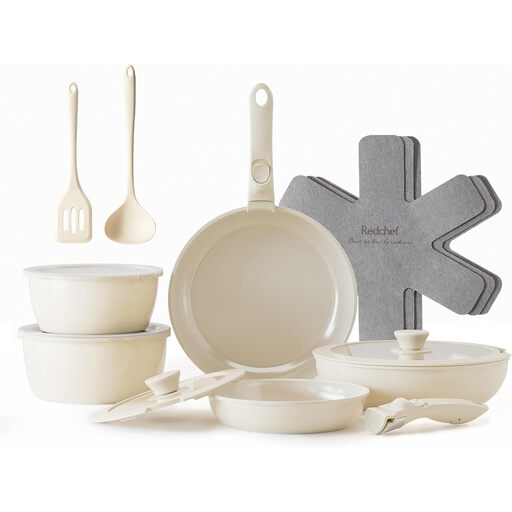
Why it stands out: This 16-piece set is all about versatility and space-saving. Thanks to its detachable handle system, the pots and pans stack perfectly. The manufacturer promises up to 75% space savings in your cupboards.
Highlights:
Who is it for? For families, those moving into their first flat, or anyone short on space (small kitchen, studio, camper van) looking for a complete and clever solution.
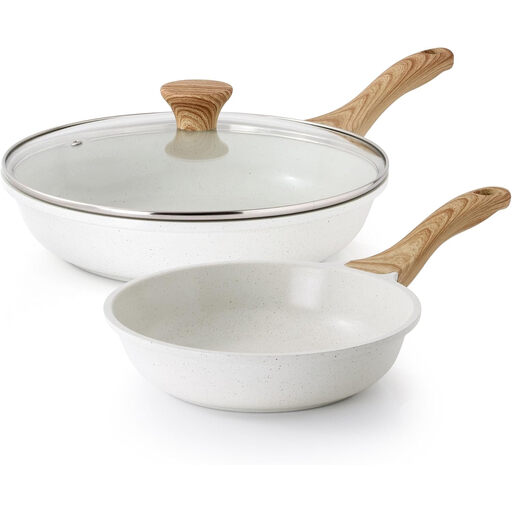
Why it stands out: This set of two pans (20 cm and 28 cm with lid) gets straight to the point. With its simple and effective design, it's the perfect duo for everyday cooking, from morning omelettes to evening stir-fries.
Highlights:
Who is it for? Ideal for couples, students, or anyone looking for a reliable and versatile pair of pans for daily use.
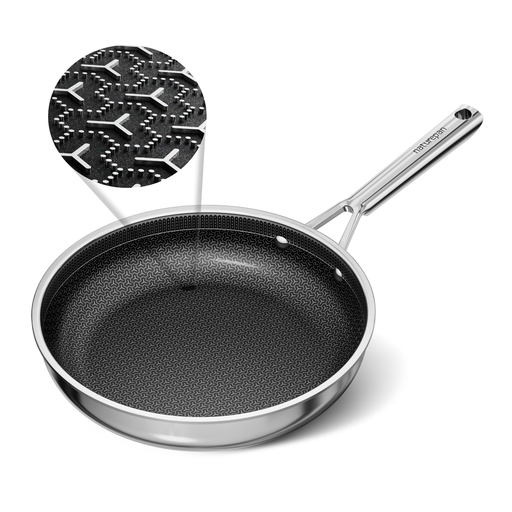
Why it stands out: This pan features an innovative hybrid concept. Its surface combines a raised hexagonal stainless steel pattern with a non-stick ceramic coating in the valleys. The idea? To offer the best of both worlds: the perfect sear of stainless steel for meats and the easy-to-clean convenience of ceramic.
Highlights:
Who is it for? For discerning cooks who love to sear a steak, duck breast, or salmon fillet, without sacrificing the convenience of non-stick for more delicate foods (eggs, fish...).
This selection has showcased models with distinct profiles. If you're looking for other sizes, materials, or designs, feel free to browse our full catalogue to find the perfect pan for you.
Discover Our Full Range of Ceramic Pans
1. What is the difference between a ceramic coating and Teflon (PTFE)? Ceramic coating is created using a "sol-gel" process that uses minerals (primarily sand) to form a glass-like, vitrified layer similar to a varnish. PTFE (polytetrafluoroethylene), better known by its trade name Teflon, is a synthetic polymer (a plastic). Although both offer excellent non-stick properties, their composition and manufacturing processes are fundamentally different.
2. How do I care for my ceramic pan to make it last longer? To preserve its coating, always use wooden, silicone, or nylon utensils. Avoid metal, which can scratch the surface. Always let the pan cool down before cleaning it. Even if it's dishwasher-safe, hand washing with a soft sponge will significantly extend its lifespan. Finally, never heat it empty at full power.
3. Is a ceramic pan automatically compatible with induction? No. Induction compatibility doesn't depend on the coating, but on the material of the pan's base. For a pan to work on an induction hob, its base must contain a ferromagnetic material (one that a magnet will stick to). Always look for the spiral-shaped icon or the "All hobs including induction" label on the packaging or product description.