
Livraison le jour même ou le lendemain

Qualité garantie

Débloquez vos offres de bienvenue: Livraison GRATUITE | Jusqu'à -80 % | 30 jours d'essai gratuits à JoyPlus
Téléchargez l'application
Choosing a new frying pan? It can be a real headache given the jungle of options and sometimes contradictory claims. More and more of you are looking for a PFAS-free non-stick pan to combine the joy of cooking with peace of mind. And for good reason: the quest for healthy, PFOA-free cooking, without other perfluorinated compounds, is a top concern.
I'm the Head of Product Recommendations at Joybuy. My role? To help you see things more clearly with practical advice and a selection of relevant products, free from over-the-top marketing hype. This guide is designed to break down the essential features and introduce you to pans suited for every need.
Before we get to our selection, let's review the key points for finding the pan that will perfectly fit your habits.
The ceramic pan is the most common alternative to traditional coatings with PFAS. Made from a sand-based material (silicon), these coatings provide excellent non-stick performance without perfluorinated compounds. The highest-performing ones are reinforced with titanium or diamond particles for enhanced durability.
Another option is the stone-effect coated pan, which also relies on a mineral base for its robustness and non-stick properties. Finally, hybrid models of non-stick stainless steel pans combine the durability and searing power of stainless steel with non-stick zones. This is often a very smart compromise.
A good pan should adapt to your equipment. Compatibility with all hobs, including induction, is a prerequisite. For induction, a thick, magnetic base is essential to ensure even heat distribution.
Being oven-safe is a real bonus. An oven-compatible pan allows you to start cooking on the hob and finish in the oven—perfect for browning a dish, roasting meat, or baking a frittata. Pay attention to the handle, though: stainless steel is generally oven-safe, but wood or certain plastics are not. Always check the maximum temperature allowed.
The 28 cm diameter is the quintessential standard size, ideal for a family of 2 to 4 people. It's the perfect size for cooking several pieces of meat or a generous portion of sautéed vegetables. For dishes with sauce or stir-fries, opt for a sauté pan: its higher sides prevent splatters and make it easier to mix ingredients.
We have selected three models that stand out for their design, performance, and ability to meet specific needs.
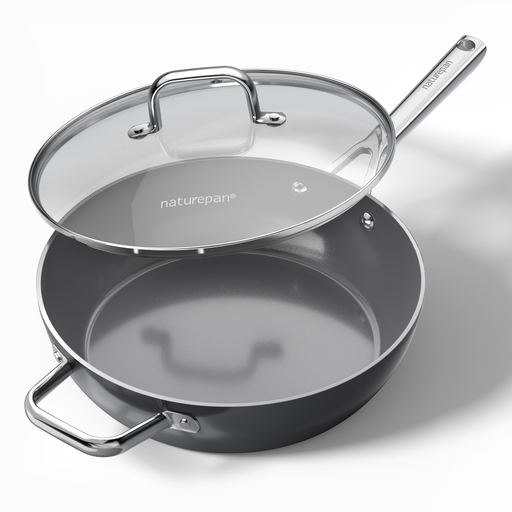
Why It Stands Out This model ticks all the boxes for versatility and durability. Its ceramic coating, reinforced with diamond and titanium particles, promises superior durability and scratch resistance. With its high sides and lid, it transforms into a true sauté pan, perfect for simmered dishes.
Pros
Who Is It For? For those who love variety in the kitchen, from quick stir-fries to slow-cooked dishes, and want a single, versatile utensil that can go from hob to oven.
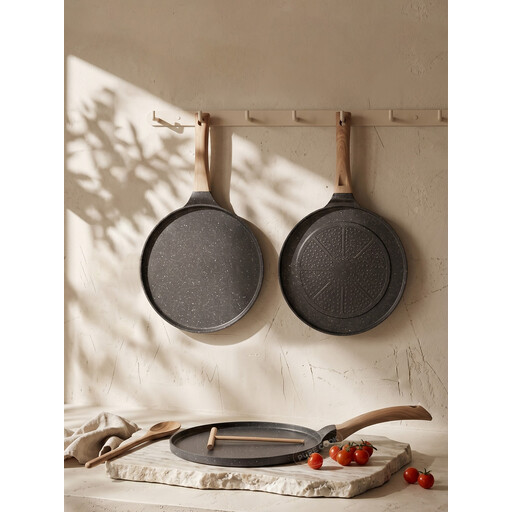
Why It Stands Out This pan's key advantage? Its lightness and manoeuvrability. Its aluminium alloy body ensures it heats up quickly and evenly, while its wooden handle offers a comfortable and perfectly insulated grip. The marble-effect non-stick coating allows for cooking with very little oil and makes cleanup a breeze.
Pros
Who Is It For? Perfect for quick, everyday cooking. Its light weight makes it an excellent choice for those who find traditional pans too heavy. Note that its wooden handle is not designed to go in the oven.
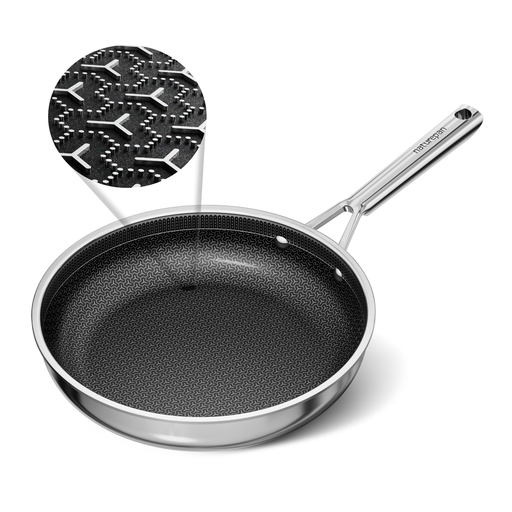
Why It Stands Out This hybrid model features innovative technology. It combines a stainless steel structure with a ceramic non-stick coating arranged in a hexagonal pattern. The idea is simple and effective: the stainless steel ridges perfectly sear meats, while the non-stick valleys prevent food from sticking. A non-stick stainless steel pan designed for performance.
Pros
Who Is It For? For demanding cooks who want the best of both worlds: achieving a beautiful golden-brown crust on a steak, just like with stainless steel, while enjoying the easy cleanup of a non-stick pan.
This selection is just a glimpse of the available solutions for healthy, high-performance cooking. To discover other models with designs or features that suit you, feel free to explore our complete collection.
Discover Our Ceramic Pan Collection
It's not easy to keep all these acronyms straight. To put it simply: PFAS (per- and polyfluoroalkyl substances) are a large family of chemical compounds. PFOA and PTFE are part of this family. PFOA, once used to manufacture PTFE (better known by the brand name Teflon), is now banned in the EU due to its toxicity. A pan certified as "PFAS-free" therefore guarantees the complete absence of this family of chemicals, which represents a much higher level of precaution than a simple "PFOA-free" claim.
A few simple steps can help preserve the coating: cook over low to medium heat, avoid thermal shock (never run a hot pan under cold water), and use wooden, silicone, or nylon utensils. Even though most models are dishwasher-safe, hand washing with a soft sponge is still the best way to extend the life of the non-stick surface.