
Livraison le jour même ou le lendemain

Qualité garantie

Débloquez vos offres de bienvenue: Livraison GRATUITE | Jusqu'à -80 % | 30 jours d'essai gratuits à JoyPlus
Téléchargez l'application
Choosing a new frying pan has become a real headache. You want a PFAS-free model that is high-performing, durable, and healthy, but you're drowning in marketing promises. As the head of product recommendations at Joybuy, my mission is to guide you through this jungle of information so you can make the right choice. This guide breaks down the common pitfalls and gives you the keys to a successful purchase.
Too many buyers regret their purchase after just a few months. Here are the three most common mistakes, often fuelled by clever marketing.
To avoid these pitfalls, simply focus on a few objective technical features.
The choice of coating is crucial. Alternatives to traditional PFAS-based coatings are gaining popularity, and for good reason.
A pan's performance largely depends on its base. A thick, perfectly flat bottom is a hallmark of quality: it ensures even heat distribution, prevents hot spots, and won't warp over time.
For an all-hob, induction-ready pan, its base must contain a ferromagnetic material. To be sure, check for the induction symbol (a coil-shaped icon) on the packaging or the bottom of the pan.
Beyond cooking performance, practical details make all the difference:
Here are a few options that meet specific needs, in line with the selection criteria mentioned above.
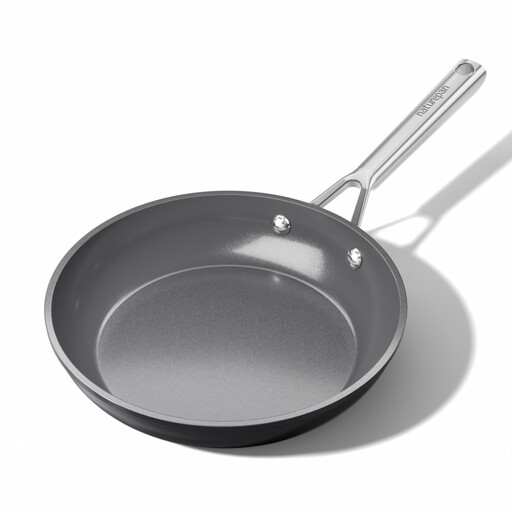
Why we chose it: Its 24 cm size is ideal for daily meals for a couple or a small family. Its versatility is a real plus: it moves seamlessly from the hob to the oven, a key feature for many recipes.
The ceramic coating is reinforced with diamond and titanium particles, a design intended for enhanced durability compared to standard ceramics, which directly addresses the problem of premature wear.
Oven-safe up to 260°C, and its optimised base ensures fast, even heat distribution on all hobs, including induction.
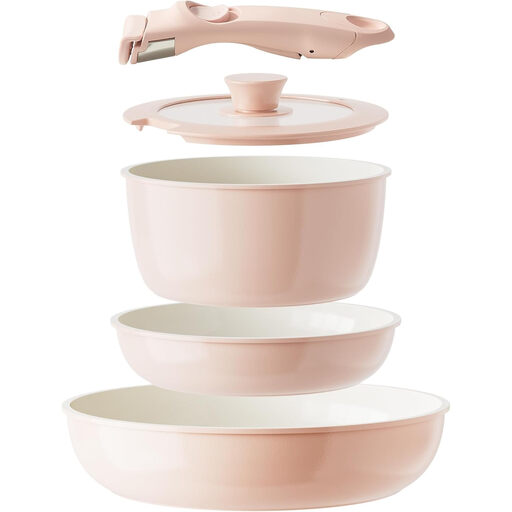
Why we chose it: Perfect for those with limited cupboard space. The detachable handle system allows the pots and pans to be stacked, freeing up valuable room.
This set is explicitly guaranteed to be free of PFAS, PTFE, and PFOA, removing any ambiguity about its coating's composition. The stackable design is a direct solution to the problem of clutter.
The removable handle allows you to move from the hob to the oven, and then directly to the table for serving. The manufacturer claims a space saving of up to 75%.
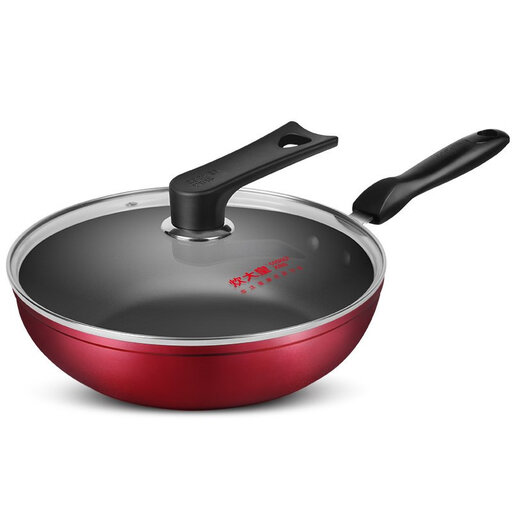
Why we chose it: Its hybrid shape, between a frying pan and a wok, with high sides and a flat bottom, is perfect for stir-frying vegetables, preparing noodle dishes, or cooking saucy meals without splatters.
This model is explicitly designed as a non-toxic, non-stick wok that is compatible with both gas and induction. Its flat bottom ensures good stability and optimal contact with induction hobs, a common flaw in traditional round-bottomed woks.
The versatility of its shape allows you to make a wide variety of dishes with a single utensil. Its coating is also designed to limit smoke emissions during cooking.
We have selected a full range of products for you that meet these strict selection criteria and current safety standards.
The lifespan of a non-stick ceramic pan depends primarily on its care. With daily use and proper care, you can expect optimal performance for 2 to 5 years. To maximise its longevity, cook on low to medium heat, as excessive heat can damage the coating over time.
Here are a few simple steps:
No, not automatically. Induction compatibility is not related to the coating, but to the composition of the pan's base. For a pan to work on an induction hob, its base must contain a magnetic material (like cast iron or certain types of stainless steel). Before buying an induction-compatible pan, always check for the specific pictogram or consult the product's technical sheet.