
Livraison le jour même ou le lendemain

Qualité garantie

Débloquez vos offres de bienvenue: Livraison GRATUITE | Jusqu'à -80 % | 30 jours d'essai gratuits à JoyPlus
Téléchargez l'application
Healthier cooking starts with the right equipment. Are you looking for a pan that doesn't stick, but are concerned about acronyms like PFAS, PFOA, and other chemicals? That's perfectly understandable. Navigating the maze of options and technical jargon can be a real challenge.
As product experts at Joybuy, our mission is to decode the market for you. This guide will help you make sense of the alternatives to traditional coatings and choose the PFAS-free pan that's truly right for you.
Before we get to our top picks, let's review the key criteria to ensure you make the right choice.
For a healthy pan, the coating is the heart of the matter. Fortunately, there are now many effective alternatives to PFAS (per- and polyfluoroalkyl substances).
A good pan must heat evenly for perfectly consistent cooking.
Think about your daily routine. A 24 cm pan is a good all-rounder for 2 to 3 people, while a highly specific model like a tamagoyaki pan will satisfy a particular craving. Don't overlook ease of cleaning, either. While most PFAS-free pans are effortless to wash by hand, being dishwasher-safe is a major plus.
We have selected three models that stand out for their materials, design, and philosophy, all guaranteed to be PFAS-free.
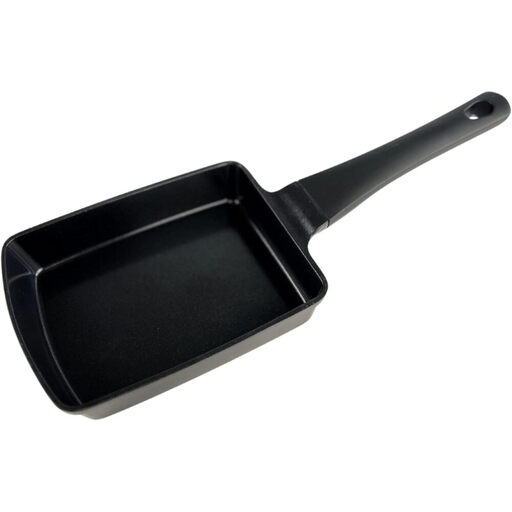
Why It Stands Out
This pan is distinguished by its unique rectangular shape, specially designed for making the famous Japanese rolled omelettes, tamagoyaki. Its non-stick ceramic coating allows you to cook with very little or no fat, which is ideal for achieving the light and airy texture of this specialty. It comes with a wooden spatula adapted to make rolling easier.
Highlights
Best For: Japanese cuisine enthusiasts or curious cooks who want a specialised tool to master a signature recipe while cooking healthily.
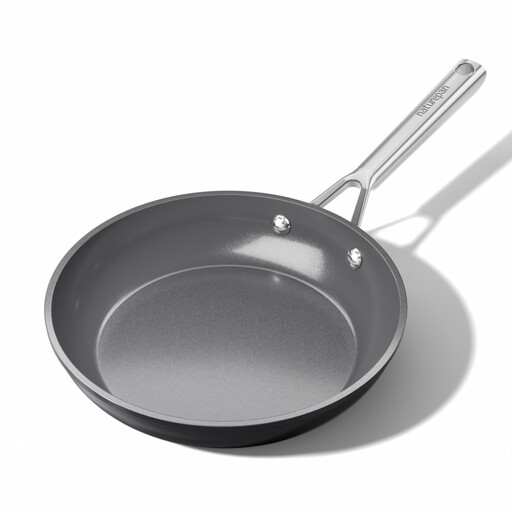
Why It Stands Out
The Naturepan focuses on durability with its exclusive coating of ceramic reinforced with diamond and titanium particles. This composition promises a non-stick surface that is much more resistant to wear and tear than conventional ceramics. Its optimised base ensures it heats up quickly and distributes heat evenly, preventing hot spots. Its stainless steel handle stays cool on the hob, and the pan is even oven-safe up to 260°C.
Highlights
Best For: Those looking for a durable and versatile pan for everyday cooking (meat, fish, sautéed vegetables). Its oven-safe capability is a true game-changer for versatility.
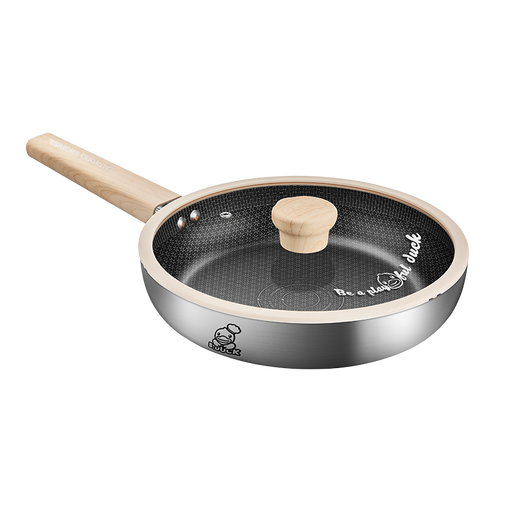
Why It Stands Out
This model offers a different approach to non-stick performance. Made from 316 stainless steel (a high-quality, highly corrosion-resistant material), it features a third-generation honeycomb pattern. This engraved structure protects the pan's base while creating a surface that limits food adhesion. One of its main advantages is its unbeatable durability: it can withstand the use of metal utensils without any issue. Its multi-layer design with an aluminium core guarantees excellent thermal conductivity.
Highlights
Best For: Cooks who prioritise durability above all else and want to use their metal spatulas without a second thought. An investment built to last for years.
Our selection highlights three different approaches to healthy, non-stick cooking. If you want to explore other sizes, materials, or designs, feel free to browse our full catalogue.
? Discover our complete range of frying pans to find the model that's right for you.
1. What is the difference between PFAS, PFOA, and PTFE?PFAS refers to a large family of chemical compounds, which notably includes PFOA and PTFE. PFOA is a substance formerly used in the manufacturing of PTFE (better known as Teflon) and is now banned in the EU due to its toxicity. PTFE is the non-stick coating itself. A "PFAS-free" pan means it does not use any compound from this chemical family.
2. How do I care for a ceramic pan to make it last? To preserve the coating of a ceramic pan, it's best to wash it by hand with a soft sponge and washing-up liquid. Avoid thermal shock (don't run it under cold water while it's still hot) and use wooden, silicone, or nylon utensils. Proper care significantly extends its non-stick properties.
3. Is a stainless steel pan with a honeycomb pattern truly non-stick? It offers excellent resistance to sticking, but its principle is different from a classic smooth coating. The secret is to always preheat the pan properly with a fat or oil. The raised structure creates a thin layer of air and oil between the food and the hot surface, which makes it much easier to release. It doesn't offer the "perfectly slick" glide of a new ceramic pan, but its advantage lies elsewhere: unparalleled durability and scratch resistance.