
Livraison le jour même ou le lendemain

Qualité garantie

Débloquez vos offres de bienvenue: Livraison GRATUITE | Jusqu'à -80 % | 30 jours d'essai gratuits à JoyPlus
Téléchargez l'application
Searching for the perfect non-stick pan? Between marketing promises and health concerns, finding the right PFAS-free model can be a real challenge. If you want a high-performance, durable, and truly healthy tool for your kitchen, you've come to the right place. This guide is for you.
The Joybuy editorial team is here to provide you with clear insights and concrete selection criteria. Together, we'll break down what makes an excellent healthy pan and present our selection of models that perfectly combine quality, durability, and safety.
Before you buy, here are the key points that distinguish a quality pan from a short-lived gadget.
The "?PFAS-free?" label has become the primary hallmark of trust. PFAS (per- and polyfluoroalkyl substances) are a large family of chemical compounds, which include PFOA and PTFE (better known as Teflon). Choosing a healthy, PFOA-free pan is a good first step, but only the "?PFAS-free?" certification guarantees the complete absence of this vast family of compounds.
Modern alternatives primarily lean towards ceramic pans. To enhance their durability, the most innovative manufacturers incorporate mineral particles. A diamond-titanium coating, for example, combines the hardness of diamond and the robustness of titanium to offer a non-stick surface that is far more resistant to scratches and daily wear.
Your type of hob is a decisive factor. If you cook on an induction hob, an induction-compatible pan is essential. It must have a flat, ferromagnetic base for the energy transfer to work correctly.
Versatility is also a major advantage. An oven-safe pan allows you to start cooking on the stovetop and finish in the oven, which is ideal for browning a dish or keeping it warm. Just remember to check the maximum temperature supported by the pan and its handle.
The standard 28?cm size is a popular choice for families, as it offers a generous cooking surface, ideal for 3 to 4 people. For more specific needs, like preparing dishes with sauce or stews, a non-stick sauté pan with higher sides will be more suitable to prevent splatters and contain larger volumes.
Here are a few models that stand out for their materials, design, and versatility, all while being guaranteed PFAS-free.
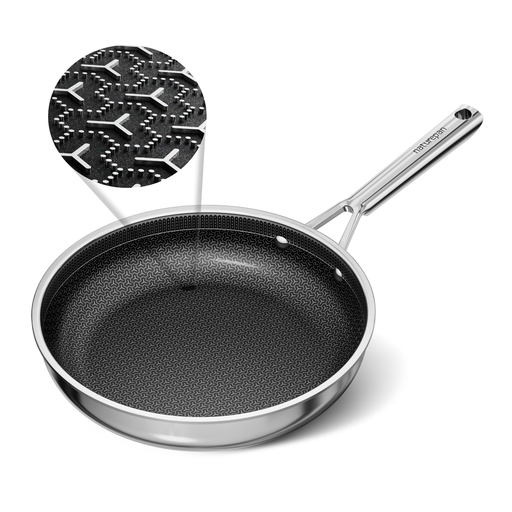
Why It Stands Out
This hybrid model combines the best of stainless steel and ceramic. Its surface features a laser-etched hexagonal pattern: the stainless steel ridges provide a perfect sear for meats, while the ceramic-coated valleys ensure foolproof non-stick performance. Its 5-ply structure, with a triple-layer stainless steel core, ensures perfectly even heat distribution.
Advantages
Who Is It For?
For demanding cooks who love to get a beautiful caramelisation on their meat and fish without sacrificing the easy cleanup of a non-stick pan. Its 28?cm size is perfect for family meals.
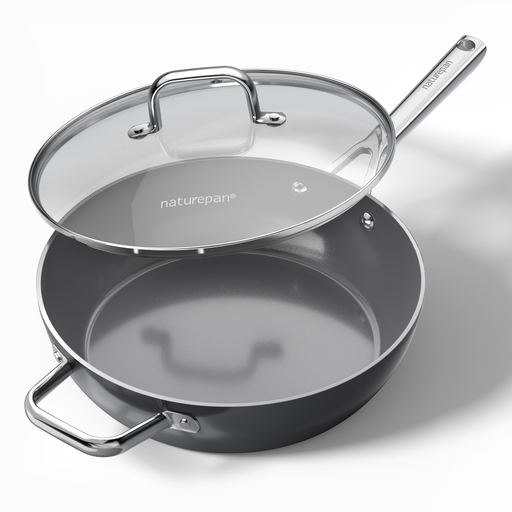
Why It Stands Out
With its high sides and lid, this non-stick sauté pan performs like a Dutch oven. It's perfect for slow-cooked dishes, generous sauces, or braising. Its ceramic coating is reinforced with diamond and titanium particles for enhanced durability.
Advantages
Who Is It For?
For those who love making complete meals in a single piece of cookware. It's the perfect tool for slow-cooking, risottos, or curries, where depth and a lid make all the difference.
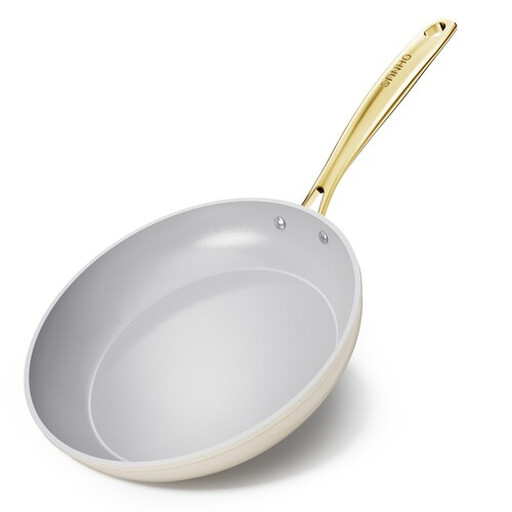
Why It Stands Out
This 26 cm model is an excellent option for everyday use. Its highly conductive aluminium body makes it both lightweight and very responsive to temperature changes. The patented diamond-titanium coating is guaranteed not only free of PFAS, PFOA, and PTFE, but also lead and cadmium, for complete peace of mind.
Advantages
Who Is It For?
For couples or small families looking for an everyday pan that is lightweight, safe, and high-performing. Its 26 cm size is perfect for cooking fried eggs, chicken fillets, or sautéing vegetables.
The choice of a pan is highly personal and depends on your cooking habits. If these models aren't exactly what you're looking for, don't worry! Other sizes, designs, or features might be a better fit for you.
? Discover our complete collection of ceramic non-stick frying pans to find the perfect model for your kitchen.
It's easy to get confused. Here's a summary to clear things up?:
A pan labelled "?PFAS-free?" offers the most comprehensive guarantee, as it excludes all of these compounds.
To maximise the lifespan of your ceramic pan, a few simple steps are all it takes?:
No, and this is a common pitfall. The "PFOA-free" claim has become standard, but it in no way excludes the presence of other compounds from the PFAS family, such as PTFE. For total peace of mind, explicitly look for the "?PFAS-free?" label or opt for alternative materials like ceramic.