
Livraison le jour même ou le lendemain

Qualité garantie

Débloquez vos offres de bienvenue: Livraison GRATUITE | Jusqu'à -80 % | 30 jours d'essai gratuits à JoyPlus
Téléchargez l'application
As a product expert at Joybuy, I see every day how choosing kitchenware can turn into a real headache. The quest for the perfect PFAS-free non-stick pan has become a priority for many health-conscious households. The problem: the market is flooded with often misleading marketing claims.
Before you pull out your credit card, it's crucial to know how to avoid the pitfalls that lead directly to buyer's remorse. Here are the three most common mistakes and our advice on how to avoid them.
To choose a durable, high-performance pan, you need to read between the lines of marketing claims. Focus on these two fundamental technical points.
The absence of PFAS (PFOA, PTFE, etc.) is non-negotiable, but not all alternatives are created equal.
Your pan's performance is directly dependent on its design.
Rather than drowning you in hundreds of options, here are three models that meet specific needs and avoid the pitfalls we've discussed.
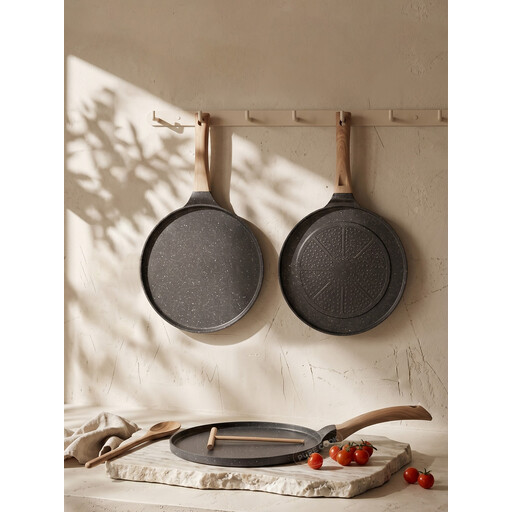
Why we love it: Perfect for those who want a simple, effective, and affordable solution for morning eggs, pancakes, or sautéed vegetables. Its light weight and wooden handle make it very comfortable for daily use.
Its aluminium body ensures fast and even heating, even on induction. No more frustrating hot spots found in entry-level models!
Its stone-effect coating cleans up in a flash, and its compatibility with all hobs (including induction) makes it an excellent blend of convenience and value.
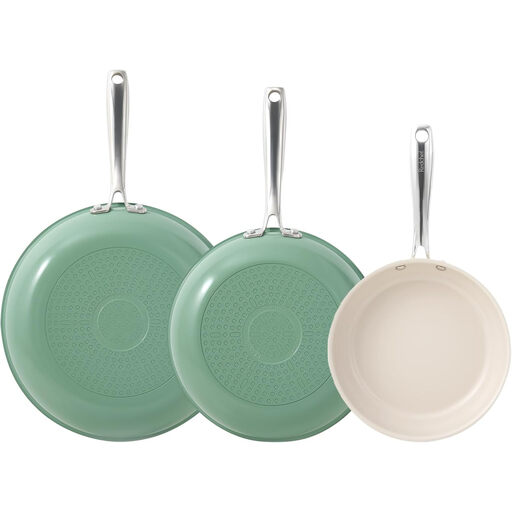
Why we love it: This set of three pans (a PFOA-free cookware set) in 20, 24, and 28 cm sizes covers every need, from single dishes to side dishes. Ideal for families juggling multiple preparations who want non-toxic kitchenware built to last.
Unlike pans with frustrating limitations, this entire set is oven-safe up to a very high temperature (450°C / 850°F), handles included. That's true versatility, from the hob to the center of the table.
A triple-layer ceramic coating designed for durability and exceptional oven compatibility, all in a set with unbeatable value.
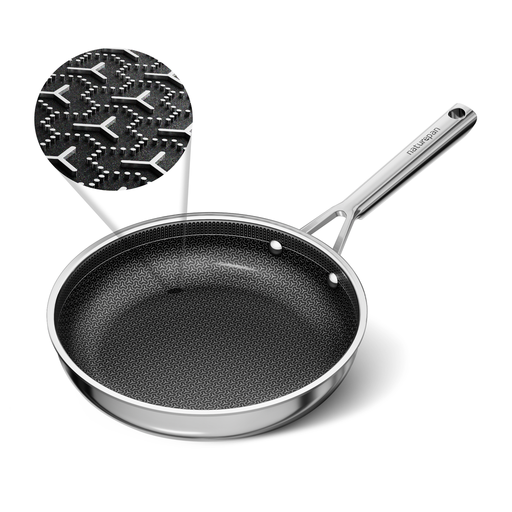
Why we love it: Designed for those who love to get the perfect sear on meat or fish. Its hybrid structure offers the best of both worlds: the caramelisation of a stainless steel pan and the convenience of non-stick, without compromise.
Its laser-etched honeycomb textured surface protects the ceramic coating from scratches. It's the solution to the fragility problem of 100% smooth coatings.
Hybrid stainless steel/ceramic technology for a perfect sear and rock-solid durability. Oven-safe up to 260°C (500°F).
We've put together a complete, up-to-date collection of pans that meet our strict selection criteria and the latest safety standards.
It all depends on the quality of the coating and how you care for it. An entry-level model will last 1 to 2 years before losing its effectiveness. A pan with a reinforced ceramic coating (titanium, diamond) or a hybrid structure, if well-maintained, can remain effective for 3 to 5 years, and sometimes even longer.
Pans certified free of PFAS, PFOA, and PTFE are guaranteed to be free of the per- and polyfluoroalkyl substances of concern. Their alternative coatings, like ceramic (derived from sand and silicon), are considered inert and stable. In practical terms, they do not release any toxic compounds into food, even in cases of accidental overheating. For complete peace of mind, choose a brand that is transparent about its product composition and certifications.