
Livraison le jour même ou le lendemain

Qualité garantie

Débloquez vos offres de bienvenue: Livraison GRATUITE | Jusqu'à -80 % | 30 jours d'essai gratuits à JoyPlus
Téléchargez l'application
Here at our editorial desk, we see it every day: more and more of you are looking to swap out your old pans for a PFAS-free non-stick pan. This is an excellent move, driven by health and sustainability concerns. The only problem is that navigating the marketing jungle can be tough.
This guide is here to cut through the noise. We'll break down the 3 most common pitfalls and give you the keys to investing in a truly high-performance and reliable pan.
To avoid buyer's remorse, it's best to know the classic mistakes. Here they are:
You don't need to get lost in the details to make the right choice. Focus on these three technical points: they determine 90% of your pan's performance and lifespan.
Perfect glide, yes, but not at the expense of your health. Modern PFAS-free alternatives rely almost exclusively on ceramic technology.
Always check that the packaging or product sheet explicitly states "PFAS-free".
Your pan should adapt to your kitchen and your habits, not the other way around.
Design details make all the difference when it comes to comfort and storage.
To illustrate these criteria, here are a few models that each meet a specific need.
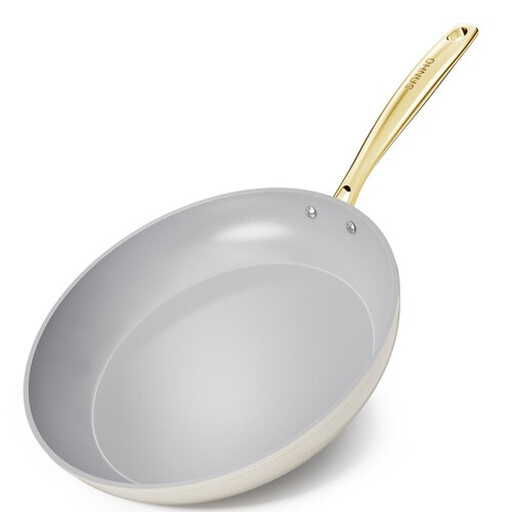
The right choice if: you cook for one or two people. Its compact size is perfect for everyday meals (eggs, small cuts of meat) without cluttering your cupboards. It's an excellent starting point for equipping your kitchen healthily.
It is explicitly guaranteed to be free of PFAS, PFOA, PTFE, lead, and cadmium. Its diamond-titanium reinforced ceramic coating is designed to last much longer than entry-level ceramics.
Versatility: compatible with all stovetops including induction and oven-safe up to 260°C (500°F). Its thick, die-cast aluminium body ensures rapid and uniform heating.
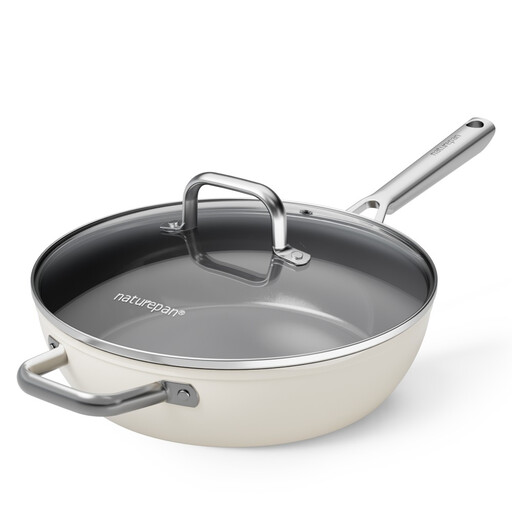
The right choice if: you prepare family-sized meals. With its high sides, large 28 cm (11-inch) diameter, and lid, this sauté pan is perfect for saucy dishes, braised meats, and one-pot meals. It reduces splatters and keeps food moist.
Its thick base is optimised for fast, even heat distribution, which prevents any warping. The stainless steel handle stays cool on the stovetop.
Reinforced ceramic coating that is PTFE/PFOA/PFAS-free. Highly versatile: induction compatible, oven-safe up to 260°C (500°F), and easy to clean (dishwasher-safe).
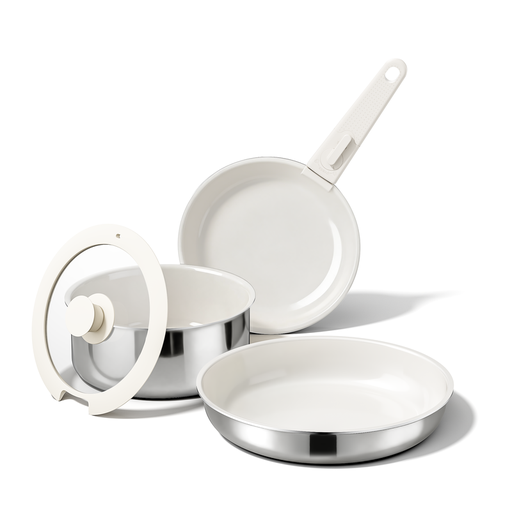
The right choice if: you have a small kitchen or hate cluttered cupboards. The detachable handle allows you to stack pans and pots for dramatic space-saving.
This induction cookware set combines a robust triple-layer stainless steel base with a durable ceramic coating. The handle's locking system is secure for risk-free handling.
Maximum flexibility: the pieces go from the stovetop to the oven (up to 250°C / 480°F), then directly to the table or into the fridge. The entire set is fully dishwasher-safe for ultra-simple maintenance.
Explore our full selection of products that meet our criteria for performance, durability, and health safety.
It all depends on the quality of the coating and how you care for it. A good reinforced ceramic coating (diamond, titanium), used over medium heat with wooden or silicone utensils, can remain perfectly non-stick for several years. The secret? Avoid thermal shock (don't run a hot pan under cold water) and never heat it while empty.
Yes, absolutely. Ceramic coating technologies have made huge advancements. Good models, reinforced with titanium or diamond particles, offer a glide that is comparable, or even superior, to older PTFE coatings. Their main advantage is that they are more stable at high temperatures and contain no controversial chemical substances.