
Livraison le jour même ou le lendemain

Qualité garantie

Débloquez vos offres de bienvenue: Livraison GRATUITE | Jusqu'à -80 % | 30 jours d'essai gratuits à JoyPlus
Téléchargez l'application
Finding the ideal frying pan can quickly become overwhelming. Between marketing promises and legitimate health concerns, it's hard to navigate the options. Many of you have asked us about the presence of substances like PFAS in cookware and are searching for safer alternatives for your family.
This guide is here to shed some light. As a product recommendation expert at Joybuy, my mission is to provide clear, concrete information to help you make the right choice, without the technical jargon. Together, we'll break down the essential criteria for finding a PFAS-free non-stick pan that is both high-performing and durable.
Before we present our top picks, let's review the essential points to ensure your future pan checks all the boxes: health, performance, and practicality.
The main area of concern involves PFAS (per- and polyfluoroalkyl substances), a vast family of chemical compounds used for their non-stick properties and heat resistance. Some of them, like PFOA and PTFE, raise serious health and environmental questions.
Opting for a PFOA- and PTFE-free pan is a good first step, but choosing a model labelled "PFAS-free" offers much broader assurance. The most common alternative is a ceramic coating, found on a ceramic pan. Often reinforced with minerals (titanium, diamond particles), these coatings provide excellent non-stick performance without using fluorinated compounds. Their biggest advantage? They don't release potentially harmful fumes, even in cases of accidental overheating.
Your type of cooktop is a non-negotiable criterion. The label pan for all cooktops, including induction has become the standard, as it ensures maximum versatility. For a pan to be induction-compatible, its base must contain a ferromagnetic material.
But beyond simple compatibility, the quality of the pan's base directly impacts cooking performance. A thick, multi-layered base (often an aluminium and stainless steel alloy) guarantees rapid heating and, most importantly, perfectly even heat distribution. No more of the infamous 'hot spots' that burn food on one side while leaving it undercooked on the other.
A good pan is a long-term investment. Its longevity depends as much on the robustness of its structure as on its coating. A scratch-resistant pan will naturally retain its non-stick properties for longer. While most manufacturers recommend using wooden or silicone utensils, some reinforced ceramic coatings are more forgiving of everyday mishaps.
In daily use, convenience is king. An easy-to-clean pan is a significant time-saver. Thanks to their smooth surface, ceramic coatings often clean up with a simple wipe of a sponge. For maximum comfort, check if the model is a dishwasher-safe pan. Keep in mind, however, that a gentler hand wash will extend the life of its coating.
We have selected three models that excel in safety, performance, and durability. Each has its own strengths to meet specific needs.
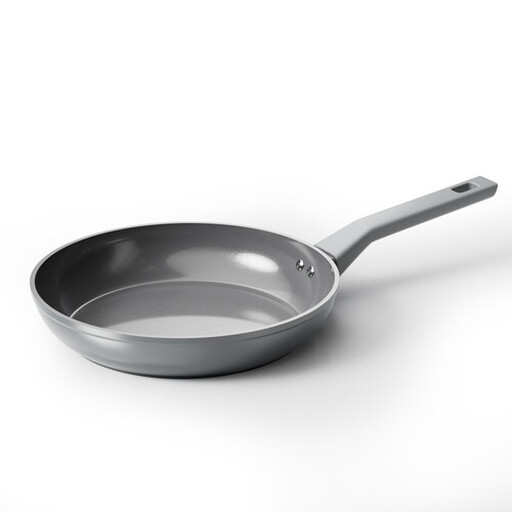
What sets it apart
The Sanho pan stands out with its sophisticated multi-layer construction. Its ceramic coating is reinforced with diamond and titanium particles, a technology designed to offer superior hardness and wear resistance. Its 4+1 layer structure ensures optimal thermal conductivity and great robustness.
Advantages
Who is it for? This is the ideal option for daily family use. A reliable, healthy, and easy-to-maintain pan designed for intensive use. Its 26 cm size is perfect for most preparations.
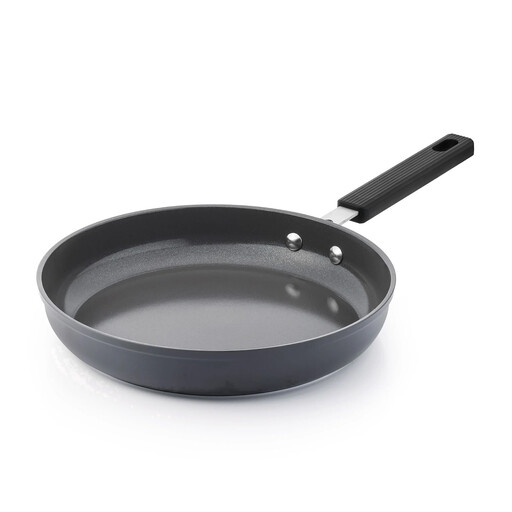
What sets it apart
The SENSARTE's strong point? Its simplicity and incredibly easy cleaning. Its ultra-smooth ceramic coating allows food to slide off effortlessly, and cleaning is as simple as a quick wipe or rinse.
Advantages
Who is it for? Perfect for students, single individuals, or couples. It's also an excellent choice as a small, secondary pan for quick breakfast cooking, especially if doing the dishes is your least favourite chore.
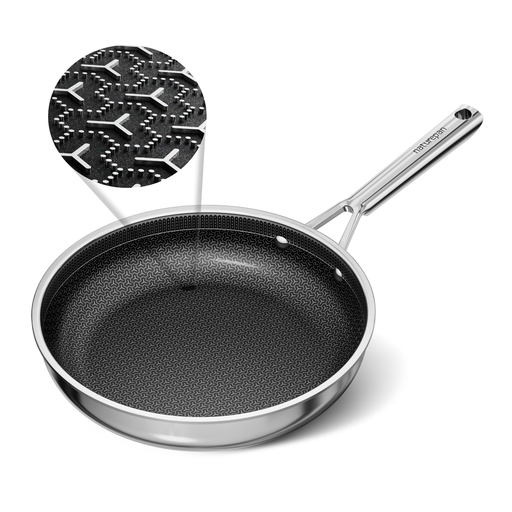
What sets it apart
The naturepan uses an innovative hybrid approach. It combines a 5-layer stainless steel base with a laser-etched hexagonal pattern. The stainless steel peaks allow for a perfect sear on meats, while the "valleys" are filled with a diamond-titanium reinforced non-stick ceramic coating. A major plus: it's oven-safe up to 260°C (500°F).
Advantages
Who is it for? This pan is for cooking enthusiasts who love to experiment. If you want to perfectly sear your meats while enjoying an easy cleanup, and if being oven-safe is an essential criterion for you, then this hybrid model is the one for you.
If you love ceramic for its durability and design, why not incorporate it elsewhere in your kitchen or dining room? Take a look at our selection of ceramic tables, an elegant solution that combines performance and style.
1. What is the difference between a PFAS-free pan and a PFOA/PTFE-free pan? PFAS is a very large family of thousands of chemicals. PFOA and PTFE (better known by the trade name Teflon) are two of the most famous compounds in this family. A pan labelled "PFOA/PTFE-free" does not use these two specific substances but could potentially contain others. A "PFAS-free" pan guarantees that no compound from this huge family has been intentionally added, offering a far superior precautionary principle.
2. How do I care for a ceramic pan to make it last longer? To preserve the coating, it's best to use wooden, silicone, or soft plastic utensils. Avoid cutting food directly in the pan or using sharp metal utensils (knives, forks). Let it cool down before cleaning to prevent thermal shock. Although many are dishwasher-safe, a hand wash with a soft sponge is still the best option to maximize the lifespan of the non-stick surface.
3. Is a ceramic pan as non-stick as a traditional pan? Absolutely. A high-quality ceramic pan offers excellent non-stick performance, especially when new. Foods like eggs or fish slide off easily, often with minimal oil. However, to maintain this performance, it's crucial to care for it properly and avoid overheating it while empty, which can degrade the coating over the long term.