
Livraison le jour même ou le lendemain

Qualité garantie

Débloquez vos offres de bienvenue: Livraison GRATUITE | Jusqu'à -80 % | 30 jours d'essai gratuits à JoyPlus
Téléchargez l'application
By the Joybuy Team, Home Goods Experts
As concerns grow over certain materials, choosing safer cookware has become a priority. At the heart of the debate are per- and polyfluoroalkyl substances (PFAS), ubiquitous in traditional non-stick coatings. In response to these concerns, opting for a PFAS-free ceramic pan has emerged as the clear choice. But faced with a dizzying array of options, how do you know which one to pick? This guide breaks down the essential criteria and presents our selection of the best models so you can cook with peace of mind.
Before you take the plunge, let's review the key factors that separate an excellent ceramic pan from a low-end model.
The secret to ceramic? A coating made from silica (a sand derivative), applied to an aluminium or stainless steel pan body. For enhanced longevity, the most reputable manufacturers reinforce this ceramic coating with mineral particles. A ceramic titanium pan, for example, combines the smooth glide of ceramic with the toughness of titanium. The goal: a perfectly non-stick surface that is stable even at high temperatures and, of course, guaranteed to be free of PFOA and PTFE, the most well-known compounds in the PFAS family.
A good pan should, above all, simplify your life. First, check for compatibility with your cooktop. The "all stovetops, including induction" label is a guarantee of absolute versatility, ensuring the pan's base is magnetic.
The other game-changing feature is oven compatibility. An oven-safe pan lets you start cooking on the stovetop and finish it in the oven, which is ideal for browning a dish or finishing a cut of meat. Pay attention to the maximum supported temperature and the handle material, which must be able to withstand the heat. Finally, while hand washing is often recommended, dishwasher compatibility remains a welcome convenience for daily use.
The diameter and height of the pan should suit your needs. A small 20 cm pan is perfect for morning eggs or a quick meal. For saucy dishes, sautéed vegetables, or family meals, a 28 cm ceramic sauté pan with high sides and a lid will be much more suitable.
After our analysis, here are the models that caught our eye for their performance, safety, and versatility.
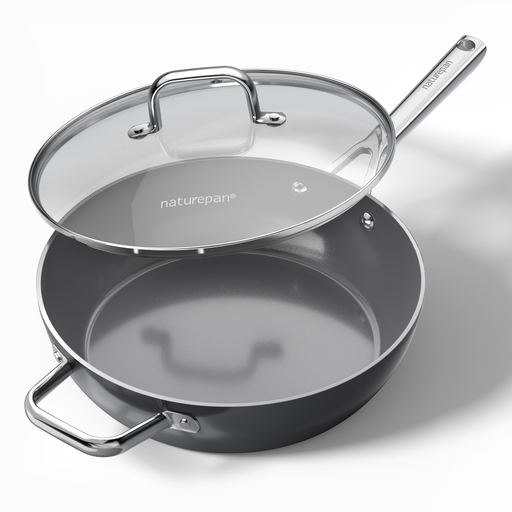
What sets it apart: Its extreme versatility makes it a true Swiss Army knife in the kitchen. With its high sides and lid, this 28 cm pan transforms into a sauté pan or a small Dutch oven to simmer, braise, or even steam. Its diamond and titanium-reinforced coating is designed for excellent durability.
Advantages:
Who is it for? For families and anyone who loves preparing complete meals in a single piece of cookware. Its versatility makes it ideal for saving cupboard space with an all-in-one product.
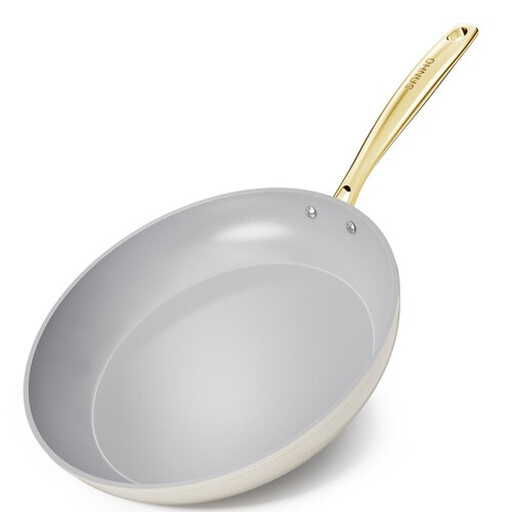
What sets it apart: This model combines aesthetics with functionality. Its compact 20 cm size is perfect for quick, everyday cooking. The thick die-cast aluminium body ensures it heats up quickly and distributes heat perfectly evenly, while its sleek beige and gold design adds a welcome touch of elegance to your stovetop.
Advantages:
Who is it for? Ideal for singles, couples, or for smaller cooking tasks (eggs, pancakes, side dishes). Its stylish design will appeal to those who believe kitchen aesthetics matter.
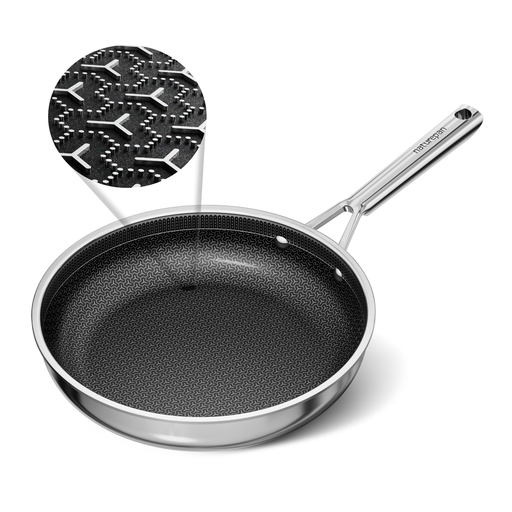
What sets it apart: This model breaks the mould with its innovative hybrid technology. Its surface combines a raised stainless steel hexagonal pattern with a non-stick ceramic coating in the valleys. This unique structure allows you to sear meats to perfection, just like on stainless steel, while still enjoying the convenience of a non-stick coating.
Advantages:
Who is it for? For demanding cooks who want the best of both worlds: the searing power of stainless steel and the convenience of non-stick, without compromise.
The models in our selection incorporate diamond particles to strengthen their coating and durability. Did you know? The diamond is more than just a gemstone. If you're intrigued by its technical applications, check out our feature on the diamond gemstone.
Yes, a high-quality pan with a ceramic coating is an excellent alternative to traditional non-stick coatings. When certified free of PFAS, PFOA, and PTFE, it won't risk releasing these controversial chemicals during cooking. Composed mainly of silica (a sand derivative), its coating is inert and stable, even at high temperatures.
To preserve your pan's non-stick properties, a few simple steps are all it takes. Avoid overheating it when empty, favour low to medium heat, and use wooden, silicone, or nylon utensils. Even though many models are dishwasher-safe, hand washing with a non-abrasive sponge is still the best way to extend the life of the coating.
No, and this is a crucial point to watch for. Induction compatibility depends on the base of the pan. To work on an induction cooktop, its base must be ferromagnetic. Before any purchase, be sure to look for the "induction compatible" pictogram (a coil symbol) or the explicit mention "all stovetops, including induction" on the packaging or product sheet.