
Livraison le jour même ou le lendemain

Qualité garantie

Débloquez vos offres de bienvenue: Livraison GRATUITE | Jusqu'à -80 % | 30 jours d'essai gratuits à JoyPlus
Téléchargez l'application
Replacing a pan is rarely a joyous occasion; it's usually born from disappointment: a peeling coating, food that starts sticking after just a few months, or a growing awareness of the questionable materials in our cookware. If your search has led you to a PFAS-free ceramic pan, you're on the right track. But be warned: the market is flooded with marketing promises that can easily lead to a poor investment. Let's break down the pitfalls to avoid so you can make a truly informed decision.
The 3 pitfalls to avoid when buying a non-stick pan:
To avoid these traps, it's crucial to look closer at a few technical specifications. These are what separate a kitchen gadget from a genuine cooking tool.
The durability of a PFAS-free ceramic pan depends primarily on its coating's composition. The most robust ones incorporate mineral particles (diamond, titanium) to dramatically increase their resistance.
A good induction pan isn't just magnetic. Its design is crucial for energy efficiency and cooking performance.
A truly practical pan should adapt to your kitchen and your habits.
Rather than a long, generic list, we've matched specific models to user profiles. The goal is to help you find the pan that truly fits your needs.
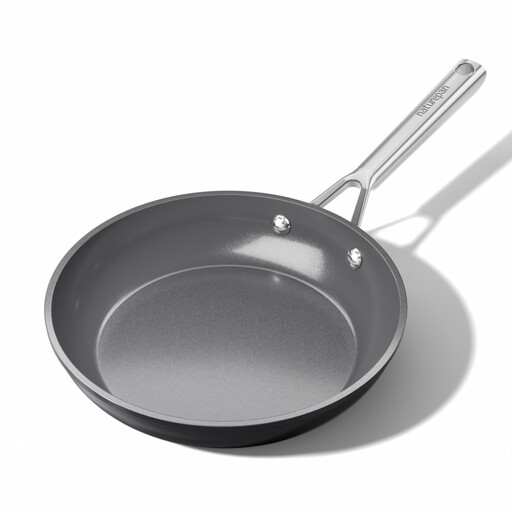
Why we chose it: Its 24 cm size is perfect for 2-3 people, ideal for daily meals from morning eggs to evening stir-fried vegetables. Its oven-safe compatibility up to 260°C (500°F) offers great versatility for finishing dishes or keeping them warm.
Its titanium and diamond-reinforced ceramic coating is built to last, avoiding the rapid degradation of low-end coatings. Its thick base ensures even heating on induction cooktops.
Fast and uniform heating; stainless steel handle that stays cool on the stovetop.
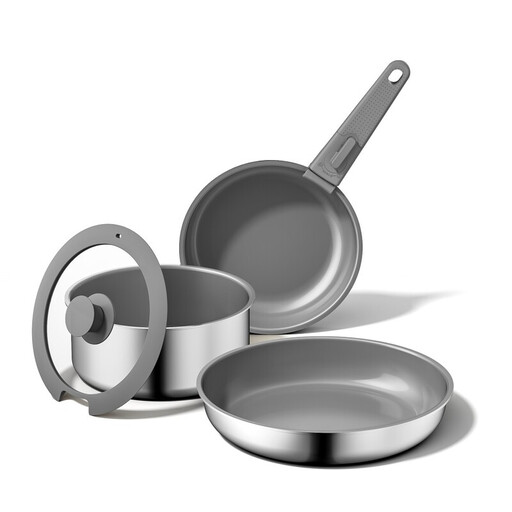
Why we chose it: This is the perfect solution for small apartments or for anyone who hates cluttered cabinets. The detachable handle allows for perfectly nested stacking, freeing up precious space.
The handle's locking system is reliable and secure, and the entire set is guaranteed PFAS-free. The tri-ply stainless steel construction ensures excellent performance on induction, a far cry from cheap, flimsy removable-handle sets.
Saves up to 70% space; ultimate versatility (goes from stovetop to oven, then to the table and fridge).
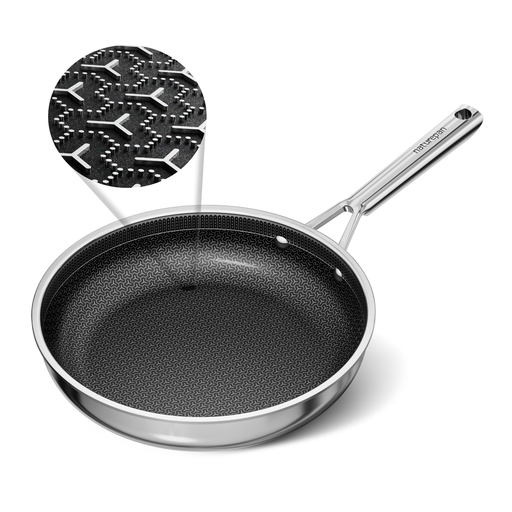
Why we chose it: For those who want to sear meat like on stainless steel, but without the sticking. Its large 28 cm size is perfect for family-sized meals or large cuts of meat, offering superior cooking performance.
Its hybrid surface (raised stainless steel pattern with recessed ceramic) solves the dilemma between a perfect sear and non-stick convenience. This technology outperforms simple coatings for demanding cooking tasks, while remaining guaranteed PFAS-free.
Superior searing performance thanks to the hexagonal pattern; 5-ply construction for exceptional heat distribution.
Discover our full selection of products that meet our criteria for durability, performance, and health safety.
The longevity of a ceramic pan, even a high-quality one, depends heavily on its care. With the right habits, a high-performance model can retain its non-stick properties for several years. The keys are: avoid thermal shock (never run a hot pan under cold water), never use metal utensils, and favour cooking over medium heat.
The number one health benefit of a certified PFAS-free ceramic pan is the complete absence of this family of chemical compounds. Traditional PTFE (Teflon) coatings can release potentially toxic fumes if overheated beyond 260°C (500°F). Being chemically inert, ceramic does not pose this risk. It offers far greater peace of mind, especially for families and anyone mindful of their cooking environment.