
Livraison le jour même ou le lendemain

Qualité garantie

Débloquez vos offres de bienvenue: Livraison GRATUITE | Jusqu'à -80 % | 30 jours d'essai gratuits à JoyPlus
Téléchargez l'application
With growing concern over per- and poly-fluoroalkyl substances (PFAS), many of you are looking to upgrade your cookware. In this quest for healthier cooking, the PFAS-free ceramic pan has emerged as the go-to alternative. But be warned: the market is saturated with options and often misleading marketing claims. Before you make a decision, learn to spot the most common pitfalls so you don't invest in a product that will only disappoint you after a few months.
Here are the 3 mistakes to avoid:
To make the right choice, rely on objective technical criteria rather than marketing speak.
The "PFAS-free" label guarantees the absence of a large family of chemicals, including the most well-known ones like PFOA and PTFE (the main component of Teflon). A healthy non-stick pan relies on a chemically inert coating that does not release any controversial substances, even at high temperatures.
Modern ceramic coatings are often reinforced to improve their durability. Look for terms like titanium ceramic pan or stone and ceramic coated pan. These mineral particles, added to the ceramic matrix, increase resistance to scratches and abrasion, thereby extending the life of the non-stick surface.
A pan's cooking performance doesn't just depend on its coating. Its body and base are just as crucial.
Rather than an exhaustive list, we've matched specific models to typical user profiles, based on their technical strengths and design.
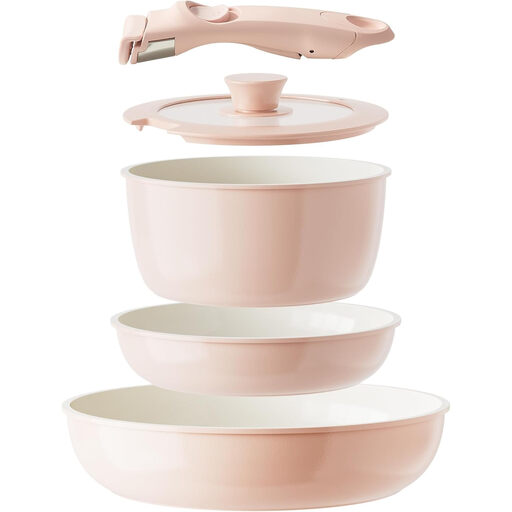
The user profile: Perfect for those struggling with limited space. Thanks to the removable handle and stackable design, the entire ceramic cookware set fits into a single drawer. A significant space-saver in your cupboards.
The removable handle solves the problem of fixed handles, which are often bulky and not oven-safe. This allows the pans to go from the hob to the oven (up to 450°C), and then straight to the fridge or the table.
Ultimate versatility: a single handle for multiple pots and pans. Unmatched space-saving: a stackable pan set design that frees up to 75% more space. Compatible with all hobs, including induction.
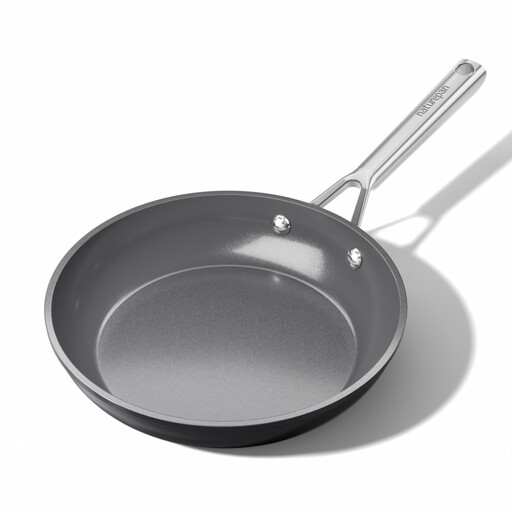
The user profile: For those who cook every day and demand unwavering durability from their equipment. The 24 cm diameter is the perfect all-rounder for meals for 2-3 people, from morning fried eggs to an evening steak.
This model tackles the durability problem head-on. Its titanium ceramic coating, reinforced with diamond particles, offers far superior resistance to scratches and wear than conventional ceramic coatings.
Enhanced durability: a coating built for heavy use. Fixed stainless steel handle: robust, it is oven-safe up to 260°C and stays cool on the stovetop.
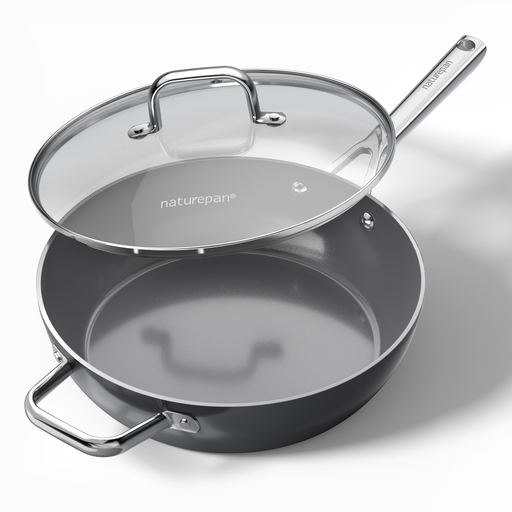
The user profile: Its large 28 cm diameter and high sides are perfect for saucy dishes, vegetable stir-fries, or cuts of meat for the whole family. The lid is a real bonus for simmering and reducing splatters.
Unlike a standard frying pan with low sides, this model doubles as a sauté pan or even a small Dutch oven. This all-in-one versatility fully justifies the investment.
Generous capacity and high sides: perfect for one-pot meals and large family dinners. Lid included: essential for braising, simmering, and keeping food warm. Durable diamond-titanium coating.
Discover our complete, up-to-date selection of pans that meet our strict selection criteria and current safety standards.
It all depends on the quality of the coating and how you care for it. An entry-level model can lose its effectiveness in less than a year. Conversely, a well-maintained pan with a reinforced coating (titanium, diamond) will retain its non-stick properties for several years. The key is to use wooden or silicone utensils.
To preserve the coating, follow a few golden rules:
Yes. A ceramic coating certified free of PFAS, PFOA, and PTFE is considered a healthy option. It is made from inert materials (derived from sand) that do not react with food and do not release toxic fumes, even in cases of accidental overheating. It's the precautionary principle applied to the kitchen for those who want to avoid traditional fluorinated compounds.