
Livraison le jour même ou le lendemain

Qualité garantie

Débloquez vos offres de bienvenue: Livraison GRATUITE | Jusqu'à -80 % | 30 jours d'essai gratuits à JoyPlus
Téléchargez l'application
Navigating the vast world of cookware can feel like an obstacle course, especially when health and durability are on the line. The quest for the perfect PFAS-free ceramic pan is a prime example: a good intention often undermined by vague marketing and unverifiable technical claims. Our mission, as editors, is to cut through the noise and help you make an informed choice.
Before you buy, here are the three common pitfalls that can turn a good investment into an almost certain disappointment:
To avoid these traps, here are the technical points on which you should make no compromises. These are the true guarantors of quality and safety for your future healthy non-stick pan.
A ceramic-coated pan worthy of the name uses "sol-gel" technology, which transforms inorganic materials into a glassy, hard, and stable surface, even at high temperatures. The most robust models incorporate reinforcing particles, like titanium or diamond, to boost resistance to scratches and abrasion. Steer clear of vague descriptions and demand details on the coating's composition and thickness.
This is the crucial point. Don't be fooled by claims like "PFOA-free" or "PTFE-free." These are just two of the thousands of compounds in the PFAS family. For absolute peace of mind, the label must clearly state "PFAS-free". This is the only guarantee that none of these chemicals were intentionally added during manufacturing.
For a pan to be compatible with all stovetops, including induction, its base must contain a ferromagnetic material. It's simple to check: look for the induction symbol (a horizontal coil) on the packaging or engraved on the bottom of the pan. A thick base, often made of forged aluminium, also ensures it heats up quickly and distributes heat evenly. This is the secret to avoiding hot spots that can ruin food and damage the coating.
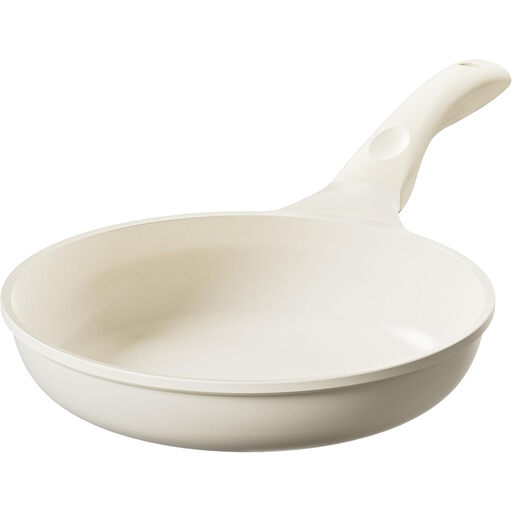
Why we love it: Perfect for handling daily meals, from morning fried eggs to evening stir-fried vegetables. Its quick cleanup (it's dishwasher-safe) and ergonomic handle make it the perfect partner for busy schedules.
Its coating is certified free of PTFE, PFOA, and PFAS, which settles the debate over partial claims. Its base is designed for full compatibility: induction, gas, and ceramic hobs.
Heats up quickly and evenly thanks to its thick base. Its bakelite handle stays cool to the touch, even during cooking.
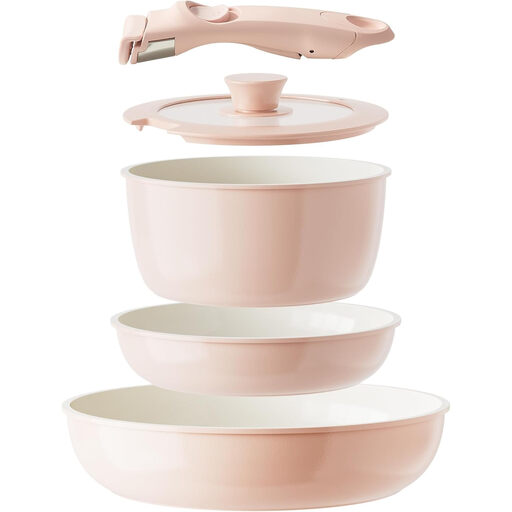
Why we love it: The perfect solution for kitchens where every square inch counts. The detachable handle is a game-changer: you can stack this ceramic cookware set for ultra-compact storage, move it from the hob to the oven, and serve directly at the table.
This pan and saucepan set is a cohesive all-in-one solution, guaranteed free of PFAS, PTFE, and PFOA across all pieces. The detachable handle solves storage and versatility issues in one go.
Saves up to 75% more space thanks to its stackable design. The pieces are compatible with all stovetops and are oven-safe (up to 230°C, without the handle).
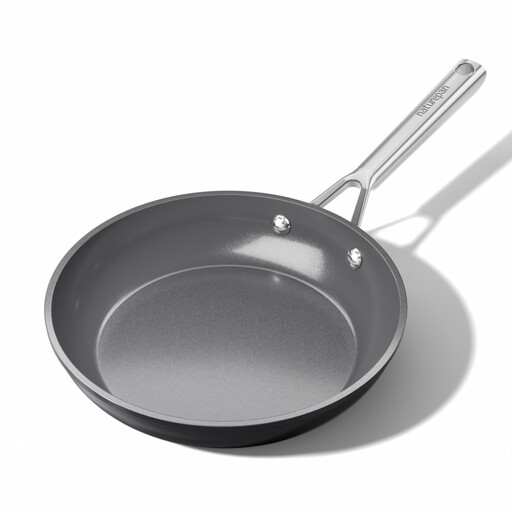
Why we love it: Designed for those who refuse to compromise on durability or performance. Its titanium and diamond-reinforced coating withstands heavy use, sears meats to perfection, and maintains a flawless non-stick glide.
Its reinforced coating promises far greater longevity than standard ceramics, sidestepping the pitfall of premature wear. Guaranteed free of PTFE/PFOA/PFAS, its oven-safe compatibility up to 260°C is a true sign of its robust build.
Enhanced scratch resistance and durability thanks to the reinforced coating. Its all-stainless steel handle allows it to go into a high-temperature oven effortlessly.
Discover our full selection of products that meet our demanding specifications for safety and performance.
The lifespan of a ceramic-coated pan depends primarily on its care. To make it last, follow a few golden rules:
A well-maintained, high-quality pan will last you for several years.
Absolutely. A new ceramic coating offers a perfect glide, allowing you to cook with very little or no oil. Unlike PTFE, however, its performance can decline if the surface gets scratched or builds up with carbonised food residue. The key? Gentle but thorough cleaning after each use to maintain its effectiveness.
The easiest way is to look for the induction symbol (a horizontal coil shape) engraved on the bottom of the pan or printed on the packaging. Another foolproof trick: hold a magnet (one from your fridge will do) to the base of the pan. If it sticks firmly, you're good to go—it's compatible.