
Livraison le jour même ou le lendemain

Qualité garantie

Débloquez vos offres de bienvenue: Livraison GRATUITE | Jusqu'à -80 % | 30 jours d'essai gratuits à JoyPlus
Téléchargez l'application
Mistrust is growing around per- and polyfluoroalkyl substances (PFAS), the infamous "forever chemicals" found in many kitchen utensils. In response, more and more households are turning to healthy and durable alternatives. The PFAS-free ceramic pan is emerging as the ideal solution, combining cooking performance with peace of mind in the kitchen.
This guide is designed to enlighten you. Our goal is to give you the keys to making an informed choice by deciphering technical specs and looking beyond marketing promises. We will break down the essential criteria before presenting a selection of tried-and-tested models.
Before you head to the checkout, here are the key points to check to find the pan that will truly fit your habits.
First step: ensure your future pan is compatible with your equipment. It is imperative to check its compatibility with your hobs, especially if you cook on induction. For this technology, a thick, flat, and ferromagnetic base is non-negotiable.
Also, consider its versatility. An oven-safe pan opens up a world of possibilities: you can sear meat on the hob before finishing it in the oven, or even gratinate a dish. Make sure that the pan and, most importantly, its handle can withstand the high temperatures of your oven.
The number one selling point of a ceramic pan is, of course, its healthy non-stick coating. It's an excellent alternative to Teflon. Its composition, guaranteed free of PFAS, PFOA, and PTFE, is reassuring. For better longevity, some manufacturers reinforce their coating with mineral particles (diamond, titanium, etc.) that improve resistance to scratches and abrasion. The result: healthy cooking with very little fat and cleaning that is no longer a chore.
A pan is an everyday tool, so its ergonomics are crucial. The weight, overall balance, and grip of the handle should not be overlooked. To optimise cupboard space, especially in small kitchens, the pan set with a removable handle is an almost magical solution. This system allows the pans to be stacked for spectacular space-saving.
We have selected a few models that stand out for their features and design, each tailored to a specific use.
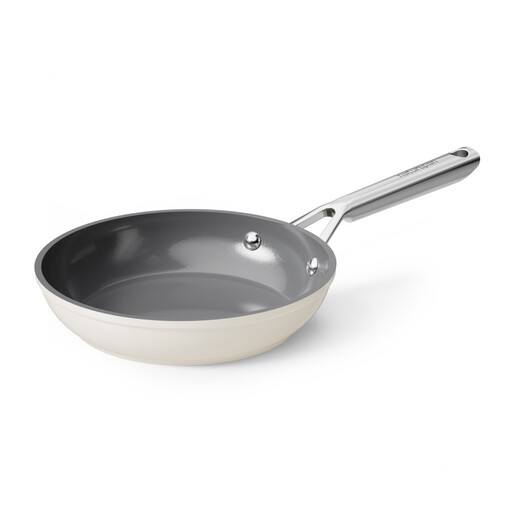
Why it stands out With its 24 cm diameter, this is the perfect everyday utensil, ideal for cooking for two or three people. Its ceramic coating, reinforced with diamond and titanium particles, promises excellent long-term non-stick performance and a healthy cooking surface.
Key features
Who is it for? For couples or small families who want a healthy non-stick pan that is versatile and perfect for fried eggs, pancakes, or a fish fillet.
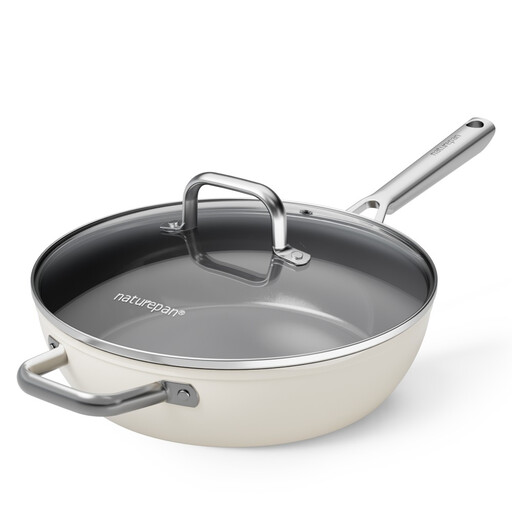
Why it stands out With its high sides and lid, this 28 cm model is a true ceramic sauté pan. It is perfect for dishes with sauce, hearty stews, or family recipes that require volume and controlled cooking.
Key features
Who is it for? For families and home chefs who love generous one-pot meals and are looking for a deep, robust, and easy-to-maintain utensil.
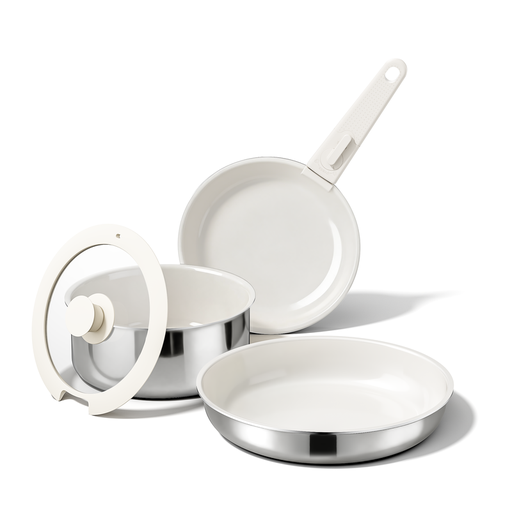
Why it stands out This ceramic cookware set is the dream solution for anyone who wants to combine performance with space optimisation. Its removable handle system is the key to ultra-compact storage.
Key features
Who is it for? The perfect solution for small kitchens, apartment living, RVs, and anyone who wants to declutter their cupboards without sacrificing the quality and safety of their non-toxic cookware.
A good pan is a cornerstone of the kitchen, but for gratins, roasts, or cakes, a high-performance oven remains essential. If you are thinking about upgrading your equipment, take a look at our selection of ovens.
Discover our selection of grey ovens
Yes. So-called "ceramic" pans use a coating based on silica (derived from sand), applied via a process called Sol-Gel. Their main advantage is that their manufacturing excludes PFAS, PFOA, and PTFE. They are therefore a recognised healthier alternative to classic non-stick coatings that contain them.
To preserve its qualities for as long as possible, a few simple steps are all it takes:
Not always. It all depends on their base: to work on an induction hob, the bottom of the pan must contain a ferromagnetic material. Today, most quality models, like those in our selection, are designed with a base compatible with all hobs. To be sure, look for the induction pictogram (a coil-shaped symbol) on the packaging or product sheet.