
Livraison le jour même ou le lendemain

Qualité garantie

Débloquez vos offres de bienvenue: Livraison GRATUITE | Jusqu'à -80 % | 30 jours d'essai gratuits à JoyPlus
Téléchargez l'application
By our product experts, July 17, 2026
Looking to switch to healthier cooking, but feeling lost in the jungle of acronyms (PFAS, PFOA, PTFE...)? It's a common concern for a growing number of health-conscious consumers who are seeking alternatives to traditional non-stick coatings.
This guide is here to demystify PFAS-free ceramic cookware sets. We'll break down the essential criteria and present our selection of the best models that combine quality, performance, and safety for healthy cooking.
Before you take the plunge, here are the key points to check to find the perfect healthy non-stick cookware set for your cooktop and cooking habits.
The first, purely technical step: make sure your future cookware set is compatible with your cooktop. For an induction cooktop, the base of the pots and pans must be magnetic.
Next, consider the composition. A quality piece of cookware is often a sophisticated mix of materials:
Cookware sets come in various sizes. Do you really need a ten-piece set, or would a selection of three or four essentials be enough for your daily routine? Think about your most common preparations:
Some sets include useful accessories like glass lids or steamer baskets. A white stockpot or a coloured one can also add a welcome touch of style to your kitchen.
Non-toxic cookware with a ceramic coating requires special care to maintain its non-stick properties over time. A few golden rules:
Here's a closer look at three models that stand out for their design and performance, catering to different types of cooks.
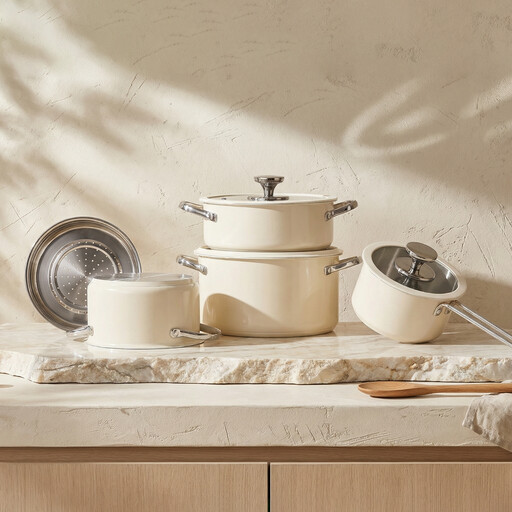
This set combines the durability of 304 stainless steel on the inside with the easy maintenance of a ceramic coating on the outside. The stainless steel interior, which is ultra-resistant to scratches and very high temperatures (up to 870°C), is complemented by a beige ceramic exterior that resists corrosion and makes cleaning up grease splatters a breeze.
For families or anyone looking to get a complete, coordinated, and durable set that can do it all (boil, simmer, steam...).
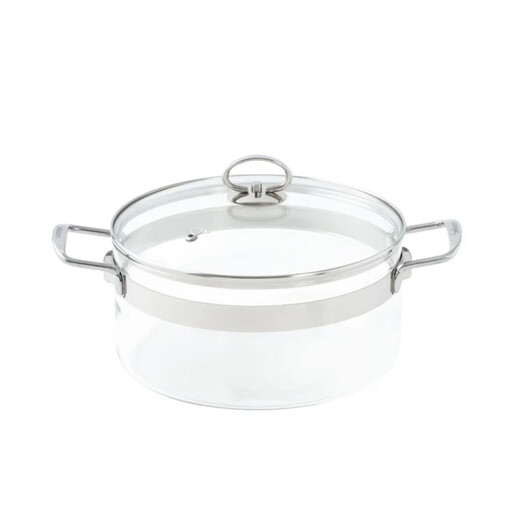
This stockpot is a game-changer: it's made entirely of borosilicate glass, a perfectly inert and non-porous material. There is no coating here. The risk associated with PFAS or PTFE is therefore eliminated by its very nature. Its complete transparency allows you to monitor your cooking without ever lifting the lid.
For healthy cooking purists who swear by raw, untreated materials. An excellent choice for slow cooking and saucy dishes, as long as you're not using an induction cooktop (unless you use an induction converter disk).
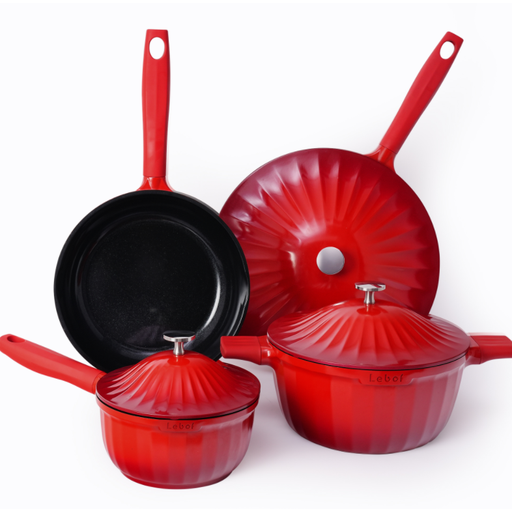
This set goes all-in on performance with a die-cast aluminium body and a titanium-reinforced ceramic coating (Ti-Ceramic). This winning combination ensures ultra-fast and even heat distribution, while providing a more durable and scratch-resistant non-stick surface.
For everyday cooks who prioritise efficiency: fast heating, reliable non-stick performance, and all-cooktop compatibility. Its modern pearl white design is a real bonus for kitchen style.
If a complete set isn't what you need, but you simply want to add to your collection (for example, with pot lids), our catalogue is full of individual items to meet every need.
A ceramic coating is created using a "sol-gel" process based on inorganic compounds (essentially, sand). It contains no fluorinated plastics like PTFE, which is the main component of traditional non-stick coatings. The absence of PFOA and PFAS is therefore the hallmark of ceramic pots and pans.
The longevity of a ceramic coating depends on two factors: its manufacturing quality and how you care for it. A high-quality coating, for example one reinforced with titanium, will naturally be more resilient. To maximise its lifespan, it's crucial to avoid metal utensils, abrasive sponges, and sudden temperature changes.
The golden rule for preserving the non-stick surface: always let your pots and pans cool down before washing them. Use warm water, a mild dish soap, and a non-abrasive sponge. Even if some models are advertised as dishwasher-safe, hand washing is still the best way to preserve the coating in the long run.