According to Santé publique France, unsweetened plain petit-suisse can be offered from the start of weaning, alongside breast milk or infant formula, but not instead of it. If you’re taking a meal into nursery, also check the ingredients and allergens in the pot you choose, its storage instructions and the nursery’s rules for handing it over. A ‘from 6 months’ label makes it easier to identify a dairy product intended for babies, but you’ll still need to check all of these things.
Who is this choice for?
Parents just starting weaning
You’re looking for a dairy product for a child of around 6 months, without confusing it with their usual milk. Santé publique France explains that unsweetened petit-suisse can be included as part of weaning, but it doesn’t replace breast milk or infant formula.
Parents taking a meal into nursery
You need to choose a pot that’s easy to identify and plan how to keep it stored properly until staff take charge of it. The product’s instructions and your nursery’s handover arrangements matter just as much as the pot size.
Parents whose child needs to avoid milk
If your child follows an exclusion diet or has an individual care plan, check the ingredients and allergens with the professionals supporting them. An ordinary dairy petit-suisse isn’t a suitable default choice.
What should you check first?
Start by deciding what type of dairy product you’re looking for, then check the specific pot and your nursery’s handover arrangements.
Baby dairy product labelled ‘from 6 months’
Worth considering: if you’d like the packaging to specify the product’s intended age and purpose.
Bear in mind: this label doesn’t make the dairy product a substitute for breast milk or infant formula, and doesn’t guarantee that the nursery will accept it.
Standard plain petit-suisse
Worth considering: if the ingredients are suitable for your child and the relevant professionals approve its use as part of the meal you’re bringing in.
Bear in mind: a standard product won’t necessarily be labelled ‘from 6 months’; check the ingredients on each individual pot.
| Criteria |
What to check |
Who is this for? |
| Age suitability and the role of the dairy product |
Check the age label, if there is one, and make sure it’s a plain, unsweetened product. According to Santé publique France, 0%, skimmed and semi-skimmed products aren’t suitable for children under 3; a dairy product doesn’t replace their usual milk. |
At the start of weaning, I want to recognise a pot that’s suitable for this stage without mistaking it for a replacement for milk. Around 42% of consumers would make this their priority. |
| Storage and handover |
Check the pot’s storage instructions, the conditions during the journey and whether you can hand it over in line with the nursery’s rules. Anses reminds us that low temperatures slow the growth of micro-organisms. |
When I’m preparing a meal to take in, I need to be able to store the product according to its label until staff take charge of it. This would be the priority for around 33% of consumers. |
| Ingredients and allergens |
Check the ingredients list and the milk allergen information on the pot you buy; if milk must be avoided, follow the individual care plan for your child. |
If my child needs to avoid milk, I can’t choose an ordinary dairy petit-suisse without taking their care plan into account. Around 25% of consumers would put this restriction first. |
Mistakes to avoid
-
Replacing usual milk with a pot labelled ‘from 6 months’
The age label tells you what the dairy product is intended for; it doesn’t mean it replaces breast milk or infant formula. Santé publique France describes it as an addition to weaning.
Keep your child’s usual milk as part of their diet, and think of petit-suisse as an additional food.
-
Automatically choosing a 0% or reduced-fat version
According to Santé publique France’s guidance, 0%, skimmed and semi-skimmed products aren’t suitable for children under 3.
Check the product description and fat content on the specific product before choosing.
-
Leaving a product that needs to be kept chilled in a bag until mealtime
If the label says a pot must be refrigerated, you’ll need to plan for the journey and the wait before handing it over. Anses stresses the importance of maintaining the cold chain.
Use transport that meets the product’s storage instructions, and hand the pot to staff promptly after checking they have somewhere suitable to store it.
-
Forgetting to mention that it contains milk
The plain petit-suisse products covered in Carrefour France’s product information contain milk. So if your child has an individual dietary restriction, simply choosing a different brand of petit-suisse won’t address it.
Share the relevant information with the nursery and follow the care plan drawn up for your child, rather than improvising a substitute.
Brands to compare
Naturnes (Nestlé)
The range includes dairy desserts for babies. Carrefour France describes P'tit Brassé Bio Nature as a product for babies from 6 months, made with whole milk and with no added sugars.
- A clear age label can help you identify the intended use of this specific product.
- P'tit Brassé is a dairy dessert. Check its category, ingredients and storage instructions rather than assuming the same features apply to the whole brand.
Gervais
Carrefour France lists a plain Gervais petit-suisse with 9.5% fat, in a pack of 12 × 60 g pots.
- The size and fat content of this product make it easy to compare using the label.
- This is a standard petit-suisse: check its ingredients and whether it’s suitable for your child before taking it into nursery.
Danone
A Carrefour France listing features plain Danone petit-suisse in a pack of 12 × 60 g pots, with 3.4% fat.
- The listing specifies pasteurised skimmed milk, pasteurised cream and lactic cultures, and identifies milk as an allergen.
- The fat content alone isn’t enough to decide whether the product is suitable for a particular child; check the product description and the full label.
Carrefour Classic'
Carrefour France lists plain Carrefour Classic' petit-suisse in a pack of 12 × 60 g pots, with 10.4% fat.
- The listed ingredients include milk, cream and lactic cultures.
- Don’t mistake this standard product for one specifically labelled ‘from 6 months’.
Auchan
Auchan France’s listing describes plain petit-suisse in a pack of 12 × 60 g pots, made with pasteurised skimmed milk, pasteurised cream and lactic cultures.
- The storage temperature given for this product is between +2 °C and +6 °C.
- When transporting it, you’ll need to keep it within this temperature range and follow the nursery’s handover arrangements.
A dairy option on Joybuy
This is plain fromage blanc for babies from 6 months, not petit-suisse. It may be worth considering if a dairy product in this category suits your needs and the nursery’s instructions.
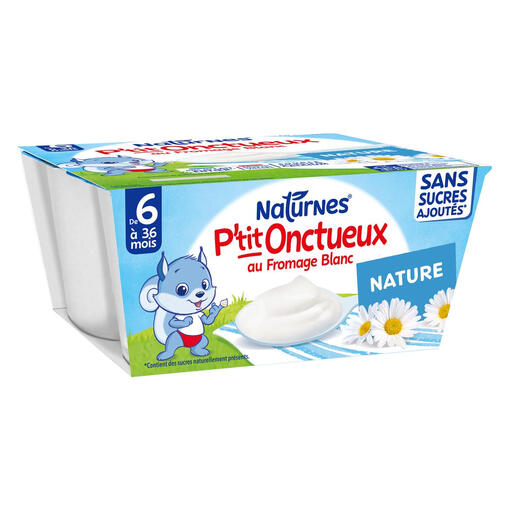 Image unavailable
Nestlé P'Tit Smooth, plain fromage blanc from 6 months, 4 × 90 g
Worth considering if you’re looking for plain fromage blanc in individual portions for weaning, rather than petit-suisse. The pack contains 4 × 90 g pots; this dairy product doesn’t replace breast milk or infant formula.
Check the ingredients, allergens and storage instructions on the pot you buy, along with your nursery’s rules on what it will accept and how to hand it over.
View on Joybuy
Frequently asked questions
Can you give a baby petit-suisse from 6 months?
Yes. According to Santé publique France, unsweetened petit-suisse can be offered from the start of weaning. It adds to breast milk or infant formula but doesn’t replace it. Choose a specific product based on your child’s needs and its ingredients.
Is 0% petit-suisse suitable for a baby?
No. Santé publique France says that 0%, skimmed and semi-skimmed products aren’t suitable for children under 3. Check the product description on the pot rather than relying on the word ‘plain’ alone.
How should you take chilled petit-suisse into nursery?
Follow the storage instructions on the pot during the journey, then hand it over promptly in line with the nursery’s arrangements. If the product needs to be refrigerated, use a suitable way to keep it cold during transport. Anses reminds us that low temperatures slow the growth of micro-organisms.
What if your child needs to avoid milk?
Don’t choose an ordinary dairy petit-suisse by default: the plain products described by Carrefour France contain milk. Follow the advice of the professionals supporting your child and the individual care plan that applies at nursery before planning their meal.


