Parents starting weaning
You’d like to introduce your baby to a dairy product at around 6 months, while keeping breast milk or infant formula at the heart of their diet, as Assurance Maladie advises.


You can offer plain petit-suisse by the spoonful once weaning has begun. It should not replace breast milk or infant formula, which remain the foundation of your baby’s diet, according to Assurance Maladie. For a baby around 6 months old, choose a product that clearly lists its ingredients and confirms that it has been pasteurised. Manger Bouger recommends introducing new textures gradually, and there’s no need to add jam at this stage.
You’d like to introduce your baby to a dairy product at around 6 months, while keeping breast milk or infant formula at the heart of their diet, as Assurance Maladie advises.
You’re choosing between a plain recipe and a fruit one. Check the ingredients list to see what’s in the product rather than relying on how it’s marketed as a children’s food.
You’d like to offer bread alongside the dairy product. Manger Bouger recommends introducing new textures gradually, so your baby’s age alone won’t tell you how best to serve bread.
For a first taste, think about the recipe and how you’ll serve it separately. A plain product offered by the spoonful calls for different skills from a slice of bread.
| What to consider | What to check | Who this matters to |
|---|---|---|
| Texture and serving | Plan to offer it by the spoonful. If you’re serving bread, choose a texture that suits your child’s abilities. | I want to introduce the product without assuming my baby is ready for bread; around 31% of consumers would make adapting the texture their top priority. |
| Plain recipe | Read the ingredients and check that the milk and cream are pasteurised, and whether any sugar has been added. | I’d rather start with a plain recipe than add something sweet; around 31% of consumers would put this choice of recipe first. |
| Keeping milk in the diet | Include the product as part of weaning without replacing breast milk or infant formula. | I’m looking to introduce a new food without replacing a breastfeed or bottle; keeping milk in the diet would be the main concern for around 25% of consumers. |
| Pack size and storage | Compare the pot sizes, use-by dates and storage instructions after opening. | I need a pack size I can use while following the storage instructions; around 13% of consumers would prioritise this. |
Recipes can differ: Carrefour’s listing for Danonino with fruit includes sugar in the ingredients, at an average of 6.2%.
If you’re introducing it for the first time, compare the ingredients lists of the specific products you’re considering.
According to Assurance Maladie, milk remains the foundation of your baby’s diet during weaning.
Offer petit-suisse as part of weaning, not as a substitute for breast milk or infant formula.
Bread can be introduced during weaning, but Manger Bouger recommends offering new textures gradually, according to your child’s abilities.
Start by offering the dairy product by the spoonful. Don’t use honey instead of jam for a child under one: Anses advises against it because of the risk of infant botulism.
The plain products described by Carrefour have different fat contents. For the Auchan product, the product title and nutritional information even give different figures.
Check the packaging of the product you buy, including its ingredients, nutritional information and storage instructions.
These products are useful for comparing specific recipes, not for choosing an entire brand. Gervais refers here to plain petit-suisse; Gervita is a range of whipped fromage frais, listed separately by Danone.
Carrefour lists plain Gervais petit-suisse in a pack of 12 × 60 g pots, with a stated fat content of 9.5%.
Carrefour lists plain Danone petit-suisse with a stated fat content of 3.4%, as well as separate listings for Danonino fruit petit-suisse.
Carrefour lists plain Classic' petit-suisse in a pack of 12 × 60 g pots, with a stated fat content of 10.4%.
Auchan lists plain petit-suisse in a pack of 12 × 60 g pots. Its product title states a fat content of 9.2%, compared with 10% in the nutritional information on the listing.
This Joybuy product is plain fromage frais described as suitable from 6 months, not petit-suisse. It’s an option for introducing a dairy product; it doesn’t determine whether bread is right for your child.
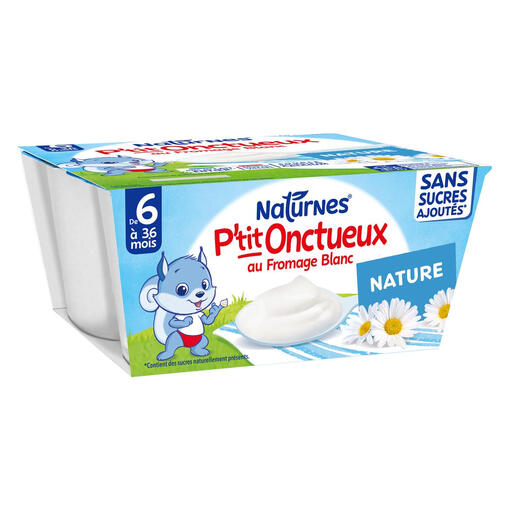 Image unavailable
A plain fromage frais to consider introducing from 6 months, alongside breast milk or infant formula. This product is described as fromage frais, not petit-suisse; check the label if you’re looking for that specific type.
Petit-suisse can be part of weaning once it has begun, but it shouldn’t replace breast milk or infant formula. Assurance Maladie reminds parents that milk remains the foundation of a child’s diet.
Check the ingredients list on the product you buy for confirmation that the milk and cream have been pasteurised. Don’t assume this from the name “petit-suisse” alone.
No. Your baby’s age alone doesn’t tell you how best to offer bread. Manger Bouger says new textures should be introduced gradually. Adapt them to your child’s abilities rather than adding bread to the dairy product straight away.
Not for a child under one. Anses advises against giving honey, whatever its origin, because of the risk of infant botulism.