A petit-suisse does not replace breast milk or follow-on formula at lunch for a baby aged 6 to 9 months. Santé publique France lists it as an optional dairy product, particularly for a snack. If you’d like to include one during your working day, check the ingredients and label, then make sure it stays chilled until it’s served.
Who is this option for?
Parents of a baby who has started weaning
You’re considering a petit-suisse as an optional dairy product, not as a replacement for breast milk or follow-on formula. Santé publique France distinguishes between these foods in its guidance for babies aged 6–12 months.
Parents who leave lunch to another adult
You need to be able to explain the meal to the person looking after your baby and make sure it’s stored as directed on the packaging. The DGCCRF recommends keeping chilled fresh products cool during transport.
Parents comparing products on the shelf
A plain petit-suisse, a fruit-flavoured version and a dairy dessert aren’t necessarily the same kind of product. The product name, ingredients and allergen information can help you identify what you’re choosing.
What should you check?
First decide how milk fits into your baby’s day, then check the dairy product you’re considering and whether you can keep it chilled. “Stage 2” doesn’t tell you whether something is a petit-suisse: follow-on formula and petit-suisse have different roles in the guidance from Santé publique France.
Breast milk or follow-on formula
Key point: it remains part of your baby’s diet, even when another adult gives them a varied lunch.
Limitation: milk on its own isn’t a varied meal. Santé publique France’s guide includes it as an option at lunch for babies aged 6–12 months and specifies that a dairy product does not replace it.
Petit-suisse as an extra
Worth considering: as an optional dairy product for a baby who has already started weaning, provided the ingredients and serving conditions are suitable.
Limitation: a petit-suisse, even in an individual pot, does not replace breast milk or follow-on formula. Santé publique France lists petit-suisse among the options for a snack.
| What matters |
What to check |
Who is this relevant to? |
| Milk’s place in the diet |
Plan for breast milk or follow-on formula as part of your baby’s day; don’t count a petit-suisse as a replacement. |
If I’m leaving my baby’s lunch to someone else, I want to know how milk is still included alongside this varied meal. This comes first for around 40% of the consumers concerned. |
| Ingredients and product identification |
Read the product name, ingredients, allergen information and pasteurisation details; distinguish petit-suisse from a dairy dessert. |
When there are several pots on the shelf, I want to identify the product I’m going to offer rather than rely on its packaging. Around 30% of consumers put this first. |
| Keeping it chilled |
Follow the storage temperature shown on the pot, and plan how you’ll transport it and keep it refrigerated. |
When the pot has to travel from the shops to the childcare setting, I need it to stay chilled until it’s served. This is the priority for around 20% of consumers. |
| Pack size and serving |
Check the pot size and give instructions that take your baby’s appetite into account, without expecting them to finish it. |
If someone else is serving the meal, I want to give them a convenient format without making the pack size a compulsory portion. Around 10% of consumers prioritise this. |
Common mix-ups to avoid
-
Assuming “Stage 2” means a petit-suisse that can replace milk
Follow-on formula and petit-suisse have different roles in Santé publique France’s weaning guidance. A dairy product does not replace breast milk or follow-on formula.
Plan how milk fits into your baby’s day before deciding whether to add a petit-suisse to lunch or another feed.
-
Choosing a dairy dessert as if it were a plain petit-suisse
Products with different ingredients can sit on the same shelf. Assurance Maladie classifies creams and flans as sweet products, unlike dairy products such as petit-suisse.
Check the product name, ingredients, allergen information and pasteurisation details for the product you choose.
-
Packing the pot without planning how to keep it chilled until mealtime
An individual pot is still a fresh product. Auchan’s product listing for Gervais plain petit-suisse 12 × 60 g specifies storage between +1 °C and +6 °C.
Check the journey and whether there’s a fridge at the childcare setting. For transporting chilled fresh products, the DGCCRF recommends using an insulated bag and keeping the journey time short.
-
Assuming the pot size is a portion your baby must finish
The 60 g shown on some products describes the pack size, not an amount your baby has to finish.
Tell the person feeding your baby that they can offer the product without insisting that your baby finishes it.
Brands to compare by product
The ingredients and instructions on each product matter more than the brand name when you’re distinguishing a plain petit-suisse from other products on the shelf.
Gervais
Product listings from Carrefour and Auchan include a plain petit-suisse in 12 × 60 g pots.
- For this product, Carrefour’s listing gives the ingredients as pasteurised skimmed milk and cream, lactic cultures and a preservative.
- The storage temperature of +1 °C to +6 °C specified by Auchan applies to this product; check the labels of other recipes and pack sizes separately.
Carrefour Classic'
Carrefour lists a plain Carrefour Classic' petit-suisse in 12 × 60 g pots.
- The name and pack size make it easy to identify the plain variety on the shelf.
- This doesn’t mean it’s follow-on formula or that it can replace it.
Auchan
Auchan’s range includes a 12 × 60 g petit-suisse and a plain organic fromage frais in the same pack size.
- These product names make it possible to compare different categories and recipes.
- The same pack size doesn’t mean they have the same ingredients or the same role in a meal; check each label.
Follow-on formula for the milk part of the meal
This product is powdered formula for babies aged 6 to 12 months, not a petit-suisse. It lets you consider the milk part of a meal planned around your working day separately.
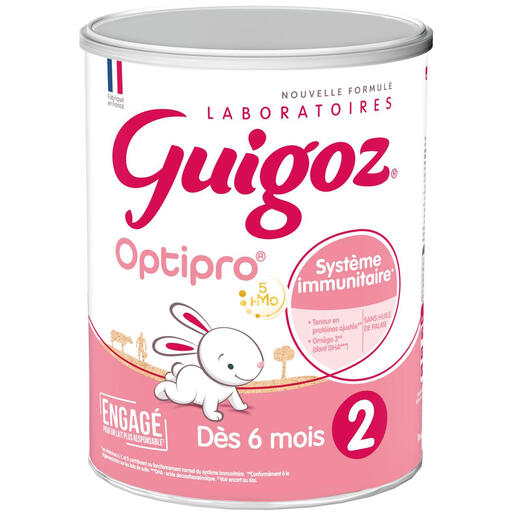 Image unavailable
Guigoz Optipro Stage 2 powdered infant formula, 830 g
To consider for the milk part of a baby’s diet from 6 to 12 months, not as an extra petit-suisse.
830 g pack. Follow the preparation instructions on the packaging; once prepared, the product should be used immediately, as directed.
View on Joybuy
Frequently asked questions
Can a petit-suisse replace follow-on formula at lunch for a baby aged 6 to 9 months?
No. Santé publique France specifies that a dairy product does not replace breast milk or follow-on formula. Its guide for babies aged 6–12 months includes breast milk or follow-on formula as an option at lunch and lists petit-suisse among the dairy products that can be offered at snack time.
How can I tell a plain petit-suisse from a dairy dessert?
Start with the product name and ingredients, rather than where it’s displayed on the shelf. Assurance Maladie classifies creams and flans as sweet products, unlike dairy products such as petit-suisse. Also check the allergen information and pasteurisation details.
Can I transport a petit-suisse before handing it over to the person looking after my baby?
Yes, as long as you can follow the storage instructions until it’s served. The DGCCRF recommends using an insulated bag to transport chilled fresh products and keeping the journey short. Then check that there’s a fridge at the childcare setting.
Does a 60 g pot have to be finished?
No. 60 g is the pack size for some products, not a compulsory portion. Give the person serving the meal a simple instruction: offer the product and take your baby’s appetite into account without making them finish it.


