For one or two people who regularly eat petit beurre biscuits, a 400 g pack may be a good fit if the biscuits are stored in a clean, dry, airtight container. If you get through a biscuit tin slowly, two 200 g packs or individual sachets let you keep some of the biscuits sealed for longer. Be sure to check the recipe and nutritional information for the product you choose, too.
Who are these pack sizes for?
Couples who regularly top up the biscuit tin
If you eat petit beurre biscuits at home several times a week, a 400 g pack could suit your routine. Carrefour product listings also show a pack containing two 200 g packs, so you can keep the second one sealed.
Occasional biscuit eaters
If you rarely open the biscuit tin, how much you open at a time matters more than the total amount. Individual sachets or a smaller pack may be a better fit.
People who pay close attention to ingredients
Ingredients and allergen information vary between the products listed by Carrefour. If you need to avoid an ingredient or are looking for an organic recipe, check the packaging of the product you buy rather than relying on the biscuit’s name alone.
What should you look for?
In a one- or two-person household, start by thinking about how quickly you get through the biscuit tin, then consider how much is left open after each use. The total weight doesn’t tell you how the biscuits are packaged: Carrefour listings include a single 400 g pack, two 200 g packs and a box of 12 sachets weighing 300 g.
| What to consider |
What to check |
Who is it for? |
| Amount opened |
Number of packs or inner sachets; whether you can store the biscuits in a clean, dry, airtight container. |
When I don’t eat biscuits very often, I’d rather not open the whole pack at once. Around 44% of consumers prioritise how much is left open. |
| Total amount |
Net weight and how quickly the biscuits are eaten. |
If I regularly get through the biscuit tin, I look for a pack big enough to fill it without building up a stash of several smaller packs. Around 33% of consumers put total amount ahead of other factors. |
| Recipe |
Ingredients, allergens and ‘may contain’ statements on the exact pack; nutritional information per 100 g. |
Before choosing a pack size, I need to know whether its recipe contains ingredients I avoid. For around 23% of consumers, ingredients are the top consideration. |
Mistakes to avoid
-
Choosing a large pack just because it says ‘family size’
A 400 g pack may not be the best choice if the biscuits take a long time to eat after opening and aren’t stored properly.
Think about how often you top up the biscuit tin, and check whether the packaging lets you keep some of the biscuits sealed.
-
Assuming all petit beurre biscuits have the same recipe
The products listed by Carrefour don’t all have the same ingredients or trace-allergen statements. An organic version does not, by itself, mean that an allergen is absent.
Check the ingredients list and highlighted allergens on the pack you buy. The Directorate General for Competition Policy, Consumer Affairs and Fraud Control reminds consumers that this is the labelling requirement for prepacked foods.
-
Comparing portions of different sizes
Nutritional values per biscuit or per portion aren’t directly comparable if the portions have different weights.
To compare two recipes, use their nutritional information per 100 g, as recommended by the Directorate General for Competition Policy, Consumer Affairs and Fraud Control. Then consider how much you usually eat.
Brands to consider when comparing pack sizes
Carrefour Classic'
Carrefour lists its Petit Beurre Original in a 400 g pack, a size worth considering if you regularly get through the biscuit tin.
- The weight and ingredients list make it easy to compare this product with other pack sizes.
- The listed recipe contains wheat, milk, egg and butter, among other ingredients. The product may also contain traces of nuts, soya and sesame.
LU
Carrefour lists a 400 g pack of LU Véritable Petit Beurre and a 300 g Pocket box containing 12 individual sachets.
- These two pack options let you choose between a standard pack and smaller, separate portions.
- The listed recipes contain wheat, butter and milk, and may also contain egg and sesame. Check the exact product.
SIMPL
Carrefour lists SIMPL petit beurre biscuits in two 200 g packs, giving 400 g in total.
- You can keep the second pack sealed while you eat the first.
- The listed recipe contains wheat, butter and milk, and may contain traces of nuts.
Carrefour Bio
The Carrefour Bio Petit Beurre listed by Carrefour weighs 167 g. It’s a better fit if you want a smaller pack or an organic recipe than if you regularly need to fill a large biscuit tin.
- The listing provides details of ingredients described as organic.
- It lists wheat, butter and milk, and may also contain traces of soya, eggs, nuts, sesame and mustard.
Petit beurre biscuits on Joybuy
This 200 g pack is better suited to a household that wants to open a smaller amount than one that regularly fills a large biscuit tin.
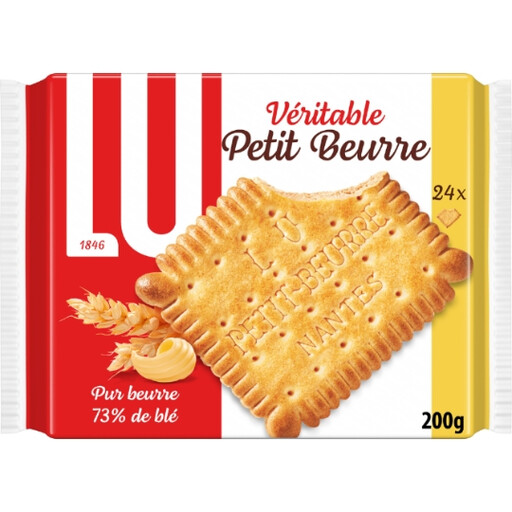 Image unavailable
LU The Original Petit Beurre, 200 g
This size is a good choice if you’d rather open 200 g of petit beurre biscuits than a 400 g pack. If separate portions matter to you, check the inner packaging before you buy.
View on Joybuy
Frequently asked questions
Is a 400 g pack suitable for a two-person household?
Yes, if you eat petit beurre biscuits regularly and store any opened biscuits in a clean, dry, airtight container. If you get through them more slowly, two 200 g packs or individual sachets let you keep some of the biscuits sealed.
How should I compare the nutritional information on two packs?
Compare the values per 100 g rather than portions with different weights. This standard format, described by the Directorate General for Competition Policy, Consumer Affairs and Fraud Control, makes it easier to compare sugar, fat and salt side by side.
Which allergens should I check in petit beurre biscuits?
Check the ingredients list and ‘may contain’ statements for the product you buy. The products listed by Carrefour include wheat and milk; depending on the recipe, they may also list egg, sesame, soya, nuts or mustard as ingredients or possible traces.


