
Livraison le jour même ou le lendemain

Qualité garantie

Débloquez vos offres de bienvenue: Livraison GRATUITE | Jusqu'à -80 % | 30 jours d'essai gratuits à JoyPlus
Téléchargez l'application
A perimeter-free robotic lawnmower can make maintaining a lawn of 500 to 1,800 m² considerably easier. But you still need to choose a model that suits the layout of your garden. Behind the promise of quick installation, there can sometimes be a few challenges related to signal, slopes or the presence of obstacles.
Before comparing models, here are three common pitfalls to avoid.
A robotic lawnmower without a perimeter cable saves you from having to bury a wire around the lawn. However, it still requires a charging station and, depending on the technology used, an antenna or positioning mast. A heavily wooded garden, a nearby wall or a covered area can interfere with satellite positioning.
Check the installation requirements, the distance between the RTK antenna and any obstacles, and whether Wi-Fi is available if the app is essential for setup.
A capacity of 800 or 1,800 m² refers to a theoretical area. Multiple mowing zones, narrow passages, trees, flower beds or slopes can reduce the actual performance. A multi-zone robotic lawnmower should allow you to create distinct sectors and define no-go zones from the app.
If your lawn is close to the stated limit, allow some margin. This will help you avoid extra mowing cycles and too-frequent returns to the charging station.
Camera vision, LiDAR and 3D sensors detect many obstacles, but they don't mean you can leave the garden untidy. A small toy, a cable, a low-hanging branch or a low-contrast object can still go unnoticed.
Children and pets should stay away from the machine when it is operating. Also remove any fragile objects before each mowing cycle and follow the manufacturer's instructions.
A robotic lawnmower with RTK navigation uses corrected satellite signals to improve positioning accuracy. This technology can be combined with cameras, a ToF sensor or a LiDAR system. Together, these help the machine navigate across multiple zones and resume its route after recharging.
Automatic mapping is particularly useful in gardens with a main lawn and secondary areas. Check the number of zones supported, whether you can create virtual boundaries, and how easy it is to edit the map in the app.
Manufacturers sometimes express slope as a percentage and sometimes in degrees. These two values are not interchangeable. For example, a 45% slope corresponds to approximately 24°, while a 60% slope is equivalent to about 31°.
For a robotic lawnmower for sloping ground, also consider traction, wheel width and tyre type. The stated maximum slope does not guarantee the same effectiveness on wet, uneven or bumpy ground.
A cutting width of 200 mm offers a good balance between manoeuvrability in narrow passages and efficiency. An adjustable cutting height of 20 to 90 mm allows you to adapt mowing to the season and grass type.
Noise level is expressed in dB(A). A model rated at 58 dB(A), like some Greenworks units, can be relatively quiet for early morning use. However, the actual noise you hear depends on the ground, the blade and the operating mode.
Also remember to check water resistance, operating temperature, the cost of replacement blades and winter storage conditions. An autonomous garden lawnmower is still an electrical appliance that requires regular maintenance.
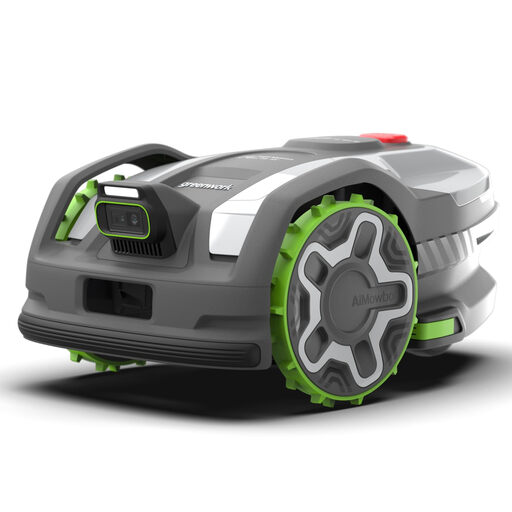
Why this choice suits this profile: With its stated capacity of 600 m², this model is suitable for moderately sized residential gardens looking to switch to a perimeter-free robotic lawnmower.
It uses virtual boundaries and automatic mapping, which avoids the need to lay a perimeter cable. However, its capacity should be weighed against the actual area to be mown.
RTK and vision navigation, multi-zone management, stated slope up to 45% and noise level rated at 58 dB(A).
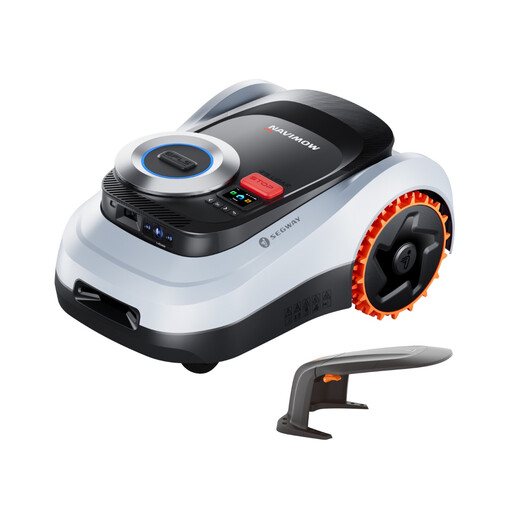
Why this choice suits this profile: This model combines LiDAR, vision, voice control and map management for owners looking for a fully connected experience.
The dual LiDAR and vision perception reduces reliance on a single sensor. According to the information provided, the interactive map also allows you to edit up to 20 zones.
Stated capacity of 1,500 m², climbing slopes up to 45%, obstacle detection and control via app, Alexa or Google Home.
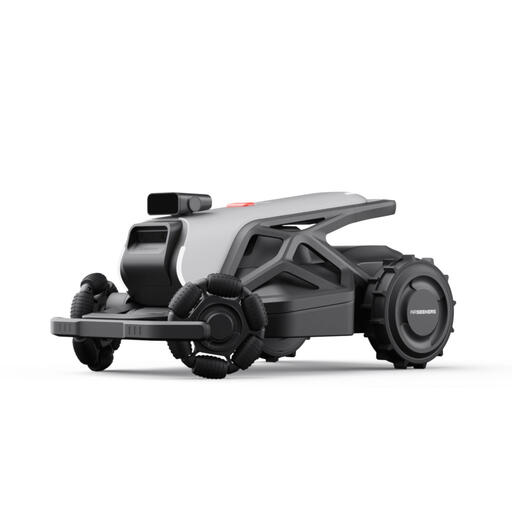
Why this choice suits this profile: Its stated area of 1,800 m² and 10 Ah battery make it ideal for large gardens and terrain with steep slopes.
Its specification sheet distinguishes the working slope, stated at 60%, from the travelling slope, given as 65%. This useful detail helps you compare expected behaviour for different uses.
VIO navigation, vision and RTK, IPX6 protection, cutting height from 30 to 90 mm and stated runtime of 120 minutes.
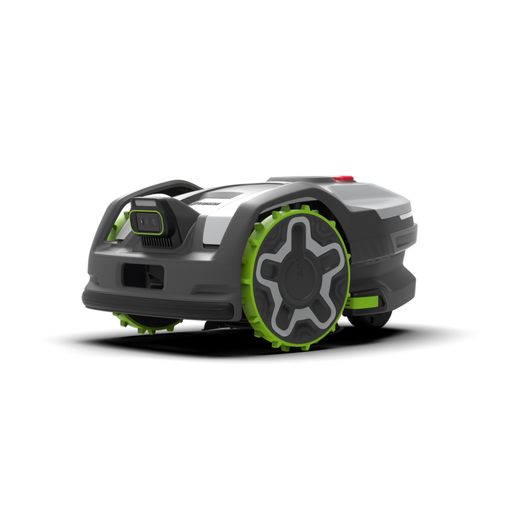
Why this choice suits this profile: This model targets gardens up to 800 m² with multiple zones and obstacles, with everything controllable from an app.
The combination of RTK, two cameras and a 3D ToF sensor is designed to manage virtual boundaries and obstacle avoidance in different lighting conditions.
Cutting width of 200 mm, adjustable height from 20 to 90 mm, multi-zone management, automatic recharging and noise level rated at 58 dB(A).
For a successful first setup of a connected robotic lawnmower with app:
Clean the underside of the machine regularly, check the condition of the blades and keep the charging contacts clean. Always switch off the appliance before any maintenance. In winter, store it in a dry, frost-free place to preserve the battery.
Depending on the model, mowing and navigation can work without a permanent connection. However, Wi-Fi is often still needed for setup, updates and remote control. Check the app's requirements before buying.
Ongoing expenses include electricity, blade replacement and, depending on the model, a possible mobile connectivity subscription. Power consumption varies depending on the area, slope, frequency of mowing cycles and number of returns to the charging station.
Its lifespan depends on the battery, exposure to moisture, maintenance and adherence to slope limits. Checking the blades, cleaning the sensors and storing the machine in a sheltered place during frosty periods are simple steps that help reduce wear and tear.