
Livraison le jour même ou le lendemain

Qualité garantie

Débloquez vos offres de bienvenue: Livraison GRATUITE | Jusqu'à -80 % | 30 jours d'essai gratuits à JoyPlus
Téléchargez l'application
A well-chosen pendant light can transform a room. More than just a light source, it becomes the true centerpiece of your decor, whether it's positioned over a dining table, in the kitchen, or at the center of a living room. But be warned: the market is flooded with models making tempting promises that can lead to disappointment once the fixture is installed. To help you see things more clearly, our guide breaks down the most common purchasing mistakes and the essential criteria to check.
What seems like love at first sight can quickly turn into regret. Here are the three common pitfalls that too often turn a promising purchase into a disappointment.
To make the right choice, a few technical points must be verified. This ensures your pendant light is as functional and durable as it is beautiful.
The basics: get out your tape measure! For a dining room pendant light, the golden rule is to leave between 75 and 90 cm (30-36 inches) from the bottom of the fixture to the tabletop. This ensures optimal lighting without obstructing your guests' view. As for the diameter, aim for about half to two-thirds of your table's width. In a living area, ensure a clearance height of at least 2.15 meters (7 feet) under the fixture to avoid bumping your head.
The function of your pendant light determines the type of lighting required.
The material is a marker of both style and quality.
To move from theory to practice, here are a few models that tick all the boxes and meet specific needs.
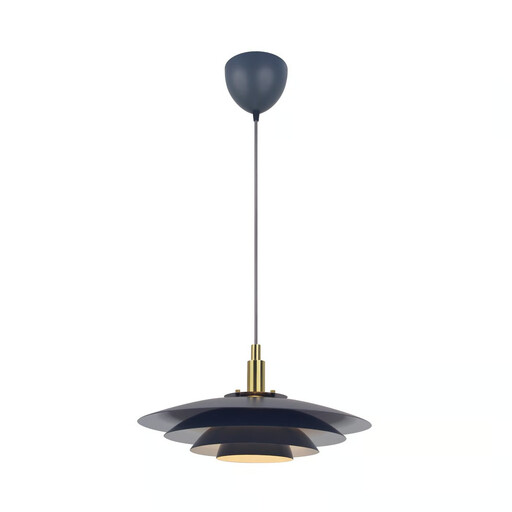
Why it's a great choice: This model is the epitome of Scandinavian design with its clean lines and layered shades. Its construction is engineered to create a soft, warm ambiance, perfect for a dining room or living area where visual comfort is the priority.
The multi-layered shade structure is specifically designed to diffuse light and prevent any glare (pitfall #2). Its 38 cm diameter is a clear dimension that allows for easy planning and integration, avoiding any unpleasant surprises (pitfall #1).
Its standout feature is its soft, glare-free illumination. The white interior of its slats optimizes reflection for a glow that is both pleasant and effective.
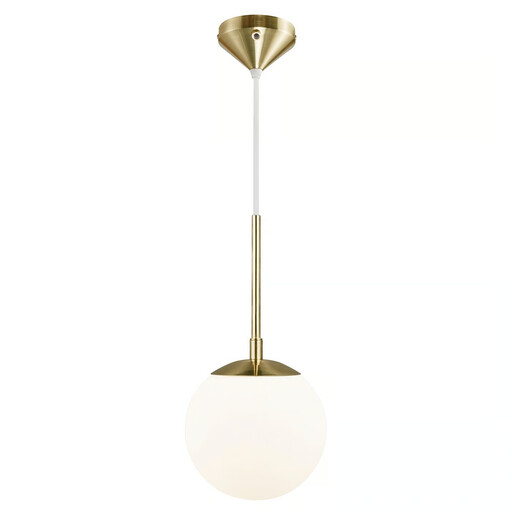
Why it's a great choice: This fixture strikes the perfect balance between simplicity and elegance. The combination of brass and white opal glass is directly inspired by Art Deco codes, adding a sophisticated touch that won't go unnoticed.
The choice of premium materials like brass-finished metal and mouth-blown glass eliminates the risk of disappointment from low-quality imitations (pitfall #3). The opal glass dome ensures a soft, diffused light, thus avoiding overly harsh illumination (pitfall #2).
The opal glass is mouth-blown, meaning each piece is unique, with subtle variations that contribute to its charm. Its design makes it a statement piece, equally beautiful on its own or grouped in a cluster.
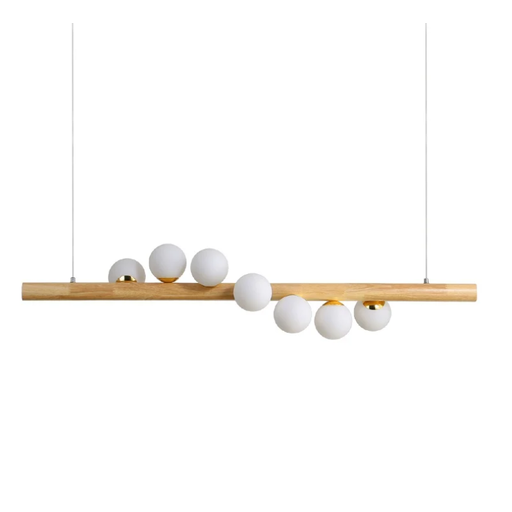
Why it's a great choice: With its 120 cm linear structure and seven glass globes, this multi-light pendant is tailor-made for large kitchen islands or rectangular tables. It masterfully combines functionality with contemporary aesthetics.
Its seven-light design ensures generous and well-distributed illumination, eliminating dark spots on your countertop (pitfall #2). Its precise dimensions (1200 mm width) allow you to plan its integration down to the millimeter for a perfectly balanced result (pitfall #1).
Its strength lies in its powerful yet warm lighting, ideal for large spaces. The asymmetrical arrangement of the globes around the central beam creates a highly graphic and sophisticated interplay of volumes.
Discover our full selection of models that meet our quality criteria and current safety standards.
Ideally, the lowest point of the pendant should hang between 75 and 90 cm (30-36 inches) above the tabletop. This height provides perfect illumination for the table without blocking the view or glaring in your guests' eyes.
An integrated LED pendant incorporates the light source directly into its design. The advantage? Designs are often slimmer and more streamlined, with an exceptional lifespan (often over 20,000 hours). The main drawback: if the LED fails, you typically have to replace the entire fixture. Conversely, a model with a standard socket (like E27 or E14) offers maximum flexibility. You are free to choose your own bulb (shape, wattage, color temperature) and replace it as you wish, whether to change the mood or simply because it has burned out.
Safety rule #1: Always turn off the power at the circuit breaker before handling the fixture. For glass, a dry microfiber cloth is sufficient for dusting. For smudges, lightly dampen it with plain water. For brass, a soft, dry cloth is your best friend to preserve the finish without scratching it. In all cases, avoid abrasive or chemical cleaning products.