
Livraison le jour même ou le lendemain

Qualité garantie

Débloquez vos offres de bienvenue: Livraison GRATUITE | Jusqu'à -80 % | 30 jours d'essai gratuits à JoyPlus
Téléchargez l'application
A pendant light can add character to the lighting in a kitchen, dining room or living room. But an attractive design alone does not guarantee the right purchase. Misjudged dimensions, incompatible bulbs or a complicated installation are among the most common disappointments.
Before placing your order, it is therefore worth looking beyond the photograph. Here are the criteria to consider, along with a selection of models suited to different uses.
A designer pendant light may look very appealing in a photograph yet seem completely out of proportion once installed. A 120 cm light fitting is more at home above a kitchen island or a large table than on the ceiling of a small room.
Measure the available space, the width of the furniture beneath it and the ceiling height. In a passageway, a cable that is too long or a structure installed too low can quickly become an everyday nuisance.
A pendant light made from opal glass or fitted with a paper shade provides a soft glow, ideal for creating a warm atmosphere. However, it may not provide enough focused light for cooking, reading or working.
For a pendant light for a kitchen island, a model with several light sources distributes the illumination more effectively. In a bedroom or hallway, softer lighting is often more pleasant.
Some models require a fixed electrical connection and cannot simply be installed on a ceiling hook. Also check the socket type, maximum wattage, voltage and whether or not bulbs are included in the box.
A pendant light that is not dimmer-compatible cannot be adjusted using a standard dimmer. Paper or fabric shades should also be paired with LED bulbs that produce little heat, and kept away from flames and intense heat sources.
Above a dining table, the length of the light fitting should remain in proportion to the tabletop, without extending much beyond either end. A linear pendant works well with a rectangular table, while a round model positioned centrally is better suited to a square or circular table.
The height depends on the room and how the light will be used. Above a table, leave enough space to avoid obstructing visibility between diners. Above an island, also consider the height of the people moving around and working in the kitchen.
Adjustable cables make it easier to adapt the light to different ceiling heights. For example, the Homary model shown below has a 1,500 mm adjustable cable.
The markings G9, E14 and E27 refer to different cap types. An E27 bulb cannot be fitted into an E14 socket. Also check the maximum wattage permitted by the manufacturer.
The voltage must be compatible with the French electrical supply, which is generally between 220 and 240 V. Light fittings with an IP20 protection rating are intended for indoor use in dry rooms, not for bathrooms exposed to water splashes.
Opal glass diffuses the light while partially concealing the bulb. Black metal creates a graphic look, while a gold or brass finish adds warmth to the overall design. Wood, meanwhile, can soften a contemporary composition.
Slight variations in bubbles or thickness in mouth-blown glass are normal and contribute to its handcrafted appearance. A paper shade, such as Tyvek, should be handled with care, dusted without water and protected from moisture and direct sunlight.
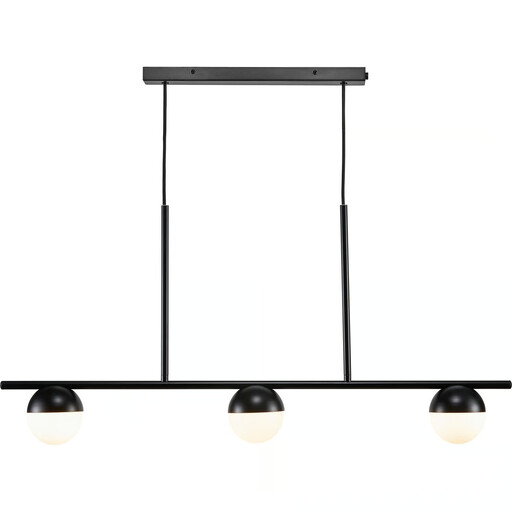
Why this choice suits this profile : Its 90 cm structure and three light sources work well above a rectangular table or worktop without visually overwhelming the space.
The dimensions are clearly stated and the G9 sockets are identified. However, bulbs are not included : remember to purchase them separately.
Mouth-blown opal glass, 200 cm fabric cable, three G9 sockets and an IP20 rating for use indoors in dry conditions.
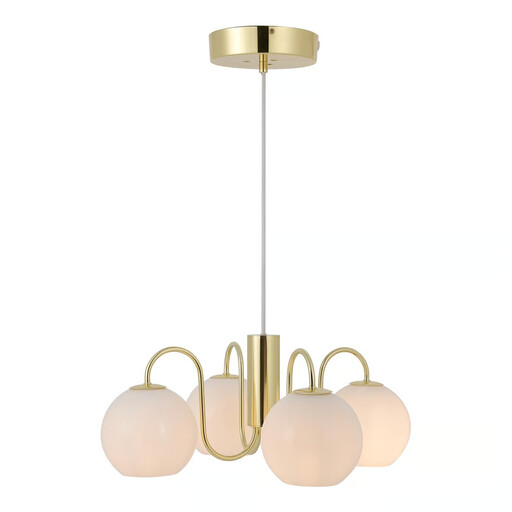
Why this choice suits this profile : The combination of glossy glass and satin brass will appeal to anyone looking for a modern light fitting with classic accents, suitable for a dining room or living room.
The four E14 sockets and maximum wattage of 40 W per bulb are clearly specified. However, the fitting is not compatible with a standard ceiling hook.
Four light sources, diffusing opal glass and a 200 cm fabric cable. We recommend having it installed by a qualified electrician.
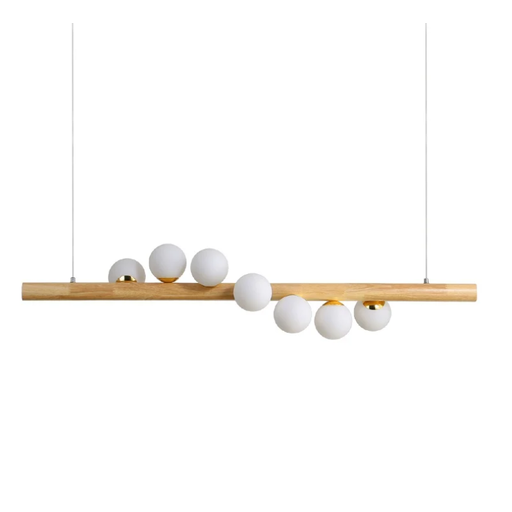
Why this choice suits this profile : With its 1,200 mm linear shape and seven glass globes, this model is designed for a large kitchen, central island or generously sized table.
The length, 220–240 V voltage and lack of dimmer are specified. The light fitting requires a fixed connection : check that your electrical installation is compatible before buying.
Seven included 5 W warm white G9 LED bulbs, 1,500 mm adjustable cable and a combination of natural wood, white glass and gold-coloured metal.
Before carrying out any work, switch off the power at the circuit breaker. For a pendant light connected directly to the mains, call on a qualified electrician and follow the applicable electrical regulations.
Then check that the ceiling fixing is secure, as well as the weight of the light fitting and the available cable length. To clean glass and metal, use a soft, dry cloth. Paper elements must be kept away from moisture. Keep the instructions so you can easily find the bulb references and maintenance guidance.
The ideal height depends on the height of the occupants, the size of the room and the shape of the light fitting. Leave enough space between the bottom of the pendant and the tabletop to maintain clear visibility between diners. An adjustable cable allows you to fine-tune its position after installation.
Not necessarily. A model with several light sources can illuminate an island effectively, but the kitchen’s general lighting may need to be supplemented with other light fittings. Consider the wattage, how the shades diffuse light and the position of the various work areas.
At the same brightness, LED bulbs generally use less electricity than older technologies. Above all, check the cap type, maximum permitted wattage, colour temperature and compatibility with any dimmer. The manufacturer’s specifications should always take priority.