
Livraison le jour même ou le lendemain

Qualité garantie

Débloquez vos offres de bienvenue: Livraison GRATUITE | Jusqu'à -80 % | 30 jours d'essai gratuits à JoyPlus
Téléchargez l'application
A pencil sharpener might seem easy to choose… until the blade snags, the lead of a coloured pencil snaps, or the shavings end up scattered at the bottom of a school bag. For a schoolchild, a parent, a teacher, an artist or a professional, the ideal model depends mainly on the pencil diameter, how often you use it, and how easy it is to maintain.
Before you buy, three common mistakes keep cropping up:
Compatibility is the first thing to check. Standard wooden pencils are usually between 6 and 8 mm in diameter, while some coloured pencils, drawing pencils or jumbo types can be 9 to 12 mm.
A two-hole sharpener can be handy when the same person uses both standard pencils and thicker ones. But bear in mind: two openings don't necessarily mean the device accepts every size. Always check the diameter range stated by the manufacturer.
For drawing mechanical pencils, the need is different. A 2 mm sharpener is designed for the thick leads used in technical drawing, architecture or sketching. Don't confuse it with a sharpener meant for coloured pencils.
The manual and electric models featured here are generally fitted with a metal blade. The quality of the result also depends on how stable the pencil is, the cutting angle and the pressure you apply.
With coloured pencils, a point that's too fine can make the lead fragile. Some users prefer a shorter or less sharp point to reduce breakage while colouring. An electric sharpener with several sharpness settings lets you adapt the result to drawing or writing. On the downside, it uses more power than a manual model and needs more regular maintenance.
A sharpener with a shavings tray is especially practical at school, in the office or on the go. Check its capacity, how well the lid closes, and how easy it is to empty. A transparent compartment lets you see at a glance when it's nearly full.
For an electric sharpener, look carefully at the power source:
In the UK, the product listing should also let you identify the manufacturer or the responsible person within the European Union. This information doesn't replace reading the usage warnings, especially when children or electrical devices are involved.

Why this choice suits this profile: This compact pack fits easily into a pencil case, at home or in a shared workspace. The different colours and portable size are real everyday advantages.
Its built-in tray collects the shavings, while its two openings let you use different types of pencils, provided you check the diameter of your stationery.
A pack of four, a plastic casing, metal blades and an integrated shavings compartment.
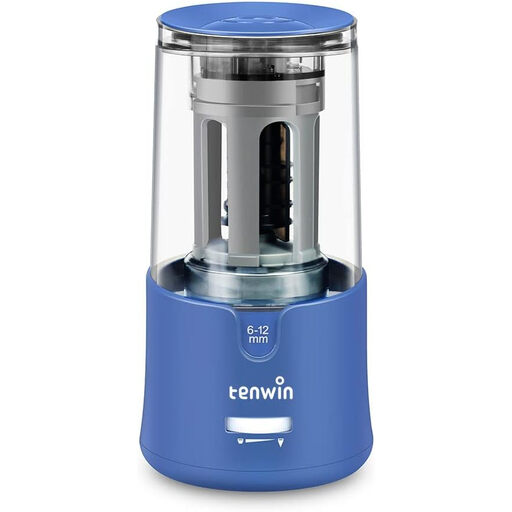
Why this choice suits this profile: It's ideal for a fixed spot where several people regularly sharpen pencils from 6 to 12 mm, for example in a creative workshop or classroom.
The stated range of 6 to 12 mm stops you assuming a single hole fits all sizes. The automatic shut-off and tray also reduce repeated handling.
Three point settings, mains adapter power supply, and shut-off when the lid is opened or if it overheats.
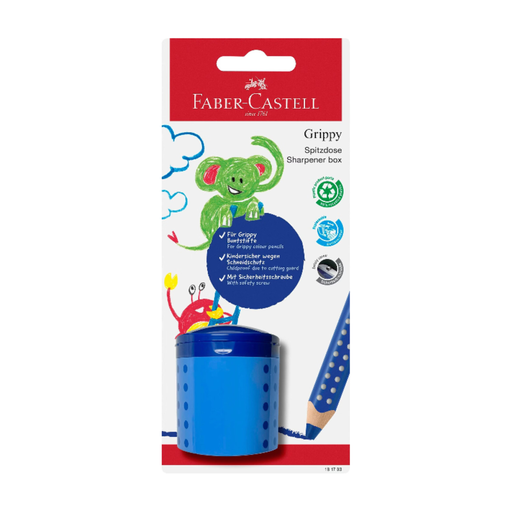
Why this choice suits this profile: Its design is aimed at children who use extra-thick coloured pencils, at home, at school or during creative activities.
Its opening is designed for very thick pencils and its click-in mechanism limits accidental exposure of the blade. Adult supervision is still recommended, though.
A large-capacity tray, a safety screw, a protective mechanism and an interchangeable sharpening unit.
We've put together a complete selection, updated in real time, of products that meet these strict criteria and European safety requirements.
Even a quality blade will eventually lose its edge if it gets clogged with wood dust or lead residue. To keep your sharpener in good condition:
How long it lasts depends on how often you use it, the hardness of the pencils and how well you maintain it. A replaceable blade can extend the life of the casing, but check first that the part is actually available.
It depends on how often you use it and the power source. A mains-powered model saves you replacing batteries, while a device running on four AA batteries can be used anywhere, at the cost of extra spending on batteries. For sharpening a few pencils a day, a manual model is usually the simplest solution.
Start by checking the diameter of the pencils. For standard models, a manual sharpener with a suitable opening may be enough. For extra-thick coloured pencils, go for a jumbo sharpener or a model that clearly states it's compatible with large diameters. A less sharp point can also reduce the risk of breaking the lead.
Use a sharpener specially designed for 2 mm leads, like the STAEDTLER Mars model shown above. Insert the lead gently, then turn slowly until you get the shape you want. This type of tool can't be replaced by a standard school sharpener.