
Livraison le jour même ou le lendemain

Qualité garantie

Débloquez vos offres de bienvenue: Livraison GRATUITE | Jusqu'à -80 % | 30 jours d'essai gratuits à JoyPlus
Téléchargez l'application
Peel-and-stick wallpaper promises a fresh new look for your walls and furniture, without the hassle of major renovations. It's easy to apply, cost-effective, and often removable, making it an appealing choice. But be warned: the market is flooded with products of wildly varying quality, and a simple decor project can quickly turn into a frustrating ordeal.
To avoid unpleasant surprises, here are the common pitfalls to watch out for before making your choice.
To prevent these issues, there are a few technical points to check before you buy. These details will make all the difference between an amateur result and a professional-grade finish.
The type of material directly impacts the resilience and ease of maintenance of your new decor.
The success of your project is 50% dependent on surface preparation. A repositionable wallpaper will not stick to just any surface—that's a guarantee.
Taking measurements is a non-negotiable step. Calculate the total area to be covered (height x width) and always plan for an extra 10% to account for cuts and potential mistakes.
For patterned papers, check the information on the pattern repeat: this is the distance at which the design repeats. A drop match or straight match requires special attention to align the panels, which can increase the amount of paper needed. For smaller projects, like a furniture makeover, a smaller adhesive roll for furniture will often be more economical.
To help you make an informed decision, here are a few options that cater to specific needs and projects.

Why it's a great choice: Perfect for a child's room decoration, this type of wall decal allows you to create a themed world without having to paper an entire wall. The "peel and stick" principle makes it easy to apply and remove as the child grows and their tastes change.
It eliminates the headache of matching patterns. As these are separate elements, there is no continuous pattern to align, which radically simplifies installation and prevents any frustration.
Total flexibility: the decals can be arranged freely to fit the space and furniture. Removal is generally simple and leaves no trace on a wall in good condition.

Why it's a great choice: For those who dream of a slatted wood wall without breaking out the saw and screws. This faux wood wallpaper brings warmth and structure to a room. It's perfect as an accent wall behind a sofa or as a headboard.
The vertical slat pattern is much more forgiving with alignment than complex designs. Furthermore, its long roll length (508 cm) is designed to minimise seams on a standard-height wall, ensuring better visual continuity.
Made from quality PVC vinyl, it is durable and washable, allowing it to escape the trap of fragile papers. It combines the aesthetic of a premium material with the practicality of a modern covering.
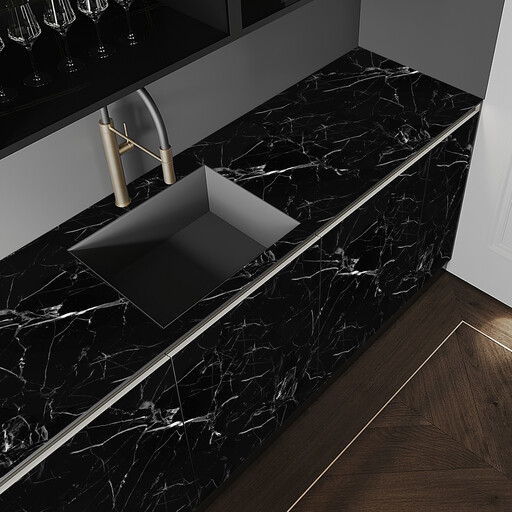
Why it's a great choice: Perfect for creating a strong focal point on a controlled budget. This marble effect adhesive is ideal for an accent wall, a kitchen backsplash (away from the cooktop), or for customising furniture to give it a luxurious touch.
Its durable and easy-to-clean PVC vinyl surface protects it from the trap of papers that get damaged at the first scuff. The advice to order rolls from the same production batch helps avoid unpleasant surprises with colour variations (from different "dye lots").
The 60 cm wide roll allows you to cover more surface area, faster, and is well-suited to furniture dimensions. The high-contrast marble effect provides an immediate designer look at an unbeatable cost.
We have selected a full range of products that meet our quality criteria and current safety standards.
On a wall that is in good condition, smooth, and well-prepped, a quality peel-and-stick wallpaper is designed to be removed without a trace. To minimise risk, gently heat the paper with a hairdryer during removal. Then, pull gently and parallel to the wall (never towards you). The best guarantee is to test it on an inconspicuous area first.
Yes, but with a few precautions. Opt for a PVC vinyl model, which is moisture-resistant. Absolutely avoid areas with direct and prolonged water contact, such as inside a shower or on the wall behind a sink without a backsplash. However, it's perfect for the other walls in a bathroom or for updating kitchen cabinet doors.
The secret is to be methodical. Never remove the entire adhesive backing at once. Peel back only the first 10 to 15 centimetres, position the top of the panel, then smooth from the centre outwards with a plastic squeegee or a soft cloth. Then, unroll the rest of the paper gradually while continuing to push out the air. If a stubborn bubble persists, discreetly prick it with a fine needle and smooth it down again.