If you want a simple recipe
You’re looking for your first jar made with peanuts alone, with no added sugar or salt, so you can decide what to add to your toast or recipes.


For your first shop, choose a peanut-only recipe if you also want to avoid added salt and oils. The claim ‘no added sugar’ does not, by itself, mean the product is low in sugar: compare the ‘of which sugars’ figure per 100 g. If you choose a peanut butter with oil that rises to the surface, check the instructions for stirring.
You’re looking for your first jar made with peanuts alone, with no added sugar or salt, so you can decide what to add to your toast or recipes.
You check the ‘of which sugars’ and ‘salt’ figures per 100 g, even when several jars claim to have ‘no added sugar’.
You’re deciding between a smooth texture and crunchy peanut pieces, and want to know whether the recipe also contains added oils, salt or sugar.
For your first purchase, start with the ingredients, then compare the nutritional information per 100 g. Once you’ve found recipes that meet your criteria, choose the texture you prefer.
| Criteria | What to check | Who is it for? |
|---|---|---|
| Added sugar and ingredients | Read the ingredients list, then check the ‘of which sugars’ figure per 100 g: no added sugar does not mean sugar-free. | For my first shop, I want to avoid added sugar and understand what’s in the jar; around 50% of consumers would put this composition at the top of their list of criteria. |
| Added salt and oils | Compare the salt content per 100 g and look for oils in the ingredients list, even on a jar labelled ‘no added sugar’. | If I’ve already ruled out added sugar, I also want to know whether the recipe contains salt or oils; this would be the main criterion for around 30% of consumers. |
| Texture and how you’ll use it | Choose between smooth and crunchy; if the oil rises to the surface, check the instructions for stirring. | I prefer pieces in my recipes or a smooth texture on my toast, but I wouldn’t choose on texture alone; around 20% of consumers would prioritise texture. |
Peanut butter with no added sugar can still contain naturally occurring sugars. Auchan’s product listings for Jardin Bio Étic, Skippy and Yoonuts show 3.5 g, 3.7 g and 5.9 g of sugars per 100 g, respectively.
To compare jars, check both the ingredients and the ‘of which sugars’ figure per 100 g. Don’t assume that a product is lower in sugar just because no sugar has been added.
Auchan’s listing for Skippy Smooth with no added sugar includes rapeseed and cottonseed oils, as well as salt. It shows 1 g of salt per 100 g, compared with 0.01 g per 100 g for Jardin Bio Étic, which is made with peanuts.
If you’re looking for a recipe with no added salt or oils, check the full ingredients list and the salt content per 100 g.
Monoprix Courses’ listing for Menguy’s Smooth includes sugar in the ingredients and shows 8.7 g of sugars per 100 g. Its texture alone therefore doesn’t meet the ‘no added sugar’ criterion.
If avoiding added sugar matters to you, check the ingredients before choosing based on texture.
All the products reviewed contain peanuts. Auchan’s listing for Jardin Bio Étic also warns that it may contain traces of tree nuts and sesame.
If you have an allergy or avoid certain ingredients, read the label on the specific jar you’re buying, including any ‘may contain’ warnings.
These products show how ingredients and texture can vary. Compare the features of the jar you’re considering rather than relying on the brand name alone.
The organic peanut butter listed by Auchan contains peanuts only, with no added sugar or salt.
The smooth peanut butter with no added sugar listed by Auchan and Carrefour contains 97% peanuts.
The organic crunchy peanut butter listed by Auchan contains roasted peanuts as its only ingredient.
Carrefour sells a 350 g jar of organic peanut butter labelled ‘No Added Sugar or Salt’.
The standard smooth peanut butter listed by Monoprix Courses provides a useful comparison with recipes containing no added sugar.
This jar may be worth considering for your first shop if you’re looking for a peanut butter to assess based on its ingredients. Before choosing it to avoid added sugar, check the ingredients and nutritional information on the jar.
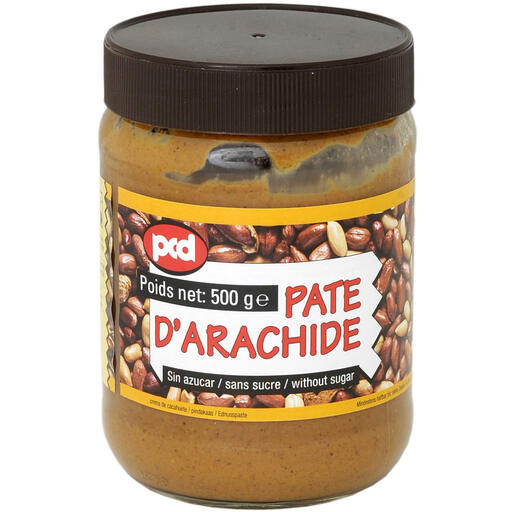 Image unavailable
If this is your first purchase and you’re looking for a short ingredients list, check the ingredients on this 500 g jar, then look at the ‘of which sugars’ figure per 100 g: the ‘Sugar-Free’ label alone doesn’t tell you the total sugar content.
No, these claims aren’t interchangeable. The DGCCRF notes that nutrition claims are regulated in the European Union under Regulation (EC) No 1924/2006. To assess a jar, also compare its ingredients and the ‘of which sugars’ figure per 100 g.
Compare their nutritional information per 100 g, then check their ingredients lists. The DGCCRF says that displaying values per 100 g makes it easier to compare products. Pay particular attention to sugars, salt and fat, depending on what matters to you.
Follow the instructions on the jar. For the Jardin Bio Étic product listed by Auchan, oil may naturally rise to the surface, and the listing recommends stirring before use. Don’t assume that every recipe needs stirring.
No, a product containing peanuts isn’t suitable for someone with a peanut allergy. Check the label on each product, including any warnings about traces of other allergens.