
Livraison le jour même ou le lendemain

Qualité garantie

Débloquez vos offres de bienvenue: Livraison GRATUITE | Jusqu'à -80 % | 30 jours d'essai gratuits à JoyPlus
Téléchargez l'application
Pattex glue can be used to repair everyday items, fix a skirting board or assemble wooden components. But relying solely on the words “strong glue” is the best way to choose the wrong product. Your choice mainly depends on the materials, exposure to moisture and the format you need.
Multi-purpose glue can bond glass, wood, cardboard or certain plastics. That does not mean it is suitable for every surface. PE, PP and PTFE are generally not compatible with conventional formulas. Copper, brass, silicone and some flexible PVCs may also require a specialist glue.
Take the time to check the list of compatible materials on the product page, rather than relying on an overly general claim.
Glue can grip in a few seconds or minutes while still needing 24 hours to reach maximum strength. Loading a shelf, handling a repair or exposing an assembly to water too soon could compromise its hold.
Pattex No Nails No Screws adhesive, for example, generally requires initial support, followed by curing time before it can bear its full load.
Water-resistant glue is not necessarily designed for prolonged immersion. Some formulas withstand moisture, splashes and temperature fluctuations, while others are intended only for indoor use on dry surfaces.
For a bathroom, a sheltered patio or an outdoor repair, check the product information carefully for details about water, UV rays and the temperature range.
No Nails No Screws glue in a cartridge is used with a sealant gun. It is particularly suitable for skirting boards, mouldings, panels, hooks and shelves. For small repairs, a tube is more convenient. Epoxy glue generally comes as two components to be mixed or in a self-mixing syringe. It can also be used to fill gaps.
Repair putty is kneaded, shaped and then left to harden. It is particularly suitable for filling and rebuilding missing sections, rather than for accurately bonding two perfectly aligned surfaces.
A 20 to 50 g tube is enough for occasional repairs. A 260 to 450 g cartridge is better suited to fixing several items as part of renovation work. For a workshop or regular use, multipacks and large bottles of wood glue can reduce repeat purchases, provided you follow the manufacturer’s storage instructions and stated use-by date.
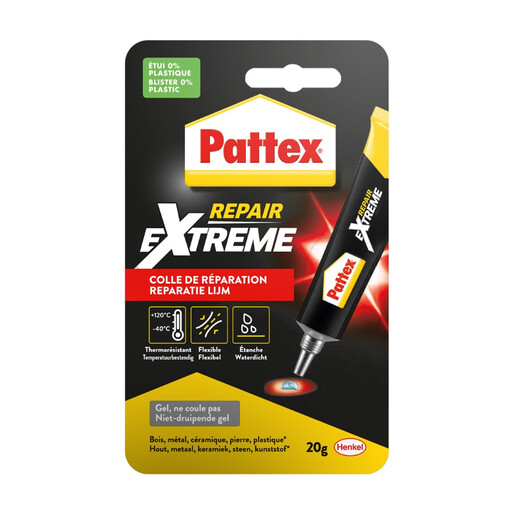
Why this choice suits this user: Its small tube is suitable for everyday repairs to items made from wood, cork, stone, cardboard, textiles, glass, ceramics or certain plastics, both indoors and outdoors.
Its gel texture helps prevent drips on vertical surfaces. However, the product information lists several exclusions, including PE, PP, PTFE, ABS, rigid PS, copper and brass.
A 20 g format, a solvent-free formula and application on compatible porous and non-porous surfaces.
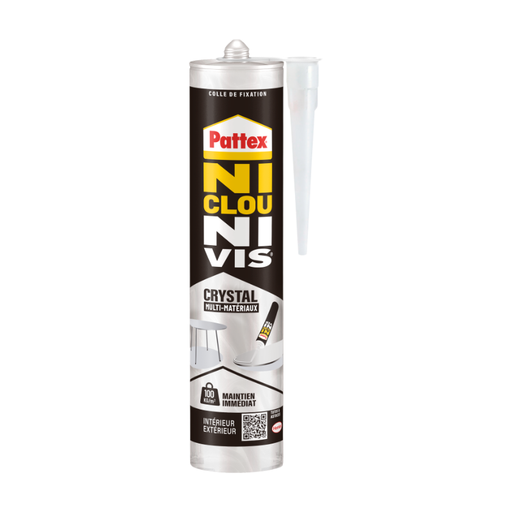
Why this choice suits this user: Its clear finish is ideal for decorative projects where the appearance of the bond matters, particularly on glass, mirrors and certain plastics.
The clear finish reduces the risk of an unsightly seam becoming visible. However, you still need to check compatibility: PE, PP, PTFE, acrylic glass, copper, brass and flexible PVC are excluded.
A solvent-free formula, stated resistance to moisture and UV rays, and the option to reposition the pieces during the period specified on the product page.
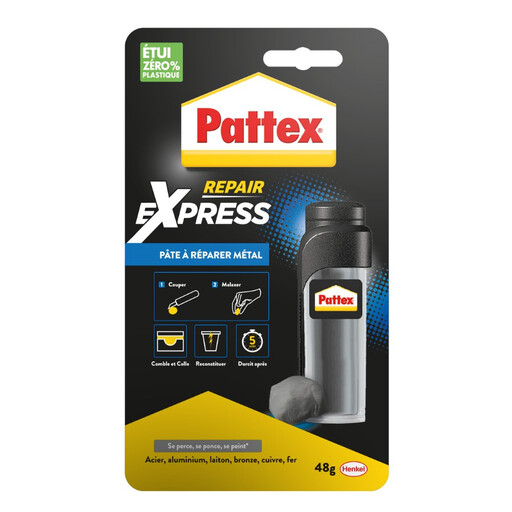
Why this choice suits this user: This epoxy putty is designed for repairs to steel, aluminium, copper, brass, bronze or iron, including parts with a hole or an area that needs rebuilding.
It is not only for bonding two flat surfaces: the putty can be kneaded and shaped, then sanded or drilled once hardened. It is not compatible with PE, PP or PTFE.
Stated resistance to water, including immersion, and a temperature range of between -30 °C and +120 °C.
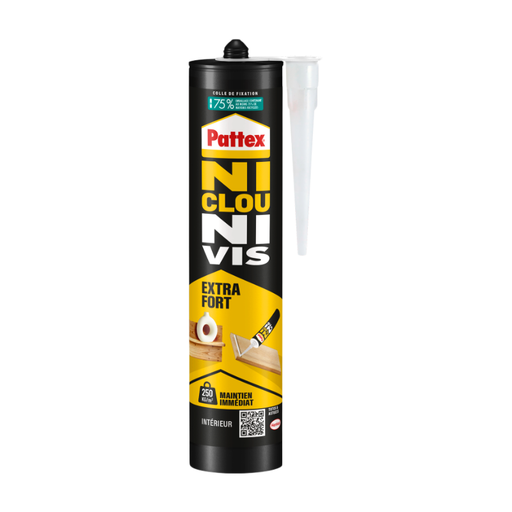
Why this choice suits this user: Its cartridge is suitable for fixing skirting boards, battens, hooks and shelves to an indoor wall or ceiling, provided at least one of the two surfaces is porous.
The requirement for “one porous surface” prevents it from being used incorrectly between two completely smooth surfaces. The product information also advises against continuous exposure to moisture and use on certain plastics.
A solvent-free formula and drill-free fixing for indoor projects involving wood, brick, stone or plaster.
We have put together a complete, real-time updated list of products that fully meet these strict selection criteria and European safety regulations.
For indoor fixing on wood, brick, stone or plaster, No Nails No Screws Extra Strong may be suitable if one of the two surfaces is porous. For outdoor use or damp areas, choose a product whose information clearly states resistance to water, moisture and temperature fluctuations.
For joining two metal parts or filling a defect, epoxy glue or metal repair putty will generally be more suitable than universal glue. Thoroughly degrease the surfaces and wait until curing is complete before subjecting the repair to mechanical stress.
Carefully reseal the tube or cartridge, then store the product in a cool, dry place away from heat and sunlight. Always consult the label and safety data sheet for the precautions specific to your chosen formula.