
Livraison le jour même ou le lendemain

Qualité garantie

Débloquez vos offres de bienvenue: Livraison GRATUITE | Jusqu'à -80 % | 30 jours d'essai gratuits à JoyPlus
Téléchargez l'application
Fixing a shelf, putting up a decorative panel or repairing an object doesn't always mean getting out the nails and screws. You just need to choose the right Pattex fixing adhesive. A formula designed for an interior wall won't necessarily be suitable for a bathroom, a metal surface or a floor covering.
Commercial descriptions can also be confusing. Instant grab doesn't mean the maximum load is reached straight away, and the term "multi-material" doesn't mean you can skip checking which surfaces are incompatible. Here are the criteria to consider before ordering, along with a selection of products suited to different uses.
An instant-grab adhesive can hold a piece in place from the first few seconds, but it often takes up to 24 hours to fully cure. During that time, a shelf, panel or heavy item may need temporary support.
Being resistant to humidity, rain or splashes doesn't mean a product can stay underwater permanently. Several Pattex fixing adhesives are suitable for indoor and outdoor use, but exclude total immersion. Keep this distinction in mind for a shower, a heavily exposed terrace or a pond.
A multi-material adhesive can bond to wood, metal, glass or ceramic, but some plastics remain particularly difficult to fix. PE, PP, PTFE, copper, brass and flexible PVC are notably excluded from several of the references shown below. Always check the technical data sheet and test on an inconspicuous area.
Start by identifying both surfaces: a porous surface such as plaster, brick or wood, or a non-porous surface such as glass, metal or tiles. An extra-strong interior fixing adhesive may require at least one of the two surfaces to be porous.
For glass, mirrors and certain decorative items, a clear adhesive gives a more discreet finish. For skirting boards, battens or objects fixed to an absorbent wall, a no-nails-no-screws adhesive designed for porous surfaces will generally be more suitable.
In a kitchen, near an oven or hob, a high-temperature neoprene adhesive may be more appropriate than a standard formula. The Pattex Contact Adhesive Neoprene High Temperature reference claims resistance up to 120 °C, according to the product data provided.
For outdoor use, check resistance to UV, humidity and temperature fluctuations. Some Pattex Flextec formulas are rated for a range of –30 °C to +80 °C, but they are not designed for permanent immersion.
A 20 g tube is enough for small repairs. A 290 to 470 g cartridge usually requires a caulking gun, but allows you to apply even beads on panels, skirting boards or large items. For laying a floor covering, a 6 kg bucket and a notched trowel will be more appropriate.
Also check the repositioning time, the holding time and the waiting period before putting the fixing under load. A solvent-free formula can reduce odours indoors, without removing the usual precautions: ventilation, wearing gloves and following the safety data sheet are still essential.
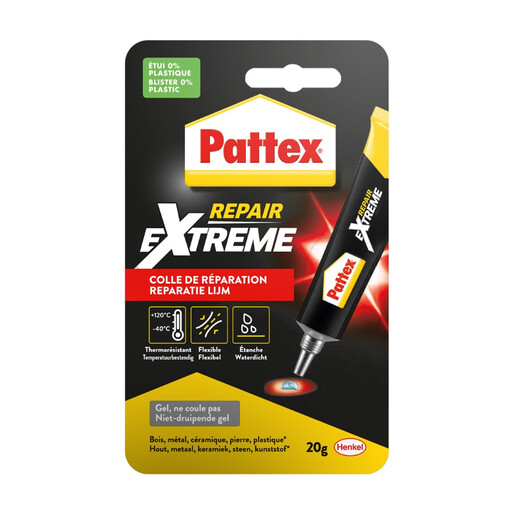
Why this choice works: its small format is ideal for everyday repairs, in flats and houses alike, on compatible porous or non-porous surfaces.
The gel texture doesn't drip much on a vertical surface, while the solvent-free formula means you don't need to get out a large cartridge for a one-off repair.
Instant-grab gel, indoor and outdoor use, claimed compatibility with wood, glass, ceramic, textile and stone.
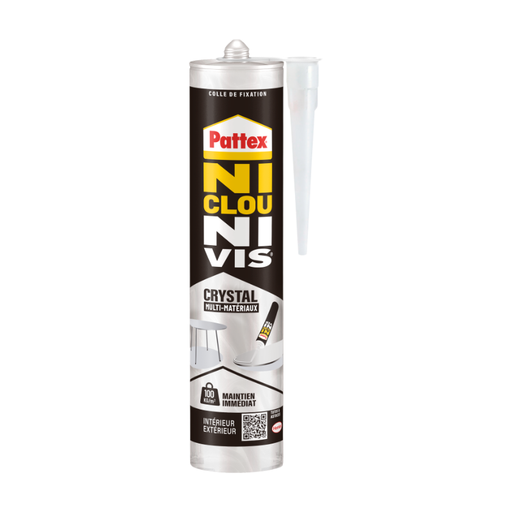
Why this choice works: its clear finish is ideal for mirrors, glass, compatible transparent plastics and visible decorative items.
The transparency minimises visual impact, while the claimed resistance to humidity and UV means you don't need to use an indoor-only adhesive.
Initial hold claimed after 15 seconds, repositionable for up to 15 minutes and stated resistance from –30 °C to +80 °C.
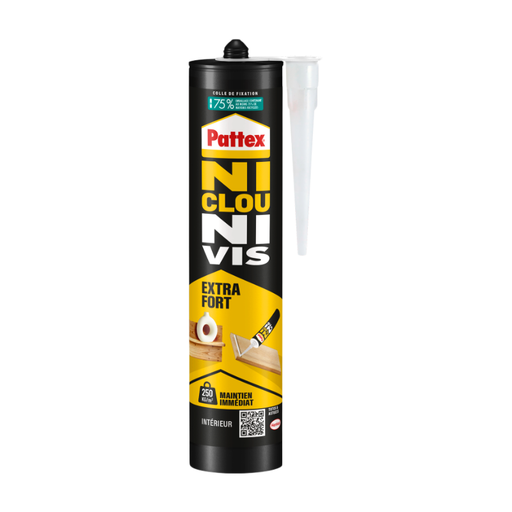
Why this choice works: this no-nails-no-screws adhesive is designed for interior walls and ceilings, particularly for skirting boards, battens, hooks and shelves.
The data sheet specifies that at least one surface must be porous and excludes continuous humidity, which reduces the risk of compatibility errors.
Solvent-free formula, indoor application and intended use on wood, brick, stone and plaster.
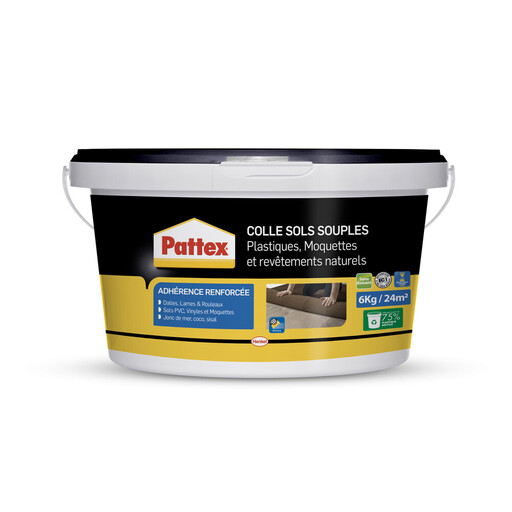
Why this choice works: its large format is designed for laying carpet, vinyl, PVC, textile, coir or sisal over a large area.
This is a dedicated adhesive for flexible floors, not a multi-purpose repair glue that would be difficult to spread over a large area.
Solvent-free formula, notched trowel application, claimed compatibility with concrete, cement and wood substrates, as well as underfloor heating.
Pattex high-temperature neoprene adhesive, available in a 650 g tin, is suitable for bonding wood, laminate, metal, rigid PVC, ceramic, glass, cork, leather or rubber, according to the list provided. It can be applied with a brush, trowel or spray gun using the appropriate thinner.
The instructions recommend applying a thin layer to both surfaces, waiting around 10 to 15 minutes until it becomes tacky to the touch, then pressing firmly together. It is not intended for flexible PVC, Teflon, polyethylene, polypropylene, polystyrene or permanent immersion.
Discover an updated selection of adhesives for fixing, repairing, laying and assembling, with formats suited to domestic projects and professional jobs alike.
Initial hold can be achieved after a few seconds, depending on the formula and the surfaces. The final strength stated on the product data sheets is typically reached after around 24 hours. Always follow the drying time and provide temporary support for heavy items.
Some references are designed for indoor and outdoor use, with claimed resistance to humidity, UV and temperature fluctuations. However, they do not automatically replace a mechanical fixing for a structural load, a handrail or an element subject to high stress. Check the load, the nature of the surface and any exclusions mentioned in the technical data sheet.
For a small object, a repair adhesive in a 20 g gel will be more practical. For a panel, skirting board or wall fixing, choose a cartridge compatible with a caulking gun. The right choice depends less on the "strong" promise than on the compatibility between the materials, the environment and the format you need.